
CITES Documents for Crocodile and Alligator Leather Products: A Buyer Checklist
Part of: Exotic Leather Guide
Do not approve a commercial shipment of crocodile or alligator leather goods from a product photo and an invoice alone. First identify the scientific species, check its current listing and destination-country rules, then match the official permit or certificate to the goods, parties, quantities and transport documents.
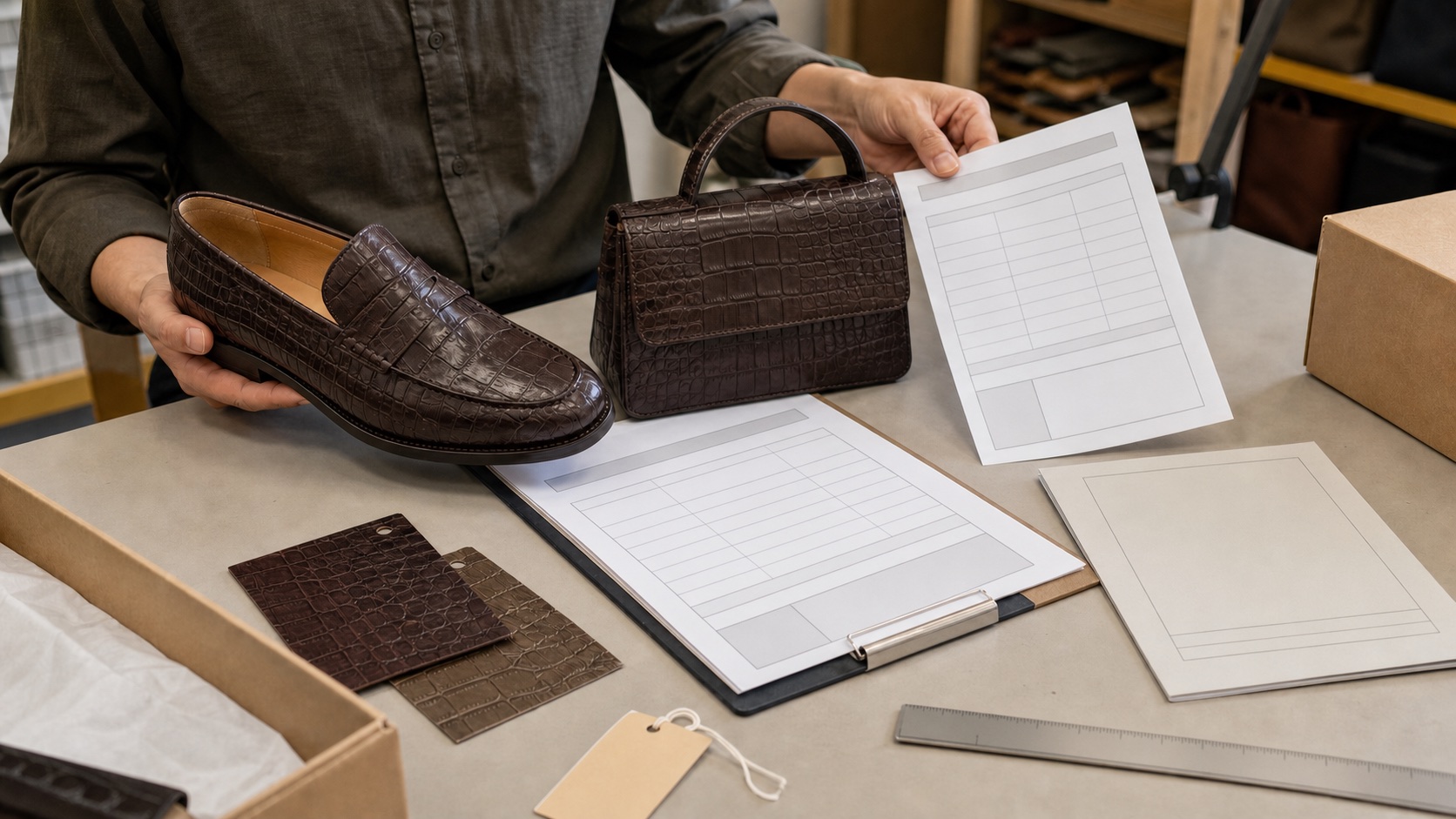
That is the short answer for buyers searching for a CITES permit for crocodile leather, an alligator leather CITES certificate or an exotic leather import checklist. The difficult part is that “crocodile leather” is a commercial description, not a complete compliance record. Requirements can change with the exact species and population, source, country of origin, export or re-export country, destination, commercial purpose and product form.
This guide was checked against CITES, U.S., EU and UK official sources on July 17, 2026. It is a practical sourcing workflow, not legal advice. Confirm the actual shipment with the relevant CITES Management Authorities, customs broker and wildlife inspection authority before payment, booking and dispatch.
Why the scientific species name comes before the permit number
CITES regulates international trade in listed animals and plants, including covered parts, derivatives and products. Crocodilians are not handled as one uniform entry. A listing can differ by species and, in some cases, by population. That means a quotation that says only “genuine crocodile leather” does not give the buyer enough information to decide which documents apply.
Ask the supplier to provide the scientific name used in its material records, the country of origin, the stated source, and whether the planned movement is a direct export or a re-export. Check the current entry in the CITES Appendices and confirm the interpretation with the responsible authority. Do this before treating a permit example from a previous shipment as suitable for the new order.
This is also a basic supplier-verification issue. The shoe supplier and factory verification checklist explains how to separate a trading claim from evidence tied to the legal entity, material source and actual order.
The document chain a buyer should map
A useful file is not a single PDF called “CITES.” It is a chain that connects the legally acquired material to the international movement and the destination import process.
- Material identity: scientific name, common name, source, country of origin and the supplier's traceability records.
- Export authority: the permit or certificate issued or validated by the CITES Management Authority of the export or re-export country.
- Commercial shipment: invoice, packing list, purchase order, carton count and product description that agree with the controlled goods.
- Transport record: airway bill, bill of lading, courier record or other shipment identity used for presentation and clearance.
- Destination process: any required import permit, wildlife declaration, inspection, designated entry point, customs entry or domestic certificate.
Under the CITES framework, international trade in Appendix II specimens generally requires an export permit or re-export certificate. Appendix I movements follow a stricter framework and commercial trade is heavily restricted. Countries can adopt stricter domestic measures, so “CITES does not require an import permit for this Appendix II movement” is not the same as “the destination has no import requirement.” The CITES explanation of how the Convention works is the right starting point, followed by destination-specific advice.
Seven fields that should match before dispatch
| Field | What to compare | Typical problem |
|---|---|---|
| Species | Scientific name on the permit, source records and product file | Only a broad common name appears in the quotation |
| Product term | Finished shoe, bag, belt, watch strap, skin or other declared form | The permit describes a different specimen type |
| Quantity | Permit units and quantity against invoice, packing list and cartons | Pair, piece, kilogram and product counts are mixed |
| Origin and source | Country of origin, source code and upstream material record | A re-export file loses the original origin reference |
| Parties | Exporter and importer names and addresses against commercial documents | The buying company or shipping entity changed after issue |
| Validity and endorsement | Issue date, validity, signatures, stamps or approved electronic validation | An expired, incomplete or unendorsed copy is circulated |
| Shipment identity | Transport reference, packages and final dispatch data where required | The booked shipment no longer matches the document pack |
The exact permit format and endorsement process depends on the issuing system and route. Use the CITES permit-system information to understand document types and codes, but let the issuing and destination authorities decide what is valid for the shipment.
Direct export and re-export are different records
A direct export starts in the country from which the specimen or material originates. A re-export occurs when the material or finished product leaves a country that previously imported it. For example, leather may originate in one country, be tanned or traded through another, and be made into finished goods in a third. The buyer should not remove those steps from the record simply because the factory made the final shoe or bag.
Ask the supplier which country is shown as the origin and which authority will issue the export or re-export document. If a re-export certificate is expected, ask what prior permit or legal-acquisition record supports it. Do not accept a screenshot of a permit number with the species, origin, exporter or quantity cropped out.
For product development, keep the material-document assumption tied to the approved sample and bill of materials. If a genuine crocodilian panel is replaced with embossed cowhide, or an embossed option is upgraded to genuine material, the product description and document route must be reviewed again.
Destination-country checks for U.S., EU and UK buyers
United States
The U.S. Fish and Wildlife Service defines wildlife broadly enough to include wild-animal parts and products. Its importer guidance says wildlife imports and exports are generally declared on Form 3-177 and must use a designated wildlife port unless an approved exception applies. Commercial importers or exporters can also need a wildlife import/export license, while protected species may require separate permits.
Confirm the port, declaration, license, inspection and CITES plan with USFWS before the goods leave the supplier. A normal customs entry does not automatically complete the wildlife clearance.
European Union
The European Commission wildlife trade overview explains that the EU implements CITES through four Annexes and can apply stricter measures. Import, export, re-export and internal commercial use can involve different documents, and enforcement remains with the individual Member States.
The buyer should identify the Member State of first entry, check the current EU Annex, review any import suspension and contact the national CITES authority. Do not assume that clearance practice in one Member State or for one species applies to another route.
Great Britain
Current UK government guidance tells commercial movers to check the species, apply for the relevant import, export or re-export permit and coordinate with the Management Authority of the other country. It also warns that a permit from one side does not guarantee that the other country will issue its corresponding document.
Great Britain, Northern Ireland and the EU should not be treated as one route. State the actual destination and transit plan when asking the broker or authority for instructions.
Where buyers lose control
- Requesting documents only after bulk production is packed.
- Using “crocodile,” “alligator” or “exotic leather” without a scientific name.
- Assuming a raw-skin tag, supplier invoice or authenticity card replaces the shipment permit.
- Reusing a permit example from another species, exporter, origin, quantity or destination.
- Changing the importer, port, carrier, quantity or product description without checking whether the documents must change.
- Sending a cropped scan while the original or approved electronic record is required for endorsement or presentation.
- Confusing a personal-effects exemption with a commercial wholesale shipment.
- Booking an ordinary courier route before confirming wildlife inspection and entry-point requirements.
A four-checkpoint purchasing workflow
1. Before sample approval
Record the material wording, scientific name supplied, source, origin and intended destination. If the buyer is still comparing materials, keep genuine crocodilian leather and embossed alternatives as separate specifications. Buyers selecting footwear styles can review the crocodile shoes category and alligator shoes category, but the product page is a design reference, not proof of a shipment's legal status.
2. Before the production deposit
Ask who will obtain the export or re-export document, what information the buyer must supply, which costs and timing are outside the factory quotation, and what happens if the permit is refused or delayed. Put those responsibilities in the purchase record instead of relying on a chat promise.
3. Before carrier booking
Give the broker the draft invoice, packing list, species, quantity, origin, export country, destination, planned port and available permit information. Confirm the entry point and inspection process before choosing the route. For bags, the crocodile leather bag buyer checklist connects the document plan with material wording, QC and packaging.
4. Before dispatch
Review the final document set line by line. Match the permit or certificate to the goods, invoice, packing list and transport record. Keep legible copies for the buyer's compliance file, but follow the authority's instruction on originals, electronic permits and border presentation. Do not let the cartons move because the factory says the missing paper can be “sent later.”
What to send for a document review
Prepare the product type, scientific species name supplied, common name, source, country of origin, material supplier, export or re-export country, destination, importer legal name, intended quantity and unit, draft invoice description, expected shipping route, planned port, and every permit or certificate sample already available. Mark any field that is still provisional.
For production coordination with Marcusius, send the initial brief through the contact form. If the project includes material declarations, permit drafts, broker comments, invoices and revised packing lists, use the Buyer Portal so the files remain attached to the same sourcing discussion. Final legal and customs approval should still come from the responsible authorities and the buyer's broker.
Documentation applies per product form, so confirm the same paperwork plan when a shipment includes exotic leather belts alongside shoes or bags.
Buyer FAQ
Exotic Leather Import FAQ
Does every crocodile or alligator leather product need the same CITES documents?
No. The document route depends on the exact species and population, source, product form, country of origin, export or re-export country, destination, purpose and stricter domestic rules. Confirm the current listing and shipment plan with the relevant CITES authorities and customs broker.
Is a supplier invoice or authenticity card enough for a CITES shipment?
No. Commercial records help identify the goods, but they do not replace an official permit, certificate, wildlife declaration or import document when one is required. The required original or approved electronic record must match the actual shipment and follow the authority's presentation process.
When should a buyer check CITES documents for leather goods?
Start before approving the material and production deposit, confirm the destination process before carrier booking, and complete a final line-by-line match before dispatch. Waiting until the cartons are ready leaves little room to correct species, party, quantity, port or permit problems.
Shoe Import FAQ
How do I import shoes from China safely?
Agree the Incoterm in writing so you know where the seller's responsibility ends, confirm your HS classification and duty rate with your country's tariff lookup or a customs broker before ordering, and review draft shipping documents before the goods leave China. Inspect before cartons are sealed, use your own freight forwarder rather than defaulting to the factory's, insure the cargo, and declare values accurately — as importer of record the compliance exposure is yours.
What is the difference between FOB and CIF for shoes?
Under FOB the seller delivers the goods to the origin port and loads them with export formalities complete, and the buyer pays sea freight, insurance, destination clearance, duty and onward delivery. Under CIF the seller also pays freight and insurance to the destination port, so the quoted price is higher, but the buyer still handles import clearance, duty and delivery — and inherits the carrier and routing the seller chose.
Who pays customs duty on imported shoes?
The importer does, in essentially every country. The factory manufactures and ships, but classification, duty payment and import compliance are the legal responsibility of the importer of record. The exception is a DDP arrangement where the seller delivers duty paid, and even then the buyer should confirm precisely what is included. Duty rates for footwear vary widely by destination and construction, so confirm yours before committing to an order.