
China Shoe Supplier or Factory? A Buyer's Verification Checklist
Part of: China Footwear Sourcing Guide
The quickest way to verify a China shoe supplier is to connect six things: the legal company, the payment account, the people handling development, the place where production will happen, the evidence for your exact product, and the quality plan for your order.
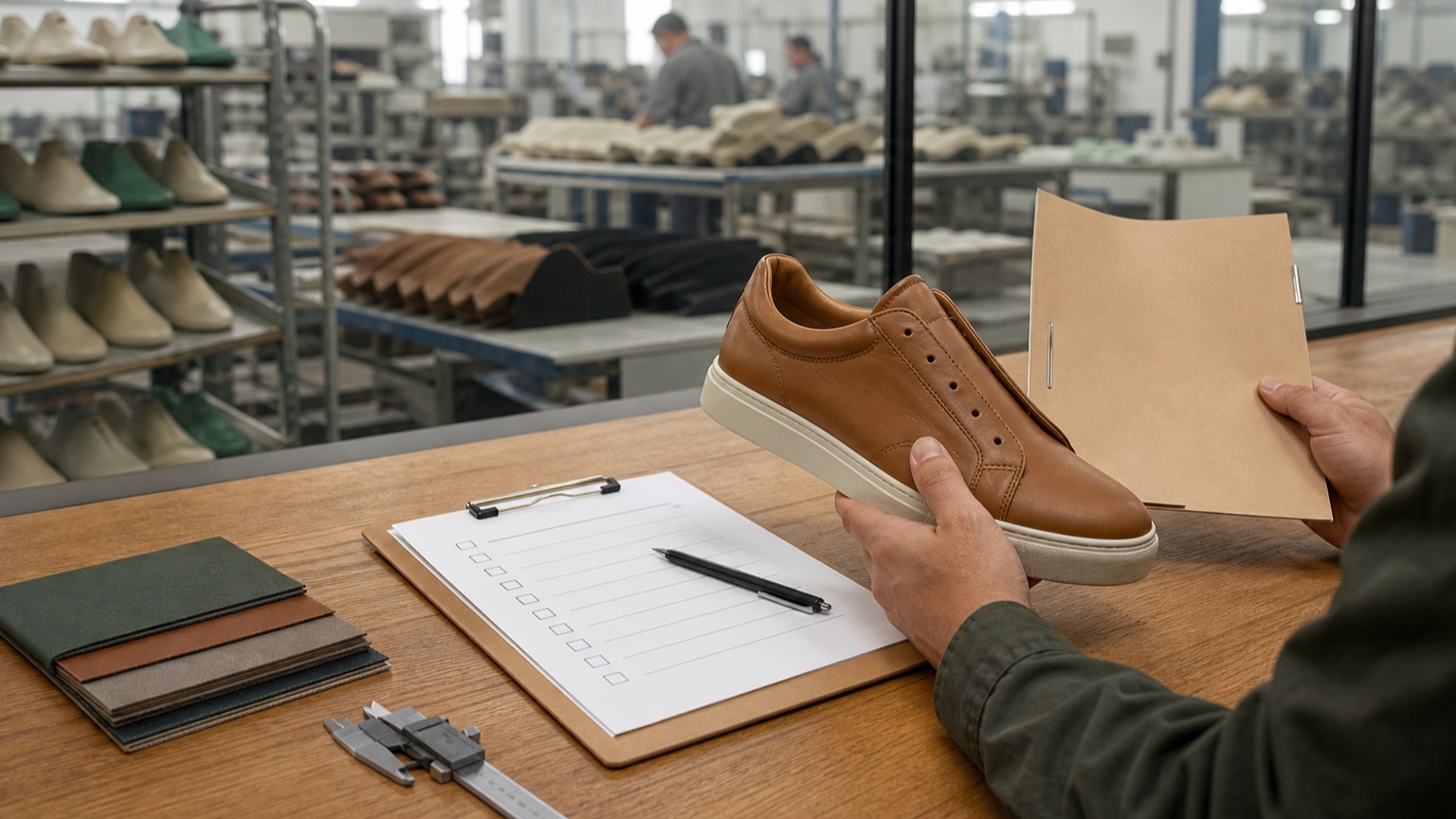
No single photograph, certificate, video call, or business license proves all six. Verification works when the details agree with each other. A company name on an invoice should match the company you researched. The workshop shown on video should make the construction you are buying. The test report should cover the relevant material and destination requirement, not a vaguely similar shoe.
This guide gives footwear buyers a practical sequence to follow before paying for development or committing to bulk production. It is not a promise that every supplier must own every machine. It is a way to understand who controls the work and where your risk sits.
Shoe supplier, manufacturer, or trading company: what is the difference?
A manufacturer normally owns or operates production facilities. A trading company buys from one or more factories. A sourcing company may coordinate development, materials, production, inspection, and export work across several partners. In real footwear supply chains, the lines can overlap.
That is not automatically a problem. Sneakers may involve an upper factory, a separate outsole supplier, a printing partner, and an assembly line. Goodyear welt shoes need a different set of skills and equipment. Even a factory that assembles the shoe may subcontract boxes, metal hardware, embroidery, laboratory testing, or specialized leather work.
The useful question is not simply, “Are you a factory?” Ask instead: Which company signs the contract, which site develops and assembles this shoe, which processes are outsourced, and who is responsible when a sample or shipment does not match?
A six-layer China shoe supplier verification process
1. Confirm the legal company in Chinese
Ask for the supplier's full registered Chinese company name, Unified Social Credit Code, registered address, and a current business-license copy. Search the name or code in China's official National Enterprise Credit Information Publicity System. The system publishes registration and public credit information for market entities.
Compare the registered status and address with the quotation, contract, website, and email signature. A small spelling difference in an English trade name may be harmless; a completely different Chinese company needs an explanation.
A registration record proves legal identity, not footwear capability. Business scope can provide context, but it should not be treated as a factory audit. Continue with product and site evidence.
2. Match the contract and payment path
The company named as the seller should be clear before money moves. Compare the beneficiary name on the bank instructions with the legal company and pro forma invoice. If an export agent, affiliated company, or third party will receive payment, ask for the relationship and responsibility in writing before you approve the arrangement.
Also confirm that the quotation states the product, quantity basis, material assumptions, sample scope, branding, packaging, delivery term, and what is excluded. A bank account can belong to a real company and still be attached to an unclear deal. Commercial clarity is part of verification.
3. Verify the site and the capability for your construction
A live video walk-through is more useful than a polished factory montage. Ask the supplier to move from the office into the development room, material area, cutting, stitching, lasting, sole attachment, finishing, packing, and finished-goods area as relevant. You are not counting machines for decoration. You are checking whether the workflow matches the shoe.
Ask who owns the site, which company employs the production team, and which steps are subcontracted. Then ask product-specific questions. A supplier for custom sneakers should be able to explain lasts, outsole molds, upper construction, bonding, size coverage, and logo methods without hiding every answer behind “no problem.”
If the project is important or the answers remain unclear, arrange an independent on-site audit or visit. Verify the address independently before travel.
4. Test development knowledge before ordering a sample
Good footwear development answers become more specific as your brief becomes more specific. Send a compact requirement with reference views, market, quantity range, sizes, material direction, logo locations, packaging, and target timing. The shoe manufacturer inquiry guide shows how to structure that first message.
Then listen to the questions you receive. Useful questions may cover the last, outsole availability, upper pattern, material thickness, color standard, lining, fit expectation, size grading, logo method, packaging artwork, and performance claims. A supplier who immediately gives a final price without identifying missing details may be quoting a different product from the one in your head.
Before bulk work, keep a dated record of the approved construction, materials, colors, branding, packaging, and sample changes. Use the shoe sample approval checklist to make the decision easy to forward and audit.
5. Make compliance evidence product-specific
There is no universal “shoe certificate” that clears every style for every country. Requirements depend on the destination, user, age group, materials, claims, and sales channel. Ask which requirement applies, who is responsible for it, and what document will prove it.
For example, the U.S. FTC Leather Guides address misleading statements about the composition and characteristics of leather and imitation-leather products. For children's products, the CPSC explains that relevant products may need third-party testing through a CPSC-accepted laboratory and supporting documentation. For products made with CITES-listed species, permit and certificate requirements depend on the species, source, direction of trade, and national rules; the CITES glossary is a useful starting point.
Check that every report shows the exact product or material, applicant or manufacturer, laboratory, method, result, and date. Do not accept a folder of unrelated reports as proof for your order. When legal interpretation matters, confirm it with your importer, customs broker, testing laboratory, or qualified adviser in the destination market.
6. Agree on quality control before production
Ask how the supplier controls incoming materials, first-piece approval, inline work, size assortment, appearance, packaging, and final release. Define critical, major, and minor defects in language tied to the shoe. “Good quality” is not an inspection standard.
The current ISO 2859-1:2026 sets out AQL-indexed sampling schemes for lot-by-lot inspection. It can support a sampling plan, but it does not decide which crooked stitch, shade difference, fit problem, wrong label, or bond failure your business considers critical. Those decisions belong in the approved specification and inspection brief.
Before shipment, use a written inspection scope and keep the report, photos, defect counts, carton selection, and release decision. The site's pre-shipment shoe inspection checklist covers the practical product and packaging checks.
Supplier verification scorecard
| Area | Useful evidence | Question to resolve |
|---|---|---|
| Legal identity | Chinese name, credit code, official registry record | Who is the contracting seller? |
| Payment | Matching beneficiary, invoice, written third-party explanation | Who receives the money and carries responsibility? |
| Production | Live site evidence, process map, subcontractor disclosure | Where and by whom will this shoe be made? |
| Development | Relevant questions, sample record, material and tooling detail | Does the team understand this construction? |
| Compliance | Product-specific reports, permits, labels, responsible party | What exact rule or claim does each document support? |
| Quality | Approved sample, defect rules, inspection plan, release record | How will differences be found and decided? |
Do not turn this into a decorative points game. One unresolved payment identity or an unexplained production site can matter more than five attractive documents.
Ask for this 12-item remote verification pack
- Full registered Chinese company name and Unified Social Credit Code.
- Current business license and registered address.
- Contracting seller and proposed bank-beneficiary name.
- Production-site address for the project.
- Live walk-through of the relevant development and production areas.
- Clear list of in-house and subcontracted processes.
- Examples of unbranded work using the same construction or material family.
- Available lasts, outsole molds, size range, and tooling assumptions.
- Draft material and component specification for the sample.
- Sample stages, revision method, and approval record.
- Product-specific testing, labeling, permit, or compliance plan.
- Inline and final inspection plan, including defect definitions and packaging checks.
Red flags that deserve a pause
- The company name changes between the website, license, quotation, contract, and bank instructions without a written explanation.
- The supplier will show only edited videos and cannot answer simple questions about the site or production sequence.
- Every technical question receives an instant “yes” but no material, tooling, size, or process detail.
- Test reports are cropped, expired for the stated purpose, issued to an unrelated party, or cover a different product.
- The quotation is unusually complete before the supplier has asked enough questions to understand the shoe.
- The supplier discourages sample records, inspection, or written approval.
- Payment instructions change late in the discussion or arrive from an unexplained email account.
A red flag is a reason to verify, not always proof of wrongdoing. The important part is whether the supplier can give a consistent, checkable answer.
A trading company can still be the right partner
Some buyers reject any company that does not own the assembly line. That can remove useful partners. A capable sourcing company may control communication, material purchasing, specialist workshops, inspection, export documents, and small-order coordination better than one factory trying to do everything.
Judge the operating model honestly. Who approves materials? Who keeps the reference sample? Who can stop production? Who owns the customer relationship with subcontractors? Who pays for a remake when the agreed specification is missed? Transparency and control are more useful than a factory label used only for sales.
What to send after the supplier passes the first check
Move from general verification to a real product brief. Share the shoe type, target market, reference images, quantity and color split, size range, material direction, logo, packaging, performance claims, destination, and preferred sample date. If you are still defining the project, organize those points into a one-page private label development brief before asking for a final quotation.
To discuss a project with Marcusius, send the facts you already know through the contact form. For drawings, material references, or an active sample discussion, use the Buyer Portal so the requirement thread and attachments stay together.
Buyer FAQ
Sourcing Cost FAQ
Why are Chinese shoe manufacturers cheaper?
Mostly supply-chain density rather than wages: tanneries, sole makers, hardware suppliers and packaging printers sit close together in the manufacturing clusters, so revisions and material substitutions happen in days instead of weeks. Add equipment already amortised across years of production, narrow specialisation that makes small orders quotable, and intense competition between factories. Labour cost is a factor but no longer the decisive one, which is why footwear production has not simply moved to the lowest-wage country.
Are cheap shoes from China good quality?
Quality tracks the specification and the factory rather than the country: the same cluster produces both high-end welted footwear and disposable goods. A fair price for a well-specified shoe is genuinely lower than most buyers expect, but a quote dramatically below others for the same written specification usually means different materials, construction shortcuts, or quality control removed from the budget. Compare all quotes against one identical specification and ask which line item differs.
What is a realistic minimum order for a startup?
It depends on how the shoe is made. Exotic leather shoes and bags can start at a single pair or piece because each is cut individually with no line setup to spread, while casual and dress styles in ordinary leather typically start around 20 pairs. Minimums usually apply per style and per colour rather than per order, and the ability to test one style at a small quantity is generally worth more to a startup than a marginally lower unit price.