
How to Approve Shoe Samples Before Bulk Production
Part of: China Footwear Sourcing Guide
Approving a shoe sample is not just saying, "Looks good." That small sentence can start bulk production, so it needs more care than a quick reply from a phone.
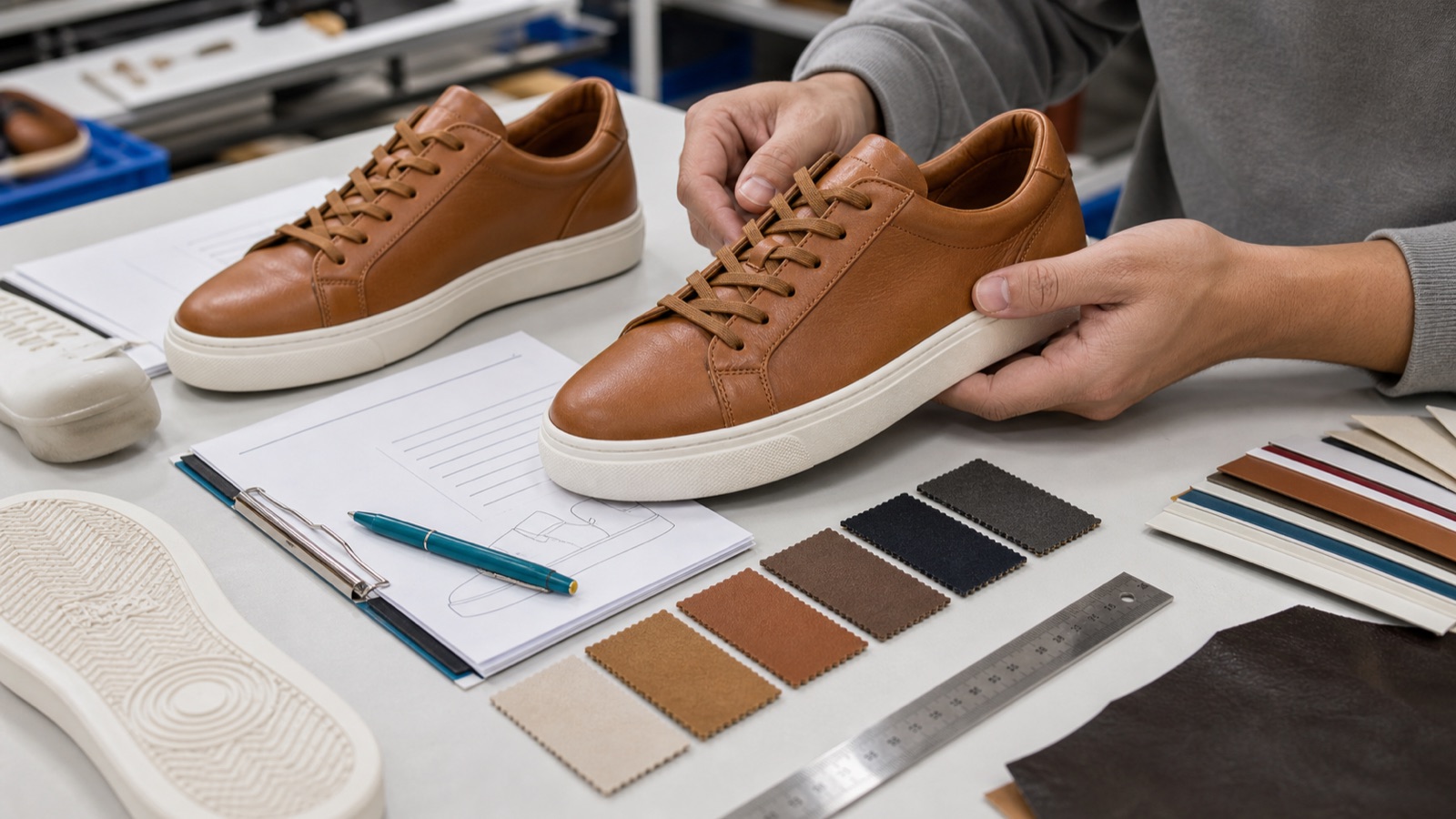
From the factory side, sample approval is the moment when a project changes from development to production planning. Materials may be booked, uppers may be cut, outsole work may be arranged, packaging may be printed, and the production team will follow the approved sample as the reference. If something is unclear at this point, it can become expensive later.
This guide is written for buyers who already have a first sample, revision sample, or pre-production sample in hand and want to check it properly before approving bulk production.
Do not review the sample only from photos
Photos are useful, but they do not tell the whole story. A shoe can look fine in a front photo and still feel stiff, fit too narrow, have a weak heel counter, or use a lining that does not match the price level.
If you receive a physical sample, put it on a table first. Look at it calmly. Then hold it, bend it, check the inside, check the bottom, and compare both left and right shoes. If the sample is for a brand launch, ask someone with the target foot size to try it on for a short walk indoors.
For remote review, ask the factory for more than beauty shots. Request side view, top view, back view, outsole view, inside label, insole logo, box label, and close-up photos of the details you care about.
Check the overall shape before small details
Start with the big picture. If the shape is wrong, perfect stitching will not save the sample.
- Does the toe shape match the reference?
- Is the topline height right?
- Does the side profile look too flat, too bulky, or too narrow?
- Does the outsole make the shoe look balanced?
- Do the left and right shoes look like a proper pair?
Buyers sometimes spend ten minutes discussing a logo size while missing that the last shape is not right. Shape should be confirmed first because it affects the whole shoe.
Fit and comfort need plain notes
Fit feedback does not need to be professional language, but it should be specific. "Not comfortable" is hard to fix. "The forefoot is tight after five minutes" is much easier.
Useful fit notes include:
- Toe room: too tight, too long, too round, or too pointed.
- Instep: pressure on the top of the foot or too loose when walking.
- Heel: slipping, rubbing, or too stiff.
- Width: narrow at forefoot, loose at waist, or unstable at heel.
- Insole: too thin, too hard, too soft, or needs better arch support.
If your target market needs a particular fit standard, say it clearly. A men's US casual sneaker, a European dress shoe, and a comfort loafer should not be judged with the same expectation.
Material approval should be written down
Material is one of the most common places where sample and bulk production drift apart. A sample may use available stock material, while bulk needs a larger quantity from a different lot. That is why material approval should be written down.
Check these points:
- Upper material texture, thickness, softness, and color.
- Lining material comfort and breathability.
- Insole material, foam feel, and logo surface.
- Outsole material, weight, flexibility, and grip direction.
- Hardware color, buckle finish, zipper smoothness, or metal logo quality.
If the color is important, do not rely on one phone photo. Ask for photos in natural light and indoor light, or use a physical color swatch when possible.
Logo and branding need exact approval
Private label buyers should look at logo placement as carefully as the shoe itself. A logo that is 3 mm too high may not sound serious in writing, but it can look strange when repeated on 300 pairs.
Check:
- Logo position on tongue, side, heel, insole, outsole, box, dust bag, or hang tag.
- Logo size and spacing.
- Print, embossing, woven label, metal logo, or heat transfer quality.
- Color match between shoe logo and packaging logo.
- Box label, barcode, SKU, size mark, and carton mark.
Keep the logo artwork version number in your approval note. It sounds boring, but it prevents confusion when several files are shared during development.
Use three levels for sample feedback
A long list of comments can overwhelm both sides. We like to separate feedback into three levels:
- Must fix: problems that block approval, such as wrong shape, wrong material, wrong logo position, poor fit, or incorrect packaging.
- Nice to improve: small refinements that would make the sample better but may not require a full remake.
- Acceptable: minor differences you can accept in bulk production.
This is more useful than marking everything as urgent. The factory can then decide whether a revision sample is required or whether the change can be corrected directly before production.
Mark photos instead of writing long paragraphs
For shape, stitching, logo, and color comments, marked photos save time. Draw arrows. Circle the issue. Write short notes near the part you mean.
Good feedback looks like this:
Photo 1: Toe shape is too round. Please make it closer to reference A.
Photo 2: Tongue logo should move down about 5 mm.
Photo 3: Side stitching is acceptable. Please keep this standard for bulk.
That kind of feedback is easy for sales, sample room, and QC staff to understand. It also creates a record if someone needs to check the decision later.
Know when to ask for a second sample
Not every small issue needs another full sample. But some changes should not be approved only by words.
Ask for a revision sample when:
- The last shape or fit changes.
- The outsole changes.
- The upper material changes.
- The logo method changes.
- The packaging structure changes.
- The first sample has workmanship problems that may repeat in bulk.
For size-sensitive projects, ask for a size-set sample or pre-production sample before bulk cutting. This is especially useful for custom sneakers, leather shoes, and loafers where fit and proportion matter.
Confirm packaging before production starts
Packaging is often left until late, but it should be confirmed with the sample. A good shoe with a wrong box label still creates trouble for warehouse, retail, or Amazon-style receiving.
Before bulk production, confirm:
- Box size and box strength.
- Logo printing on box, tissue paper, dust bag, or insert card.
- Barcode, SKU, color, and size label.
- Packing method: one pair per box, carton quantity, and carton mark.
- Any care card, spare lace, silica gel, or hang tag.
If the packaging artwork is not ready, say whether the shoe sample is approved separately from packaging. Do not leave that detail vague.
What to write when you approve a sample
When you approve the sample, write the approval in a way that can be saved and forwarded. A clear approval note may look like this:
We approve the latest black leather sneaker sample dated July 2 for bulk production, based on the attached photos and physical sample. Approved points: upper shape, outsole, tongue logo, insole logo, lining, and box direction. Before bulk, please adjust the box label SKU as marked in the attached image and send final packing photo for confirmation.
This approval is much safer than "OK, go ahead." It says what is approved and what still needs a final check.
Keep the sample thread in one place
Sample development can involve photos, files, comments, revised artwork, packaging notes, and shipping details. If everything is spread across separate messages, mistakes become easier.
For Marcusius projects, buyers can use the Buyer Portal to keep the requirement thread, attachments, and follow-up notes in one place. It still works with email notification, but the project record is easier to review before production.
If you are still at the earlier inquiry stage, read how to email a shoe manufacturer and get a useful quote. If your technical details are not ready yet, use the shoe tech pack checklist before asking for final sample approval.
Final sample approval checklist
- Overall shape and proportion match the approved direction.
- Fit comments are specific and tested on the target sample size.
- Upper, lining, insole, outsole, and hardware materials are confirmed.
- Logo placement, logo method, and artwork version are approved.
- Packaging, label, barcode, and carton mark are confirmed or listed as pending.
- Must-fix issues are separated from nice-to-improve comments.
- Marked photos are attached for every visual correction.
- Pre-production or size-set sample is requested if fit, grading, or material risk remains.
- Written approval clearly states what is approved before bulk production starts.
A shoe sample is a promise between buyer and factory. The clearer that promise is, the smoother the production will be.
Buyer FAQ
Footwear QC FAQ
What are the most common footwear defects?
Frequent inspection findings include open or untidy sole joints, broken or uneven stitching, left/right mismatch, wrong measurements or labels, finish contamination, shape/alignment differences and packing errors. The severity is not universal; compare each finding with the product specification and the order’s written defect rules.
Is A/B/C footwear grading a universal standard?
No. A, B and C are common commercial labels, but suppliers and buyers may define them differently. Write what each grade means for the order, including whether it can ship, must be repaired and reinspected, needs buyer approval, or must be rejected or replaced. Record the actual finding as well as the grade.
What does AQL mean in a footwear inspection?
AQL is an index used in an acceptance-sampling plan, such as the schemes in ISO 2859-1:2026. It is not a guarantee that every uninspected pair conforms or a universal defect allowance. The lot, sampling scheme, defect classes, sample size and acceptance/rejection numbers must be specified together.
First Order FAQ
How do I buy wholesale shoes from China as a small business?
Start with one repeatable style rather than a broad range, find a factory whose minimum order quantity matches your budget, and settle the specification in writing before sampling. Approve a physical sample rather than photographs, keep the approved pair as your reference, agree the size chart by internal measurement and plan a realistic size curve, then inspect before shipping. Budget two to three months from first enquiry to stock in hand, and for costs beyond the unit price — sampling, freight, destination duty and bank charges.
What is a typical MOQ for shoes from a Chinese factory?
It depends on how the product is made. Exotic leather shoes and bags can start at a single pair or piece because each is cut individually, ordinary leather casual and dress styles typically start around 20 pairs, and factories geared to volume production may quote several hundred. Minimums usually apply per style and per colour rather than per order, and a very low minimum can carry a higher unit price.
How long does a first shoe order take?
Realistically two to three months end to end: specification and quotation over days to weeks, sampling in 7-15 days plus shipping and review time with at least one revision round, bulk production in 15-21 days after confirmation, then inspection and freight — weeks by sea or days by air at much higher cost. Count backwards from the date you need stock rather than forwards from today.