
How to Import Shoes From China: Terms, Documents and Customs
Part of: China Footwear Sourcing Guide
Most import problems aren't manufacturing problems. They happen after the shoes are made. The order was right, the sample was approved, production went fine — and then the buyer discovers that "FOB" meant they owed the freight, that the shipment is sitting at a port because a document is missing, or that duty turned a good margin into a thin one. This page is about that half of the job: the terms, the paperwork, and the customs process. If you're still deciding what to order, our first-order guide covers that, and buying in bulk covers scaling. This one starts once the shoes exist.
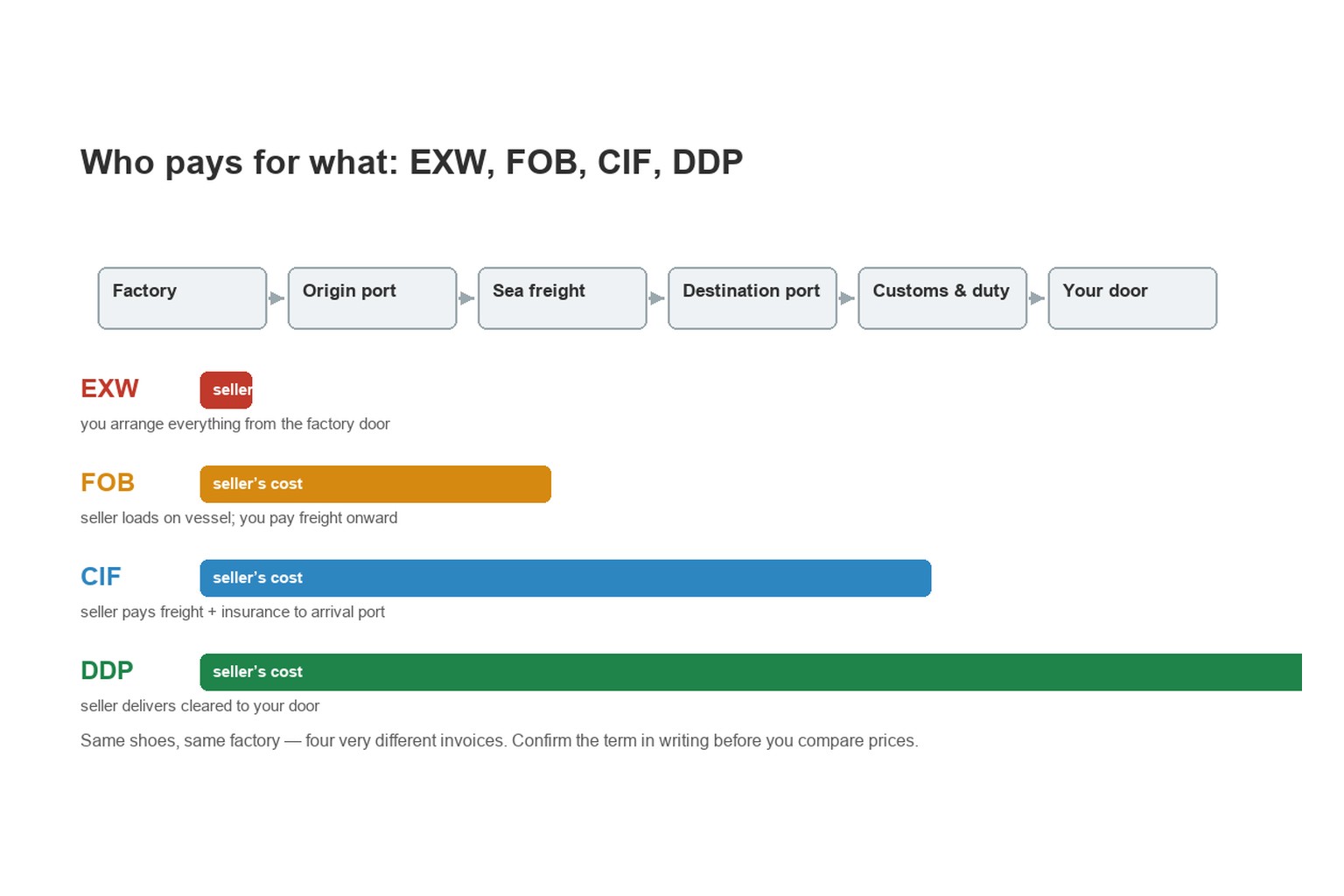
Incoterms: why two quotes aren't comparable
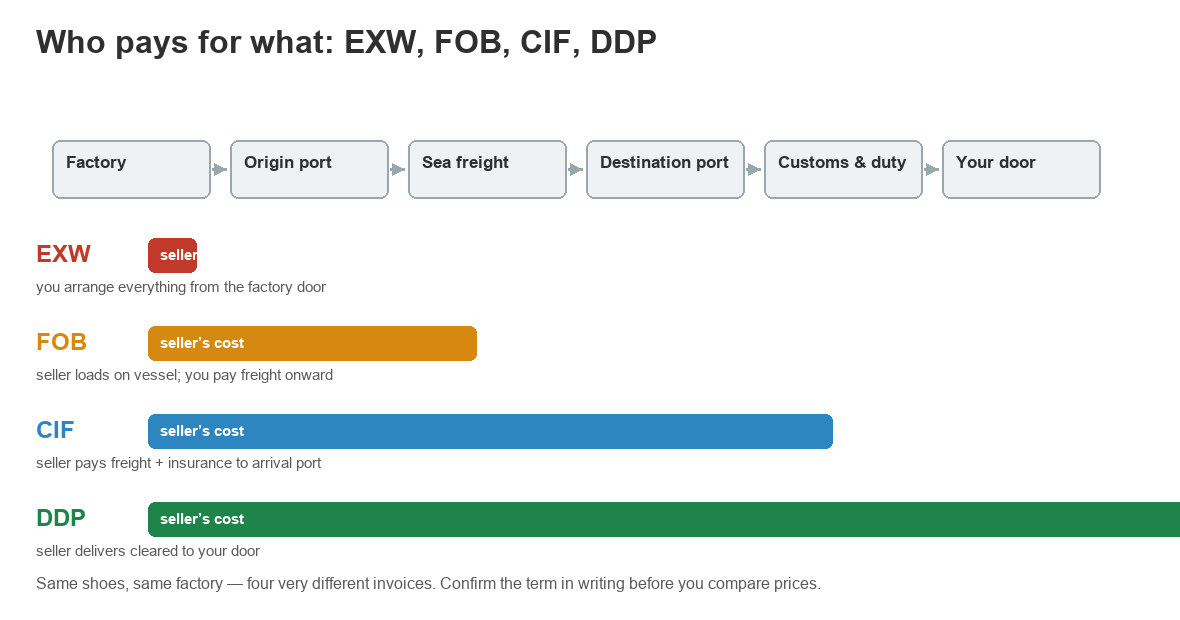
A price means nothing until you know where the seller's responsibility stops. Four terms cover almost every shoe order:
- EXW (Ex Works) — the goods are yours at the factory door. You arrange and pay for everything: local transport, export clearance, freight, insurance, import clearance, delivery. Lowest quoted number, most work, and not a beginner's term.
- FOB (Free On Board) — the seller gets the goods to the origin port and loaded, with export formalities done. You take over from there: sea freight, insurance, destination clearance, duty, delivery. This is the most common term in footwear and a sensible default for buyers with a freight forwarder.
- CIF (Cost, Insurance and Freight) — the seller pays freight and insurance to the destination port. You still handle import clearance, duty and onward delivery. Convenient, but you inherit whatever carrier and routing the seller chose.
- DDP (Delivered Duty Paid) — the seller delivers to your door with duty paid. Simplest for you, highest quoted price, and the term where you should ask exactly what is and isn't included, because "duty paid" arrangements vary in quality.
So when one factory quotes lower than another, check the term before concluding anything. An FOB price and a DDP price for identical shoes should differ substantially — that gap is freight and duty, not generosity or greed. Always have the term written on the quotation and the invoice.
The documents, and why each one exists
Paperwork causes more delay than shipping does, and it's almost always avoidable. The standard set:
- Commercial invoice — what was sold, to whom, at what value and on what Incoterm. Customs uses it to assess duty, so the values must match reality.
- Packing list — cartons, quantities, weights and dimensions. Also what your warehouse checks against on arrival.
- Bill of lading (sea) or air waybill (air) — the transport document, and for sea freight often the document that controls release of the goods. Getting this wrong strands shipments.
- Certificate of origin — sometimes required, sometimes the basis for a preferential duty rate depending on your country's trade agreements. Ask before shipping, not after.
- Product-specific documents — for exotic leather this is where CITES documentation lives, and it's non-negotiable: crocodile, alligator, python and lizard goods cross borders with permits or they don't cross at all.
One habit worth forming: ask for draft documents before shipping and read them. Correcting an invoice while the goods are still in China is a five-minute email; correcting one after arrival can mean storage charges accumulating daily.
Customs and duty: your job, not the factory's
This surprises first-time importers more than anything else. The factory makes and ships; classification, duty and import compliance are the importer's legal responsibility in essentially every country.
Footwear is classified under HS Chapter 64, and leather-upper footwear typically falls under heading 6403 — but the digits after that vary by construction, upper material and sometimes gender, and the rate attached varies enormously by destination country. Two practical rules:
Confirm your own code and rate before you commit to the order, using your country's tariff lookup or a customs broker. A shoe that's profitable at one duty rate can be marginal at another, and finding out at clearance is too late.
Declare accurately. Under-declaring value to reduce duty is fraud in your jurisdiction, not a clever tactic, and the exposure sits with you as importer of record. Any supplier who volunteers to under-declare is telling you something about how they handle other things too.
Also budget the charges that aren't duty: customs brokerage, port handling, terminal fees, possible inspection charges, and delivery from port. Together these are rarely trivial, and they're why landed cost — not unit price — is the only number that tells you whether an order works.
Sea or air, and when the answer changes
Sea freight is the default for footwear: shoes are light for their volume, and the cost per pair at any reasonable quantity is small. The trade-off is time and variability — transit plus port handling plus clearance, any of which can slip.
Air freight costs several times more per unit and compresses the timeline to days. It earns its price in exactly two situations: a first small order where you'd rather pay for speed than tie up months, and a genuine emergency where missing a season costs more than the freight. Using air routinely means your planning is broken.
Two things worth knowing regardless of mode. Consolidation: if your volume doesn't fill a container, LCL (less than container load) shares one — cheaper than air, more handling than FCL. Your forwarder will advise, and it's worth having your own forwarder rather than defaulting to the factory's. Insurance: under FOB you're carrying the risk once goods are loaded, and cargo insurance is cheap relative to a lost shipment.
What actually goes wrong
- Term mismatch. Buyer assumes DDP-like service, factory quoted FOB. Prevented by one line on the quotation.
- Document errors. Names, values or quantities that don't match across invoice, packing list and bill of lading. Prevented by reading drafts before shipping.
- Wrong classification. An HS code chosen casually and questioned at clearance. Prevented by confirming with a broker before ordering.
- Missing product documents. Especially exotic leather without CITES paperwork — a shipment that cannot legally proceed.
- No inspection before sealing. Everything is cheap to fix in the factory and expensive after it ships; our defects guide covers what to check.
- Chinese New Year. Not an import issue exactly, but it wrecks more schedules than any customs problem — factories close for weeks and ports congest either side.
Questions importers ask
How do I import shoes from China safely?
Agree the Incoterm in writing so you know where the seller's responsibility ends, confirm your HS classification and duty rate with your country's tariff lookup or a customs broker before ordering, and check draft shipping documents before the goods leave. Inspect before cartons are sealed, use your own freight forwarder rather than defaulting to the factory's, insure the cargo, and declare values accurately — as importer of record the compliance exposure is yours, not the factory's.
What is the difference between FOB and CIF for shoes?
Under FOB the seller delivers the goods to the origin port and loads them with export formalities complete, and you pay sea freight, insurance, destination clearance, duty and delivery from there. Under CIF the seller also pays freight and insurance to the destination port, so the quoted price is higher, but you still handle import clearance, duty and onward delivery — and you inherit the carrier and routing the seller selected.
Who pays customs duty on imported shoes?
The importer does, in essentially every country. The factory manufactures and ships, but classification, duty payment and import compliance are the legal responsibility of the importer of record — you. The exception is a DDP arrangement where the seller delivers duty paid, and even then you should confirm precisely what is included. Confirm your duty rate before committing to an order, since footwear rates vary widely by destination and construction.
Where we fit
We manufacture in Guangzhou and quote FOB by default, which suits most buyers with a forwarder, and we'll quote other terms on request. What we can always do is give you the details your side of the process needs early — accurate carton dimensions and weights for freight quoting, draft documents to review before shipping, and the CITES paperwork plan on exotic orders before anything is cut. Tell us the destination country when you enquire and that information comes with the quotation rather than after it.
Those permit rules apply to every exotic order, including the alligator shoes range, where the CITES paperwork is prepared with the shipment rather than chased afterwards.
Buyer FAQ
Shoe Import FAQ
How do I import shoes from China safely?
Agree the Incoterm in writing so you know where the seller's responsibility ends, confirm your HS classification and duty rate with your country's tariff lookup or a customs broker before ordering, and review draft shipping documents before the goods leave China. Inspect before cartons are sealed, use your own freight forwarder rather than defaulting to the factory's, insure the cargo, and declare values accurately — as importer of record the compliance exposure is yours.
What is the difference between FOB and CIF for shoes?
Under FOB the seller delivers the goods to the origin port and loads them with export formalities complete, and the buyer pays sea freight, insurance, destination clearance, duty and onward delivery. Under CIF the seller also pays freight and insurance to the destination port, so the quoted price is higher, but the buyer still handles import clearance, duty and delivery — and inherits the carrier and routing the seller chose.
Who pays customs duty on imported shoes?
The importer does, in essentially every country. The factory manufactures and ships, but classification, duty payment and import compliance are the legal responsibility of the importer of record. The exception is a DDP arrangement where the seller delivers duty paid, and even then the buyer should confirm precisely what is included. Duty rates for footwear vary widely by destination and construction, so confirm yours before committing to an order.