
What Shoe Material Is Most Durable? Leather, Rubber, EVA and PU Compared
Part of: Private Label Shoe Manufacturing
"What's the most durable shoe material?" doesn't have one answer, and any page that gives you one is selling something. A shoe is four or five materials doing completely different jobs, and the material that's toughest in one position is a poor choice in another. Rubber outlasts everything underfoot and would be miserable as a lining. Leather ages beautifully as an upper and is the wrong answer for a running outsole. So here's the useful version: what wins in each position, why, and how to tell which part of your own shoes is about to give up.
The short answer, by component
- Outsole (ground contact): rubber. Nothing in common use resists abrasion as well.
- Upper: full-grain leather, if it's cared for. Coated synthetics resist water and scuffs better in the short term but can't be restored once the surface fails.
- Midsole (cushioning): PU outlasts EVA; EVA is lighter and more comfortable when new.
- Lining: leather for moisture and long life, synthetic textile for cost and quick drying.
That list is the whole article in six lines. The rest explains the reasoning, because knowing why lets you judge a shoe nobody has written about.
Is rubber actually the most durable?
For the outsole, yes — and it isn't close. Rubber's advantage is abrasion resistance: the ability to be dragged across concrete thousands of times and lose very little material. That's the specific failure the ground inflicts, and rubber is the common material that handles it best. It also stays flexible across a wide temperature range and grips wet surfaces better than most alternatives.
What rubber is bad at is weight and cushioning. A full rubber sole thick enough to cushion would be exhausting to walk in, which is precisely why modern shoes use a foam midsole for comfort and a thin rubber outsole for wear. When someone asks whether rubber is durable, the honest answer is: it's the most durable material in the position it's used, and it's used in that position because it's the most durable there.
One nuance worth knowing when comparing shoes: not all rubber is equal. Harder compounds last longer but grip less; softer compounds grip better and wear faster. That's a genuine trade-off rather than a quality difference, and it's why a trail shoe and a dress shoe with the same "rubber outsole" spec wear at completely different rates. Our outsole materials guide goes through the compound options in detail.
Uppers: leather versus synthetics, honestly
Full-grain leather is the long-game answer. It resists tearing, moulds to the foot instead of creasing against it, and — the property nothing synthetic shares — it can be restored. Scuffs polish out, dry leather takes conditioner, and a scratched surface can be refinished. A leather upper on a well-built shoe routinely outlives several soles.
Its weaknesses are real too: it needs occasional care, it absorbs water without treatment, and it costs more. Also worth knowing — "genuine leather" as a stamp is not a quality tier; it often means a lower split of the hide. Full-grain and top-grain are the terms that indicate the good stuff.
Coated synthetics and PU-coated fabrics win the first year. They shrug off water and scuffs, need no care, and cost less. What they can't do is recover. When a coating starts to crack or delaminate — and coatings do, eventually — there's no repair; the shoe is finished. Synthetic uppers fail suddenly and visibly, while leather degrades slowly and can be pulled back.
Woven textiles and knits are the lightest and most breathable and the least abrasion-resistant of the three. They're the right choice for athletic shoes where weight matters and the shoe has a defined life anyway. In a work environment with rough surfaces, they're the first thing to go.
Midsoles: why the cushioning dies before the shoe looks worn
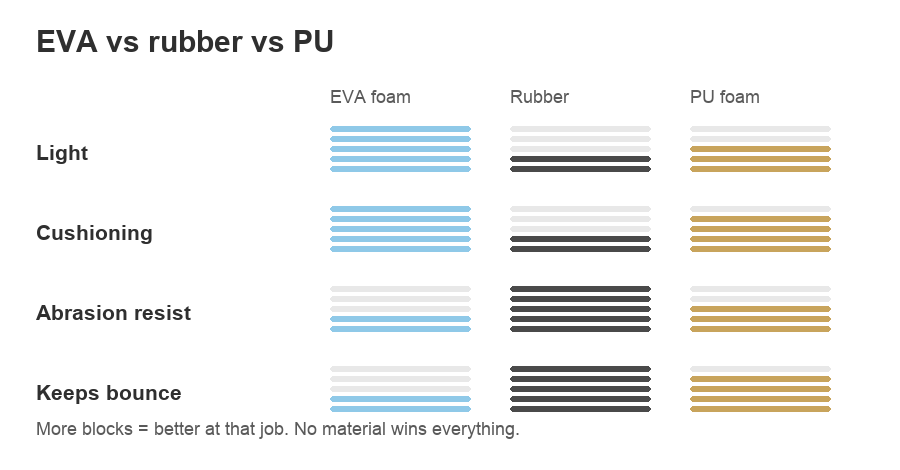
This is where most shoes actually expire, and where most owners misread the evidence. Foam midsoles don't wear away — they take a permanent set. The cells compress under thousands of footfalls and gradually stop springing back, so the shoe feels flat and dead while the tread still looks perfectly good.
EVA is the light, comfortable, faster-flattening option. PU is denser and heavier but holds its cushioning considerably longer, which is exactly why it dominates work boots and standing-all-day footwear where comfort in month eighteen matters more than grams on day one. If you're buying for a hard floor and a long shift, PU is usually the right answer even though EVA feels better in the shop. The full EVA explanation — density, why it flattens, how to check — is in our EVA midsole guide.
Linings and the parts nobody thinks about
Linings fail more often than people expect, especially at the heel, where friction is highest. A worn-through heel lining is uncomfortable and awkward to repair. Leather lining manages moisture and lasts longest; synthetic textile is cheaper and dries faster but abrades sooner. In a work shoe worn eight hours a day with sweat involved, this is not a trivial line item.
Two more quiet failure points: stitching, which on a well-made shoe outlives everything but on a rushed one is the first thing to go at stress points, and the bond between midsole and outsole, which is a process quality issue rather than a material one — the same defect covered in our footwear defects guide.
Diagnose your own shoes: what's actually worn out
Before replacing a pair, work out which material gave up — the answer often means a repair rather than a purchase.
- Tread smooth, shoe still comfortable: outsole wear only. On a welted or otherwise resoleable shoe this is a routine repair, not the end.
- Tread fine, but the shoe feels flat and your legs tire sooner: midsole foam has taken a set. This is the invisible one, and on cemented shoes it's usually terminal.
- Shoe leans when set on a table: midsole compressed unevenly, typically at the outer heel. Same verdict as above.
- Upper cracked or peeling: if leather, often restorable; if a synthetic coating, it's finished.
- Heel lining worn through: repairable by a good cobbler, and worth doing on an otherwise sound shoe.
Two habits extend everything above: rotate between two pairs so foam and leather both recover between wears, and dry wet shoes at room temperature with the shape supported — never on a radiator, which hardens leather and accelerates foam breakdown.
Common questions
Is rubber a durable material for shoes?
For the outsole, rubber is the most durable material in common use — its abrasion resistance is what the ground actually tests, and nothing standard beats it there. It's a poor choice for cushioning because a rubber layer thick enough to cushion would be far too heavy, which is why shoes pair a thin rubber outsole with a foam midsole. Harder rubber compounds last longer but grip less; softer ones grip better and wear faster.
What is the most durable shoe material overall?
There isn't a single winner, because durability is position-specific. Rubber wins the outsole, full-grain leather wins the upper over the long term because it can be restored rather than merely resisting damage, PU outlasts EVA in the midsole, and leather lining outlasts synthetic textile. The most durable shoe is one that uses the right material in each position and is built so worn parts can be replaced.
Which shoe material lasts longest for work shoes?
For a work shoe worn all day, the combination that lasts is a full-grain leather upper, a rubber outsole, a PU midsole rather than EVA, and a leather lining at the heel. PU is the key difference from athletic footwear: it's heavier than EVA but keeps its cushioning far longer, which matters more than initial softness when the shoes are worn eight hours a day for a year or more.
If you're specifying rather than buying
For brands ordering production, none of the above is a purchasing decision — it's a spec sheet. Name the leather type and thickness rather than writing "leather," state the outsole compound and hardness direction, name the midsole material with density and thickness, specify lining by material and position, and state which abrasion or flex tests matter for your market. Then approve a physical sample against those fields and re-check them at bulk, because materials are exactly where sample-to-bulk substitution shows up. Our sample approval guide covers the mechanics, and we quote against these fields directly — tell us the wear environment rather than the material name and the recommendation usually changes for the better.
Buyer FAQ
Shoe Materials FAQ
Is rubber a durable material for shoes?
For the outsole, rubber is the most durable material in common use — abrasion resistance is the specific failure the ground causes, and nothing standard beats rubber there. It is a poor cushioning material because a rubber layer thick enough to cushion would be far too heavy, which is why shoes pair a thin rubber outsole with a foam midsole. Harder rubber compounds last longer but grip less, while softer compounds grip better and wear faster.
What is the most durable shoe material overall?
There is no single winner, because durability is position-specific. Rubber wins the outsole, full-grain leather wins the upper over the long term because it can be restored rather than only resisting damage, PU outlasts EVA in the midsole, and leather lining outlasts synthetic textile at the heel. The most durable shoe is one using the right material in each position and built so worn parts can be replaced.
Which shoe material lasts longest for work shoes?
For all-day work wear, the lasting combination is a full-grain leather upper, a rubber outsole, a PU midsole rather than EVA, and a leather lining at the heel. PU is the key difference from athletic footwear: it is heavier than EVA but keeps its cushioning far longer, which matters more than initial softness when shoes are worn eight hours a day over a year or more.