
How to Clean Crocodile Leather: Shoes, Bags and Belts
Part of: Exotic Leather Guide
The message usually arrives on a Monday. A shop owner we supply writes: "Customer got caught in the rain with the black crocodile bag. She's upset. What do I tell her?" We make crocodile leather shoes, bags and belts in Guangzhou, and some version of that message has landed in our inbox every month for years. So here's the answer we send back — the full version, covering everyday cleaning, rain, stains, storage, and the point where home care stops and a professional should take over.
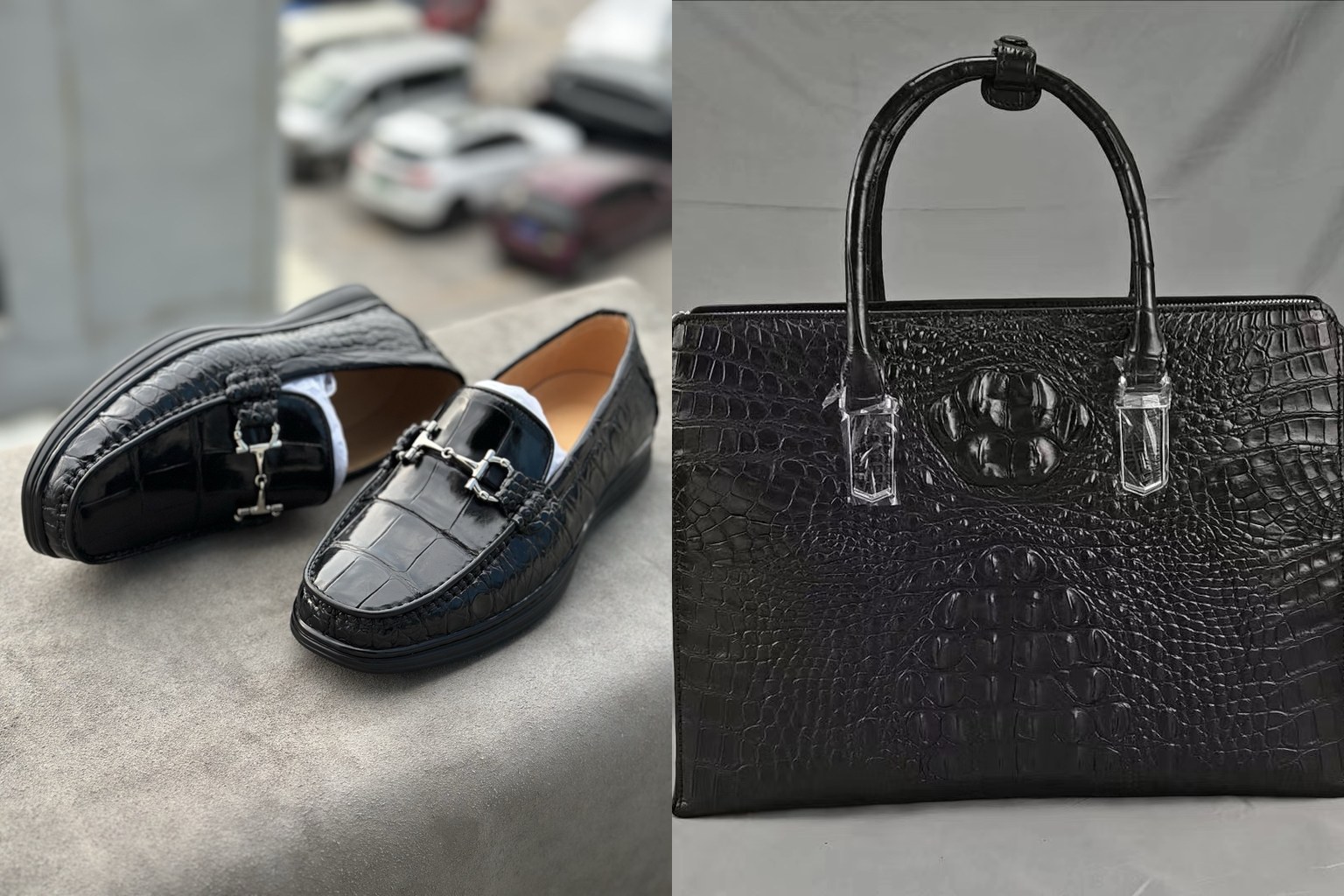
The short answer
Wipe the piece with a soft, dry cloth, following the direction of the scales. Keep it away from heat, direct sunlight and anything containing alcohol or solvents. If it gets wet, blot it and let it dry on its own at room temperature with the shape supported. Done regularly, that's about ninety percent of crocodile leather care.
The other ten percent is knowing what not to do — and this is where most damage actually comes from. The crocodile pieces that reach us in bad shape usually weren't ruined by neglect. They were ruined by good intentions: a hair dryer aimed at a rain-soaked vamp, calf-shoe polish rubbed into glazed scales, an alcohol wet-wipe used on a "quick mark". Crocodile forgives being left alone far more than it forgives the wrong treatment.
First, look at your finish
Crocodile leather is sold in two broad finishes, and they don't behave the same way, so check yours before you clean anything.
Glazed (shiny) finish. The surface has been polished under pressure until it carries a hard, lacquer-like sheen. That sheen seals the surface, which is why dust and light dirt wipe straight off a glazed shoe. The trade-off: the gloss layer shows fine scratches, and solvents or waxes will dull it in a way a cloth can't bring back.
Matte (natural) finish. The surface is left closer to its natural state. It hides scuffs and fingerprints well and ages with more character, but it's more absorbent — water and hand oil sink in faster, and a matte piece will often darken where it's handled most. Hornback cuts, with their raised ridges, are usually finished matte.
If you can see your reflection in the scales, treat it as glazed. If the surface looks soft and reads more like stone than glass, treat it as matte. And if you're not certain the piece is genuine crocodile in the first place, run the checks in our real-vs-embossed verification guide — embossed calf is a legitimate product, but it's cared for like calf, and this article is about the genuine article.
The five-minute routine that prevents most problems
After a day's wear, before the piece goes back on the shelf or in the closet:
- Wipe the whole surface with a soft, dry cotton cloth, always moving along the scale rows rather than across them. The scale edges are where dust settles, and wiping along the rows lifts it out instead of packing it in.
- Check the seams, the welt on shoes, the base corners on bags. Grit collects there first and grinds at the stitching.
- For crocodile shoes: fit shoe trees or at least stuff the toes with paper, and don't wear the same pair two days running. Leather that rests a day between wears lasts visibly longer.
- For bags: empty it out, wipe the handles (hand oil is the quiet enemy), and let it stand in shape rather than slumping on a hook.
- For belts: hang them or roll them loosely. A sharp fold tonight is a crease line next month.
None of this needs a product. A cloth and two minutes of attention beat any spray you can buy.
Caught in the rain: the first ten minutes
Water itself doesn't destroy crocodile leather. What destroys it is what people do next. Here's the sequence we give our own customers:
- Blot, don't rub. Press a dry, colorfast cloth or plain paper towel against the wet areas and lift the water off. Rubbing pushes water — and any street dirt in it — into the scale edges.
- Support the shape while it's damp. Wet leather is soft leather. Stuff shoes with plain paper, stand a bag upright with a light cushion inside, lay a belt flat. Whatever shape it dries in is the shape it keeps.
- Dry at room temperature, nowhere else. No hair dryer, no radiator, no sunny windowsill, no leaving it in a hot car. Heat is the one mistake you can't undo: it hardens the leather and can lift the scale edges. A full dry takes a day, sometimes two. Let it take that long.
- Don't panic over dark spots. On matte finishes especially, wet patches darken. As the piece dries evenly, those marks usually settle back. Judge nothing until it's completely dry.
- Once fully dry, buff lightly. A soft cloth along the scales brings the surface back. If a defined watermark ring has survived the full dry, stop — that one belongs to a professional, and rubbing at it makes it worse.
Stains, drinks, and the bottle you shouldn't reach for
Coffee, wine, sauce — blot immediately with a dry cloth or napkin, same rule as rain: lift, don't rub. For the residue, wring a clean cloth out in plain water until it's barely damp and wipe along the scales, then let the area air-dry. Test any wet cloth on a hidden spot first — inside a strap, under a flap — and watch how the leather takes it before you touch the visible surface.
Grease and oil are different: don't press a damp cloth into them. Lift what sits on the surface with a dry cloth and then leave it alone. Small grease marks often migrate into the leather and fade from view on their own over days. Chasing them with water or cleaner usually spreads them instead.
And the do-not list, learned from pieces sent back to us over the years: no alcohol wipes, no baby wipes (most carry cleansers), no nail-polish remover, no saddle soap, and no calf shoe polish or wax on glazed crocodile — polish made for calf clogs the scale edges and kills the glaze it's supposed to feed. If a product doesn't say it's made for reptile or exotic leather, it isn't.
Storage is where most damage actually happens
A crocodile piece is rarely ruined while it's being used. It's ruined in the closet, slowly, between uses. The rules:
- Breathable bag, never plastic. A cotton dust bag lets moisture move; a plastic bag traps it, and trapped moisture in a warm month is how mildew starts.
- Keep the shape filled. Shoe trees in shoes, light stuffing in bags. Empty leather collapses and creases along the fold.
- Out of the sun, away from heat. Sunlight fades the color and dries the hide; a shelf above a radiator does the same thing slower.
- Nothing stacked on top. Crocodile scales hold a pressure mark far longer than smooth calf does.
- In humid months, add a silica pouch and look in once a month. If you ever find a light bloom of mildew, wipe it away with a soft dry cloth outdoors and let the piece air. If it comes back a second time, the moisture is inside — professional territory.
Bags: handles, hardware, and the shape question
On a crocodile bag, three places age ahead of everything else.
Handles. They take hand oil all day, and oil darkens matte crocodile permanently if it builds up. A five-second wipe when the bag comes off your shoulder is worth more than any deep clean later.
Hardware. Fingerprints and tarnish on zips and clasps come off with a dry cloth. What you shouldn't do is use metal polish while the hardware sits on the bag — it runs, and it bleaches the leather around the fitting. If hardware is properly tarnished or a zip drags, have it handled off the bag or by someone who does this for a living.
Shape. Don't overfill. Belly-cut panels are the softest, most beautiful part of the hide, and they'll stretch around a laptop that's a size too big — then hold that stretch. Store the bag standing, lightly stuffed, handles up, not hanging by the handles for months at a time.
Belts: the crease by the buckle
Every leather belt creases where it flexes at the buckle; on crocodile the crease shows more because the scales open at the fold. Slow it down three ways: rotate between two belts instead of wearing one daily, store the belt hanging or rolled loose in a wide coil (never folded in half in a suitcase), and in summer wipe the inside face now and then — sweat dries leather from the back where you don't see it. A crease that has already set is permanent, which is one reason a customer who loves a crocodile belt is usually a customer for a second one. If you're specifying belts for a shop, our exotic belt sourcing guide covers the build choices that affect how the flex zone wears.
What's fixable at home — and what isn't
Home care, honestly, is maintenance: dust, light water spotting, low shine on a glazed finish (a patient buff with a soft cloth, nothing on it), and mild surface dryness on matte pieces — and even there, only with a cream made specifically for reptile leather, used sparingly, tested on a hidden corner first.
Professional work is everything structural, and it's a longer list than people expect: scale edges that have lifted or curled, a scratch that has gone through the glaze, watermark rings that survived a complete dry, stitching that has opened, hardware repair, color loss, and mildew that returns after a wipe-down. We see people online asking how to restore a dried-out vintage crocodile bag with household oils, and the honest answer is: don't. Oils meant for calf darken crocodile unevenly and permanently, and a piece that might have been restored becomes a piece that can't be. A restorer who works with exotic skins — not just calf — can usually do more than owners expect, and the cost is small against what the piece is worth.
If you sell crocodile goods, aftercare is a sales tool
Here's the retail angle, since most of the people who write to us run shops. That panicked rain message isn't a problem — it's the moment the customer decides whether your shop knows what it sold them. The owner who answers with a calm, specific routine keeps the customer; the one who says "try googling it" sends them to a competitor.
Two habits make it easy. First, put a short printed care card in the box with every exotic piece — the five-minute routine, the rain steps, the do-not list. It costs a few cents and reads as confidence. Second, treat every aftercare conversation as the natural opening it is: the customer with a two-year-old crocodile belt asking about a crease is telling you the belt got worn constantly, and that's a second-belt conversation. Our reorder playbook goes deeper into that, and the retail stocking guide covers what to put on the shelf in the first place.
Quick questions we get about cleaning
How do I clean a crocodile leather bag at home?
Soft dry cloth along the scale rows for regular cleaning. For a mark, a cloth wrung out in plain water until barely damp, tested on a hidden spot first, then air-dry away from heat. Wipe the handles often — hand oil does more slow damage than dirt does. No wipes, no solvents, no calf polish.
Does water ruin crocodile leather?
Brief exposure doesn't, if you respond right: blot the water off, support the shape, and let it dry at room temperature for a full day. Matte finishes may darken while damp and usually settle as they dry. The real danger is drying it with heat — that's the mistake that can't be reversed. A watermark still visible after a complete dry needs professional attention.
Should I use leather conditioner on crocodile?
Not the one you use on calf. Calf conditioners and polishes clog the scale edges and dull a glazed finish. A glazed piece rarely needs anything beyond a dry-cloth buff; a matte piece that genuinely feels dry can take a small amount of a reptile-specific cream, tested on a hidden corner first.
Where these pieces come from
We make crocodile, alligator, ostrich and lizard goods to order in Guangzhou, one piece at a time if that's what you need — orders start from a single pair or piece, which is how many of our retail customers first tested us. If you're weighing a first exotic order, the alligator buyer checklist is a good place to start. And if a piece you bought or sold is in trouble, send us photos — we'll tell you straight whether it's a home fix or a job for a restorer.
And if you're still choosing the pair itself, our guide on how to wear crocodile shoes covers fit, styling and how the two finishes age.
Alligator asks for the same routine as crocodile, so if the pair you are caring for is one you still have to buy, our men's alligator shoes range shows the finishes and sole builds that survive it best.
Ostrich is the exception in this routine — the quill follicles hold conditioner longer, so pairs from our ostrich leather shoes range need a lighter hand and more drying time.
Buyer FAQ
Crocodile Care FAQ
How do I clean a crocodile leather bag at home?
Wipe it with a soft dry cloth along the scale rows. For a mark, wring a cloth out in plain water until barely damp, test it on a hidden spot, wipe along the scales and let the area air-dry away from heat. Wipe the handles regularly, since hand oil causes more slow damage than dirt. Never use alcohol wipes, baby wipes, solvents or calf shoe polish on crocodile leather.
Does water ruin crocodile leather?
Brief exposure does not, if handled correctly: blot the water off without rubbing, support the shape while damp, and let the piece dry at room temperature for a full day. Matte finishes may darken while wet and usually even out as they dry. Drying with a hair dryer, radiator or direct sun is what causes permanent hardening. A watermark still visible after a complete dry needs professional attention.
Should I use leather conditioner on crocodile leather?
Not a conditioner made for calf leather — calf products clog the scale edges and dull a glazed finish. A glazed crocodile piece rarely needs more than a buff with a soft dry cloth. A matte piece that genuinely feels dry can take a small amount of a reptile-specific cream, applied sparingly and tested on a hidden corner first.
Crocodile Shoe Wear FAQ
Are crocodile shoes comfortable to walk in?
They can be as comfortable as any high-quality leather shoe, but the comfort comes from the build rather than the skin: a full leather lining and footbed, a sole matched to how you walk (rubber for daily city wear, leather for formal occasions), a construction that suits you, and a last shape that fits your foot. Because crocodile uppers give less than calf, buying the correct width matters more than usual.
Do crocodile shoes stretch or break in?
Far less than calf leather. The tiles are dense and their raised edges resist stretching across the width of the shoe, so most of the break-in you feel comes from the lining conforming and the footbed compressing rather than the upper widening. Buy the size and width that fit on day one, and wear the shoes indoors for two or three short sessions before a full day out.
What do you wear crocodile shoes with?
Keep the rest of the outfit quiet and match the shoe's own formality: crocodile oxfords with tailoring, loafers with trousers or clean denim, crocodile sneakers with jeans and casual clothes. Black and dark brown pairs work with almost anything already in your wardrobe, while colored pairs are worth planning an outfit around. If you want to match an exotic belt, the leather, color and finish should genuinely agree — otherwise a plain belt in a matching color looks better.
Crocodile Durability FAQ
How long do crocodile leather shoes last?
There is no evidence-based universal lifespan for crocodile shoes. Wear frequency, fit, construction, outsole and heel wear, finish, moisture and heat exposure, storage, maintenance and repairability all affect service life. Confirm which components can be repaired and follow care instructions suitable for the exact finish.
How long do exotic leather belts last?
There is no universal lifespan for an exotic-leather belt. Flexing at the buckle, reinforcement, joining method, edge construction, finish, storage and frequency of use all matter. Inspect the crease, stitching, edges and layer separation over time rather than relying on a promise measured in years or decades.
Does crocodile leather crack or peel?
Cracking or surface lifting does not identify the material by itself. Coatings, finishes, adhesives, flexing, heat, moisture and prior treatment can fail on different materials. Stop using the item, photograph the affected area and ask the supplier or a qualified leather specialist to assess it; verify material identity through records or an appropriate test, not the damage pattern alone.
Crocodile Color FAQ
How do you keep white crocodile leather clean?
Wipe contact points with a soft dry cloth the same day you wear the piece — dye transfer from dark denim, not dirt, is white leather's real enemy, and fresh transfer wipes away while old transfer sets permanently. For marks, use a barely damp cloth tested on a hidden spot first, then air-dry away from heat. Never use bleach, whitening creams or alcohol wipes, and store the piece in its dust bag away from sunlight.
Does white crocodile leather turn yellow?
Not from age alone. Yellowing is almost always caused by sunlight, heat from radiators or hot cars, or harsh cleaning products attacking the finish. Stored in a dust bag away from daylight and cleaned with nothing stronger than a barely damp cloth, a white piece keeps its color; honest wear softens contact points toward ivory over years, which is patina rather than the all-over yellowing neglect causes.
Is brightly colored crocodile leather real crocodile?
Color alone cannot prove or disprove a natural crocodilian material claim. Different leathers and non-leather materials can be dyed, printed, embossed or coated in many colors. Use photographs to approve color and panel appearance, but verify the base material, surface treatment, species claim and component scope through the written SKU or batch record.