
How to Wear Crocodile Shoes: Fit, Styling and How They Age
Part of: Exotic Leather Guide
"I've wanted a pair for years. I just don't want to look like I'm trying too hard." That message, or some version of it, lands in our inbox most weeks. We make crocodile shoes in Guangzhou — several hundred pairs a year, one pair at a time for private customers and in runs for shops — and the questions that actually decide whether someone enjoys the shoes have almost nothing to do with the leather. They're about fit, about what to wear them with, and about what the shoes will look like in three years. Nobody writes that guide, so here it is.
Start with your week, not with the shoe
The most common mistake we see isn't buying the wrong size. It's buying the most dramatic pair in the catalog when the buyer's actual life calls for something quieter — and then the shoes stay in the box.
So a blunt question first: how many days a month will you wear a shoe you can't get muddy? If the answer is one or two, buy the dressiest thing you love — you're buying an occasion shoe and it should feel like one. If the answer is fifteen, buy the quietest pair you can find in the finish you like, because everyday shoes have to survive rain, car parks and being kicked off under a desk.
Here's how the four families we make actually behave in practice.
Dress oxfords and derbies. The formal end. Genuine crocodile with a leather sole, worn with a suit, reads as considered rather than loud — most people at the table won't identify the leather, they'll just register that your shoes are better than theirs. This is also the pair that suffers most on wet pavement, so it wants a rotation partner.
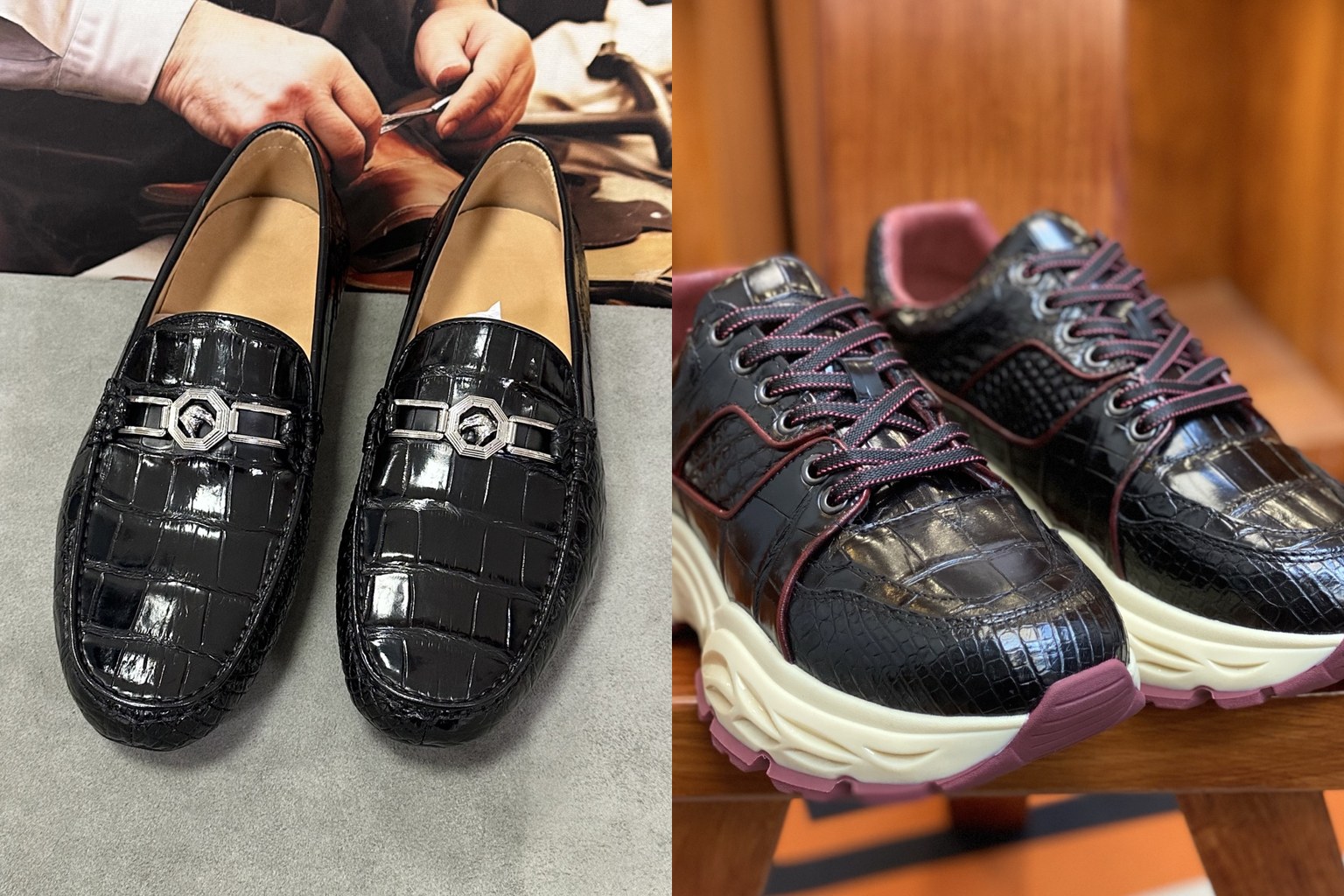
Loafers and driving shoes. The most versatile, and the pair we sell most of to first-time buyers. A black glazed loafer works under trousers at dinner and over bare ankles on a Saturday, which is why it earns its shelf space faster than anything else.
Chunky sneakers and casual lace-ups. The exotic hides inside a familiar silhouette. People read "sneaker" first and "crocodile" second, which is exactly why this style suits anyone who wants the leather without the announcement. Rubber soles handle real weather, too.
Boots. The most rugged option and the one that ages with the most character, particularly in matte finishes where scuffs read as patina rather than damage.
If it's your first pair and you can't decide, we say the same thing every time: black or dark brown, loafer or sneaker, matte or lightly glazed. It's the pair you'll actually wear, and the second pair can be the dramatic one.
Fit: crocodile does not behave like calf
This is the section people skip and then regret, so let's be specific about what's different.
A calf upper stretches. Wear a calf oxford that's a touch snug across the ball of your foot and after two weeks it's molded to you. Crocodile doesn't do that in the same way. The tiles themselves are dense and their raised edges are stiffer than smooth grain, so the panel gives far less across its width. What break-in you get comes mostly from the lining conforming and the footbed compressing under your arch — the shoe feels better, but the width you bought is essentially the width you keep.
Practical consequences:
- Don't buy snug and plan to stretch it. With calf that's a workable gamble. With crocodile it's how a pair ends up unworn. If you're between widths, take the wider one.
- Length is the part that fools people. A stiff upper can make a correctly sized shoe feel short at the toe on the first wear. Judge by where the widest part of your foot sits against the widest part of the shoe, not by the pressure you feel at your toes standing still on day one.
- Loafers should be snug at the heel from the start. They will loosen slightly as the lining settles, and a crocodile loafer that already slips at the heel in the shop will slip forever.
- Measure both feet, order for the bigger one. Obvious, and still the most common cause of a return. When we build a custom pair we ask for both measurements for exactly this reason.
- Break them in gently. Two or three hours indoors, twice, before a full day out. Not because the leather is fragile — because your feet deserve the warning.
Comfort: what actually makes exotic shoes walkable
Search the menswear forums for the most comfortable leather shoe to walk in and you'll get a hundred opinions and very little about construction. But comfort in a crocodile shoe comes from four decisions that are made before the leather is ever cut, and you can ask about all four.
The lining. Full leather lining, ideally with a leather footbed rather than a printed board. Leather manages moisture; synthetic lining is why expensive shoes sometimes feel worse than cheap ones after four hours.
The sole. Leather soles breathe and look right under formal trousers, but they're slippery when wet and wear faster on pavement. Rubber gives grip and cushioning and is the honest answer for a shoe you'll walk in all day. Many of our casual crocodile styles use a light rubber sole for exactly this reason — the leather is the luxury, the sole is the tool.
The construction. Goodyear welt gives you a resoleable shoe with a cushioning layer that molds over time; it's heavier and takes longer to feel broken in. Blake stitch gives you a lighter, more flexible shoe that's comfortable sooner but has fewer resole lives. Neither is superior — they suit different feet and different weeks, and our Blake versus Goodyear comparison goes through the trade-offs if you want the long version.
The last shape. The wooden form the shoe is built around decides whether your foot is comfortable at all. This is the one thing you can't judge from photos, which is why trying a style — or, for a custom pair, approving a sample before the full order — matters more than any spec sheet.
Styling: the rules are shorter than people think
Two of the most-read threads we've come across in men's style forums are simply people asking how to wear loafers casually. If that's the question with plain calf, adding crocodile makes people freeze completely. It shouldn't. Four rules cover almost everything.
One statement at a time. Crocodile shoes are the loud thing in the outfit. Let everything else be quiet — plain trousers, a plain jacket, no competing texture. The reason croc shoes sometimes look like a costume isn't the shoes; it's the three other things shouting alongside them.
Match the formality of the silhouette, not the leather. A crocodile oxford is a dress shoe and belongs with tailoring. A crocodile sneaker is a sneaker and belongs with jeans. The exotic skin doesn't drag a casual shoe upmarket, and it doesn't excuse an oxford with shorts.
Black and dark brown are the easy years-long buys; color is the fun one. A black glazed loafer goes with everything you already own. A blue or burgundy pair is a genuine pleasure to wear, but plan the trousers you'll wear it with before you buy, not after.
The belt question. Matching your exotic belt to your exotic shoes is a classic move, but it only works when the leather, color and finish actually agree — a matte belt with glazed shoes reads as a near-miss, which is worse than no match at all. When in doubt, wear a plain leather belt in a matching color and let the shoes do the work.
One more thing, because it comes up: nobody but you knows what your shoes cost. Crocodile at a distance reads as texture, and texture reads as care. That's the whole effect, and it's a good one.
How they age — the honest version
People ask which leathers look better with age, and the honest answer for crocodile depends entirely on the finish you chose.
Glazed pieces don't develop patina — they hold their gloss and then show their history. That hard polished surface stays bright for years with nothing but a dry cloth, but it records fine scratches, and it creases where the shoe flexes across the vamp. Those creases will appear on the first day and they're permanent. That's not a defect; it's what a glazed shoe does. If crease lines across shining black tiles would bother you every time you looked down, buy matte.
Matte pieces age the way people hope leather ages. The surface darkens slightly where it's handled, small scuffs blend in, and after a couple of years the shoe looks lived-in rather than worn out. Hornback and other textured cuts are the most forgiving of all.
What genuinely wears out on a crocodile shoe, in order: the sole, first and by a wide margin; then the heel; then the lining at the heel counter. The upper is almost always the last thing to fail, which is the real argument for the material. A well-made crocodile shoe with a replaceable sole can outlast several pairs of calf shoes bought in the same year — but only if you rotate it, keep trees in it, and let it dry properly when it gets wet. Our care guide covers the routine, and it takes about two minutes a week.
Before you buy: three things worth checking
You're spending real money, so spend five minutes too.
Confirm what the leather is. Genuine crocodile and crocodile-embossed calf are both legitimate products at very different prices, and the wording in a listing is where the difference should appear. Our verification guide shows the checks that take a minute and need no tools.
Look at the pair, not one shoe. On a properly cut pair the vamps are matched: similar tile scale, similar flow, left and right chosen to sit together. Mismatched vamps mean whoever cut them wasn't paying attention, which tells you something about the rest of the shoe. The same eye applied to edges, stitching and lining is laid out in our guide to what makes a piece luxury-grade.
Sanity-check the price. Genuine crocodile dress shoes in our catalog run roughly US$300-780 depending on cut, finish and construction. A "genuine crocodile" shoe priced far below that band is telling you something, and our price guide breaks down what actually moves a pair up or down within it.
Ordering a pair that fits your foot and your week
Most people don't realize made-to-order is available to individuals. It is, and it's how a lot of our crocodile shoes are built: exotic orders start from a single pair. You choose a style from the crocodile shoe catalog or send photos of what you have in mind, specify the leather and cut, the color and finish, the sole and construction, and your measurements. We confirm the specification in writing, and a sample takes 7-15 days depending on complexity; a repeat or larger order runs 15-21 days after confirmation. Shops work the same way — one pair to test the style, then a size run once it sells.
Tell us how you'll actually wear them. A customer who says "I walk two miles a day in the city" gets a different recommendation than one who says "twice a month, restaurants" — different sole, different construction, sometimes a different style altogether. That conversation costs nothing and it's the difference between a pair you love and a pair in a box.
Common questions
Are crocodile shoes comfortable to walk in?
They can be as comfortable as any high-quality leather shoe, but the comfort comes from the build rather than the skin: full leather lining and footbed, a sole matched to how you'll walk (rubber for daily city wear, leather for formal occasions), a construction that suits you, and a last shape that fits your foot. Crocodile uppers give less than calf, so buying the correct width matters more than usual.
Do crocodile shoes stretch or break in?
Far less than calf. The tiles are dense and their raised edges resist stretching across the width of the shoe, so most of the break-in you feel comes from the lining conforming and the footbed compressing rather than the upper widening. Buy the size and width that fit on day one, and give the shoes two or three short indoor wears before a full day out.
What do you wear crocodile shoes with?
Keep everything else quiet and match the shoe's own formality: crocodile oxfords with tailoring, loafers with trousers or clean denim, crocodile sneakers with jeans and casual wear. Black and dark brown pairs work with almost anything you already own; colored pairs are worth planning an outfit around. If you want to match an exotic belt, the leather, color and finish should genuinely agree — otherwise a plain belt in a matching color looks better.
If you're still deciding
Browse the crocodile shoes and see which silhouette you keep coming back to — that instinct is usually right, and it's a better guide than any rule on this page. Then tell us how you'll wear them and what your foot needs. We'll tell you honestly which style suits that, including when the answer is a quieter pair than the one you were looking at.
For how last shapes are actually developed and graded across sizes, our shoe last development checklist goes through the process step by step.
Buyer FAQ
Crocodile Shoe Wear FAQ
Are crocodile shoes comfortable to walk in?
They can be as comfortable as any high-quality leather shoe, but the comfort comes from the build rather than the skin: a full leather lining and footbed, a sole matched to how you walk (rubber for daily city wear, leather for formal occasions), a construction that suits you, and a last shape that fits your foot. Because crocodile uppers give less than calf, buying the correct width matters more than usual.
Do crocodile shoes stretch or break in?
Far less than calf leather. The tiles are dense and their raised edges resist stretching across the width of the shoe, so most of the break-in you feel comes from the lining conforming and the footbed compressing rather than the upper widening. Buy the size and width that fit on day one, and wear the shoes indoors for two or three short sessions before a full day out.
What do you wear crocodile shoes with?
Keep the rest of the outfit quiet and match the shoe's own formality: crocodile oxfords with tailoring, loafers with trousers or clean denim, crocodile sneakers with jeans and casual clothes. Black and dark brown pairs work with almost anything already in your wardrobe, while colored pairs are worth planning an outfit around. If you want to match an exotic belt, the leather, color and finish should genuinely agree — otherwise a plain belt in a matching color looks better.