
What Do Crocodile Shoes and Bags Actually Cost? A Wholesale Price Guide
Part of: Exotic Leather Guide
Let's answer the question you actually typed into the search bar. In our catalog — and the prices are printed on the product pages, you don't have to email anyone to see them — genuine crocodile dress shoes list roughly between US$300 and US$780 depending on style, cut and quantity. Alligator runs about US$350-550, ostrich US$200-260, python US$320-380. Crocodile-pattern embossed calf starts around US$60. Bags cover a wider spread than shoes, for a reason we'll get to.
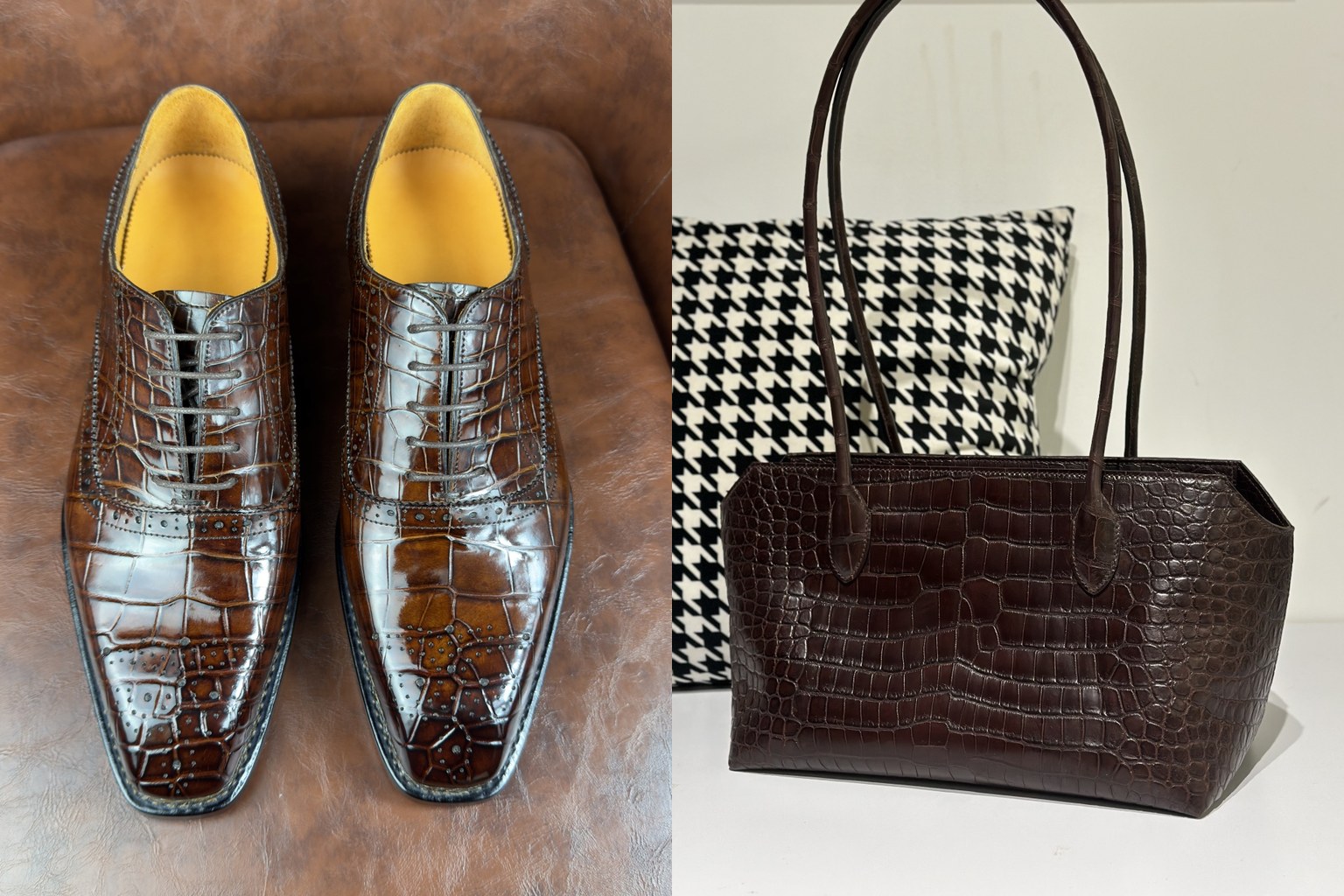
Those spreads look wide, and buyers sometimes read wide spreads as "the price is whatever they think I'll pay." It isn't. The gap between a US$300 shoe and a US$780 shoe is a series of concrete decisions, most of which are yours to make. This guide walks through what moves the number, what doesn't, and how to ask for a quote you can actually compare between factories.
The five things that actually move the price
We quote crocodile goods every day, and nearly every price conversation comes down to the same five levers.
| Driver | Why it matters | What you control |
|---|---|---|
| How much of the product is skin | A full crocodile upper uses far more material than crocodile panels with calf quarters. Same look from the front, very different cutting bill. | Ask for the exact coverage in writing: full skin, panel plus calf, or trim only. |
| Which part of the skin | Belly gives calm, even tiles and is the premium cut. Hornback is dramatic and uses a different part. Mixed-panel plans cost less than a matched-belly front. | Approve the cut and panel plan at sample stage instead of discovering it in bulk. |
| Panel size | A bag body needs one large, clean, uninterrupted panel. Large flawless panels are the scarcest part of any skin - this is why bags of the same species often cost more than shoes. | Smaller goods (belts, clutches, small leather goods) use smaller panels and price accordingly. |
| Construction | Goodyear and Norwegian welted shoes take more labor and different materials than cemented construction. Hand-finished patina adds hours per pair. | Match construction to your market. Not every customer pays for a welt; some will pay for nothing less. |
| Genuine or embossed | The biggest single fork in the road: embossed calf starts around US$60 while genuine starts around US$300. Different products, different customers, both legitimate when labeled honestly. | Decide the tier per style, and make sure the wording follows through to the label. |
And here is what usually costs little or nothing: color choice within the same finish family, your logo embossed or printed, and reasonable packaging changes. Buyers sometimes brace for a "custom color fee" that never comes. The finish process is the same whether the dye is black or burgundy.
Why a bag costs more than a shoe from the same skin
This surprises people, so it deserves its own two paragraphs. A shoe upper is assembled from several moderate-size pieces, which means the cutter can work around natural marks on the skin. A tote or briefcase body is one big rectangle — and it has to come out of the skin in one clean piece, tiles running straight, no healed scars in the middle of the front panel.
Skins with that much clean area are the exception, not the rule. So when you compare a crocodile shoe quote with a crocodile bag quote and the bag looks expensive for its size, you are not being overcharged — you're paying for the rarest real estate on the skin. It's also why small leather goods are the cheapest way into genuine exotic: they live happily on the offcuts. Browse the crocodile bags range with this in mind and the price ladder starts making sense.
Quantity breaks, with real numbers
Our product pages show tier pricing in the open. A typical alligator dress shoe lists at US$550 for 1-5 pairs, US$490 for 5-10, and US$480 above 10. Notice two things. First, the single-pair price exists at all — exotic styles start from one pair, so testing is cheap. Second, the curve flattens: the big step is from the first tier to the second, not from the second to the third.
What that means in practice: don't stretch your budget to hit a bigger tier on an unproven style. The discount will not save you if the style doesn't sell. Prove the style at the small tier, then take the quantity price on the reorder — the reorder playbook covers how to time that. Starting quantities by category are on the low MOQ page.
From unit price to landed cost
The number on the quote is not the number in your accounts. Three things sit between them:
- Shipping. Air runs about 5+ days, sea 20+ days in our usual lanes. Air rescues a broken size run; sea suits planned stock. The choice is per-shipment, not per-relationship.
- Documents. Genuine crocodilian leather travels with CITES paperwork, arranged per shipment. It is routine when planned and painful when remembered late — the CITES checklist walks through it. One more argument for consolidating orders into fewer, larger shipments.
- Duties and local costs. These depend entirely on your destination and channel, which is why we ask for the destination country in the first email — not to be nosy, but because DDP and DDU quotes are different animals.
The cheapest quote trap
We lose some quotes on price, and that's fine — sometimes the other factory is simply the right fit. But a pattern we'd warn any buyer about: when one quote lands dramatically below the others for "the same" product, the difference is usually hiding in the material wording. "Crocodile leather" that turns out to be embossed calf. "Genuine exotic" that means exotic trim on a calf shoe. The product isn't necessarily bad — but you were comparing prices for two different things.
The defense costs nothing: make every factory state the material, the coverage, and the cut in writing, in the quote itself. If you're new to reading skins, the guide on how to distinguish exotic skin plus the exotic shoes buyer checklist will get you fluent quickly.
Send this, get a real number
A quote is only as accurate as the question. These eight lines are what we need to put a firm number in writing — and any serious factory will want the same list:
- Style references — links from the crocodile shoes or bags catalog, or your own photos.
- Material level per style: genuine (and preferred cut) or embossed.
- Coverage: full skin, panels plus calf, or trim.
- Quantity per style and the size run.
- Construction preference, if you have one - welted, cemented, or "advise me."
- Branding: your logo or unbranded.
- Destination country and channel, so shipping and documents can be quoted properly.
- Timeline: when the goods need to be on your shelf. Samples typically run 7-15 days, custom bulk 15-21 days, plus transit.
With those eight, a same-day written quote is normal. Without them, everyone's first email is a list of questions, and the calendar is the thing that quietly gets expensive.
What to send us
Pricing a first program? Send the eight lines above through the contact form or Buyer Portal and you'll get tier pricing per style in writing. Not sure what to test first? The retail stocking guide covers assortment building for a first order. And if you'd rather just look at numbers first — every product page in the catalog shows its price tiers openly. We find buyers compare better, and buy more confidently, when nothing about the price is a secret.
Buyer FAQ
Crocodile Price FAQ
Do small crocodile orders pay much more than bulk orders?
Quantity pricing is project-specific. Ask for written unit prices at the quantities you are considering and list sample work, pattern or last development, material allocation, components, packaging, testing, documentation and freight separately. One catalogue example should not be treated as a universal price curve.
Why do crocodile bags often cost more than crocodile shoes?
A bag body needs one large, clean, uninterrupted panel of skin, and large flawless panels are the scarcest part of any crocodile skin. Shoe uppers are cut from several smaller pieces that can work around natural marks, so the same species prices differently across product types. Small leather goods are the most affordable entry because they use offcuts.