
Crocodile Loafers vs Lace-Up Shoes: Which Should You Choose?
Part of: Exotic Leather Guide
You've narrowed it down to two pairs. One is a crocodile penny loafer: clean across the front, easy to picture with your favourite trousers. The other has laces and a shape you already wear to work. You like both. What you don't want is an expensive pair that spends its life in the box.
Start with the loafer if you want a slip-on and already know what a comfortable loafer feels like on your feet. Start with the lace-up if adjusting the fastening matters to you. Neither choice settles the fit by itself. The particular shoe, your feet and the intended use still need to be considered together.
This guide is for choosing one personal pair, not stocking a shop. It will help you narrow the style, describe the fit problems you actually have, and ask a useful question before committing to crocodile leather. If you're already stuck between two references, send them with your fit concern through our personal-pair enquiry page.
Choose the week before you choose the shoe
Think about the last seven days when you wore proper shoes. Not the holiday you might book or the wedding you might attend. What trousers did you reach for? How often did you walk rather than drive? Were your shoes on for dinner, or from breakfast until the journey home?
For a wardrobe built around relaxed tailoring, chinos and open-neck shirts, a penny loafer is an appealing place to start. That's a styling preference, not a dress-code rule. A quiet colour and a familiar silhouette may give you more opportunities to wear an unusual leather than choosing every eye-catching detail at once.
If most of your week already involves lace-up dress shoes, there is no obligation to change the whole silhouette just because you're changing the leather. You may prefer to keep the fastening and overall look familiar. Equally, a familiar appearance doesn't mean a new pair will fit like the shoes you own.
For a wedding, bring the actual requirements into the conversation: the dress code, trousers, venue and date. “Formal” can mean quite different things to two people. A photograph of the outfit is more helpful than asking whether crocodile loafers are always suitable for weddings.
And if your normal day includes substantial walking, neither “loafer” nor “lace-up” answers the whole question. Ask about the exact sole and intended use. Don't turn a catalogue photograph into a promise of grip or all-day comfort. Our guide to wearing crocodile shoes covers outfit ideas separately; here, the goal is to choose a workable starting point.
What the fastening changes—and what it doesn't
A loafer has no laces to tighten when you want a closer hold. A lace-up gives you an adjustable closure, but it cannot turn every shoe shape into the right one for your foot. That distinction is more useful than “loafers are comfortable” or “lace-ups are safer.”
General NHS footwear advice identifies adjustable fastenings as one way of helping hold a foot in place. It does not establish that a particular dress shoe is suitable for you. Nor does it mean that tightening harder is the answer when something hurts.
The last—the form around which a shoe is made—and the pattern also matter. In its fitting guide, an established shoemaker distinguishes room over the instep from width across the foot and notes that different loafer designs can fit differently. Those are useful distinctions, not size-conversion instructions for another maker's shoes.
So don't rule out every loafer because one pair pressed on the top of your foot. But don't order another one on the assumption that a more expensive upper will solve it, either. Identify the troublesome pair and the pressure point first.
One question worth asking is: “What is actually being changed for my order?” A choice of colour and size is different from a change to the fitting shape. “Custom” should not leave you guessing whether either is included. Ask what can be assessed, what can be altered, and what still cannot be established remotely.
A decision table for the problems you already know
Use this table to decide what to investigate, not to choose a size. The right-hand column is not a verdict that lace-ups win. Sometimes the useful result is simply that neither reference is ready to order.
| What you already know | If you prefer a loafer | If you prefer a lace-up |
|---|---|---|
| Your current loafers fit comfortably | Send their size, model and a description of the fit. Treat them as a reference, not a conversion chart. | Explain why you want a change: appearance, fastening or a different use. |
| Your heel lifts but the front feels tight | Report both problems together before choosing a smaller size. | Ask whether the proposed shape addresses both areas; laces alone are not an answer. |
| Shoes press across the top of your foot | Describe where the pressure occurs and which existing pair causes it. | Discuss the opening and fit over the instep, not just the width label. |
| You alternate between different socks | Name the socks you will actually wear with this pair. | Explain how you expect to use the adjustment; don't assume unlimited room. |
| You use prescribed insoles | Ask whether the exact design can accommodate them, with advice from your clinician. | Confirm accommodation and fitting needs before treating the fastening as a solution. |
| You need the shoes for a fixed event | Agree on fit-review options and timing before committing. | Make the same checks. A familiar style does not remove delivery or fit uncertainty. |
If one row describes your experience particularly well, include that sentence in your enquiry. You don't need to diagnose your foot shape or learn shoemaking terminology. “My toes feel crowded, but the heel comes up when I walk” is already a useful description.
If you have persistent pain or prescribed orthotics, get individual advice from the professional managing that issue. This article is a shopping guide, not an assessment of a foot condition.
If the heel slips but the front feels tight
This is a frustrating combination because the obvious adjustment seems to pull in opposite directions. A smaller size sounds like a way to address the heel; the front already feels too close. Don't reduce that situation to “I'm between sizes.” Write down the two observations separately.
A short note is enough: which shoe, which size system, which foot, what socks, and where the problem appears. “EU 42, right heel lifts during a few steps, pressure beside the little toe” tells a seller much more than “42 doesn't fit.” If you don't know the correct name for an area, mark it on a photograph of the shoe rather than guessing.
Then compare that with a pair you genuinely wear comfortably. Be precise about what works. Perhaps the front feels good but the heel is only acceptable with thicker socks. That's different from an entirely comfortable reference pair. Include the qualification instead of offering it as a perfect example.
Avoid two blanket promises: that every new shoe needs painful breaking-in, or that any amount of heel movement proves a shoe is wrong. A description or a short video may help a fitter review a concern; neither gives an article enough evidence to decide your fit. If the answer is simply “it will stretch,” ask what specific observation supports that advice for the proposed pair.
For a remote enquiry, use our foot measurement guide to prepare the requested information for both feet. Keep the real-world fit notes alongside the measurements. A neat set of numbers isn't a substitute for explaining the problem you're trying not to buy again.
Look at these styles, not just the leather
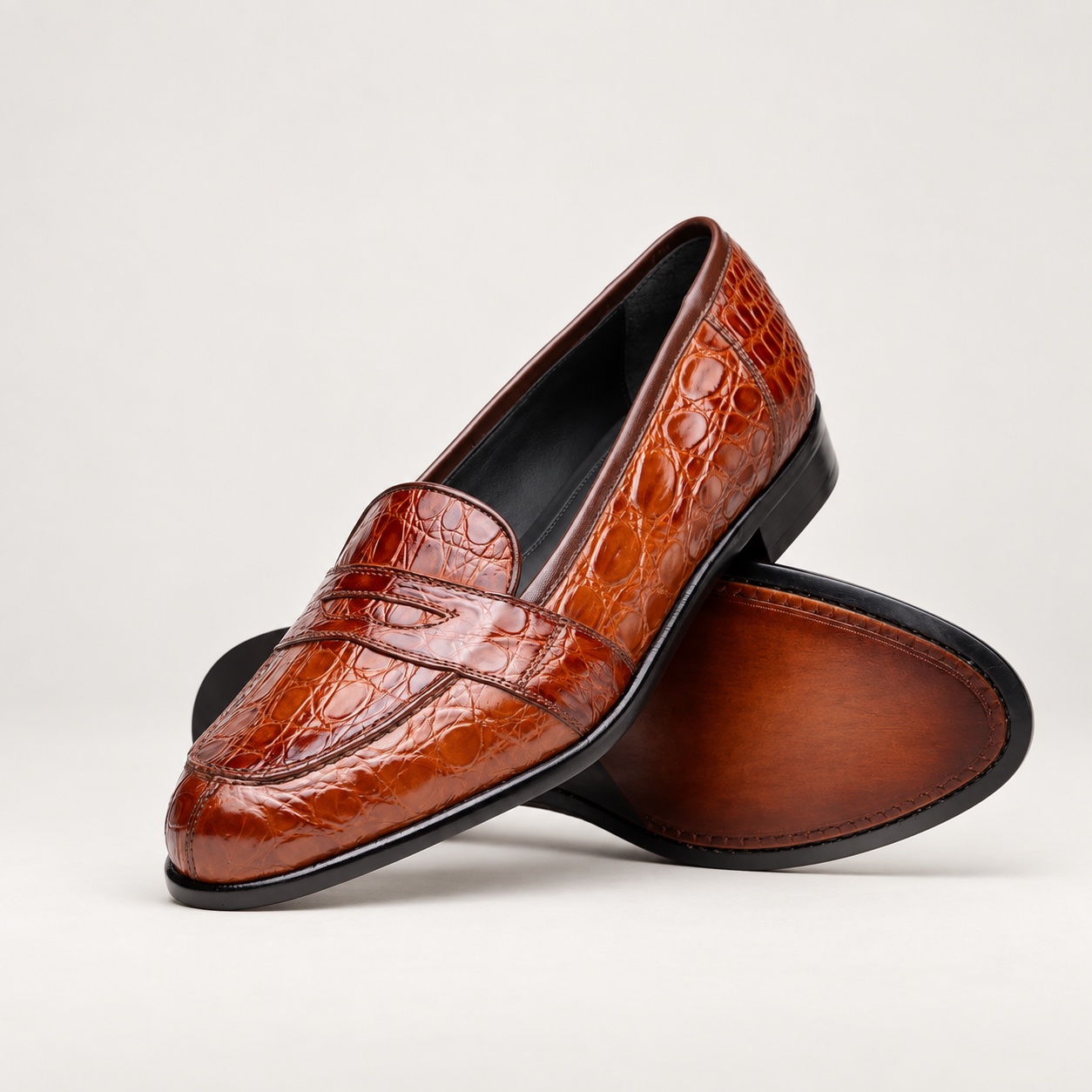
For a slip-on reference, our Polished Cognac Crocodile Penny Loafers show a penny strap, a polished cognac upper and black cowhide lining. The catalogue identifies the upper as crocodile leather and lists EU 38–46, with sizing reviewed before confirmation. Use the reference to discuss the appearance and your experience with loafers, not to assume a particular fit.
For the alternative closure, look at the Polished Black Alligator Lace-Up Shoes. These are alligator, not a second crocodile product: the catalogue specifies an alligator upper, dark grey cow suede lining and EU 38–46. They illustrate a different fastening and a darker visual direction. The comparison does not establish a comfort difference between the two leathers.
Try looking at each reference with the trousers you expect to wear. You can place the product photograph beside a photograph of the outfit; it isn't a fitting simulation, but it can help you notice whether the colour or silhouette is doing the work. If you like the cognac colour but prefer laces, say exactly that. It is a request to review feasibility, not evidence that the combination is already available.
Also separate what the gallery shows from what you still need to ask. The black pair has no underside photograph, so the gallery does not establish its outsole material or attachment. The cognac pair's brown sole appearance is a finish preview, not a construction specification.
Both galleries disclose digital edits, including background and requested appearance adjustments. Use them as style references. Ask for the final specification and the appearance review appropriate to your order; don't assume the photographed scale arrangement will be repeated exactly on another pair.
What to settle before one pair is made
Once you've chosen a direction, keep the first discussion focused. For example: “I prefer the cognac penny loafer, but my current loafers lift at the heel. Is this a suitable reference to investigate, and what would you need to review before taking an order?” That is a better starting point than requesting six colours while the central fit question is unanswered.
Separate your brief into must-haves and preferences. A fastening you can manage easily or a fit issue you need assessed belongs in the first group. A particular shade, strap treatment or scale arrangement may be a preference. If the proposed design cannot meet a must-have, another photograph of attractive leather doesn't resolve the problem.
Ask whether an existing fitting option, an in-person fitting or a trial stage is available for your situation. Do not assume a trial pair, individual last, free remake or unlimited revision is included in “made to order.” Get any proposed route, charge and limitation stated before you rely on it. If no workable fitting route is offered, it is reasonable to pause rather than turn uncertainty into an expensive experiment.
The same applies to changes after approval. If you approve a slip-on and later decide you need a lace-up, ask what that means for the specification, price and schedule. Don't assume a change of fastening is a minor cosmetic revision. Agree on the point at which the design is settled.
We accept enquiries for one personal pair. The next step is still a reviewed quotation, not an automatic promise that every combination can be made. Share your delivery country and any event date early so the relevant delivery and documentation requirements can be checked for the proposed order.
For the rest of the purchase details, use the one-pair crocodile shoe quote checklist. It covers the specification, charges, approvals and after-sales questions without making you start the style decision again.
A useful try-on is more than standing in a mirror
Before a fitting or delivery, agree on how you may try the shoes and what happens if a concern remains. A short indoor fitting, a trial service and wearing a finished custom pair for a day are not interchangeable. Custom-order terms need to be clear before the order, not discovered after a problem.
For initial handling, a shoemaker's trying-on-at-home guidance offers a sensible distinction between trying shoes and wearing them out: use a shoehorn, open the fastening properly, and take only a few steps on a suitable clean indoor surface. Its own returns arrangements do not become our policy. Follow the conditions agreed for your particular pair.
Use the intended socks and assess both shoes. Note how the fastening feels before you start changing things to make a preferred pair work. If there is a problem, record the location and the movement that reveals it. A clear observation gives the person reviewing the fit something to discuss; “I think they're fine” doesn't help if you are already making a compromise.
Don't add pads, alter the shoes or have them stretched before checking with the seller about the concern and the agreed terms. Stop if the fitting is painful. There is no value in turning a brief assessment into an endurance test, especially when you still need advice on what you are feeling.
Keep the fit review separate from the appearance review. You might love the scale layout and dislike the hold at the heel. Or the fit discussion may be straightforward while the colour needs clarification. Record each issue on its own so one attractive detail doesn't quietly overrule everything else.
Send the question you haven't been able to answer
You don't have to arrive with a final design. Two references and an honest account of how your existing shoes fit are enough to begin a useful conversation. If you've only worn trainers recently, say so; don't choose a dress-shoe size just to fill an empty box.
A first message can be this simple:
I'm choosing one personal pair and deciding between a crocodile penny loafer and a lace-up style. I usually wear [size and size system] in [the shoe I actually wear]. My main concern is [heel movement, pressure over the instep, or another specific issue]. I plan to wear the new pair for [use], with [socks]. Delivery would be to [country]. Which reference should we assess first, and what remains to be confirmed before I order?
Add a product link if you have one. If there is a deadline, include it as a date rather than “soon.” If you aren't sure whether the material must be crocodile or whether you would consider alligator, keep that as a separate question from the fastening and fit.
The right first purchase isn't necessarily the most unusual pair in the catalogue. It is the pair whose purpose you can explain, whose unresolved details have been discussed, and which you can picture wearing on an ordinary day you actually have. Start there. The colour can still be interesting.