
Alligator vs Crocodile Shoes: Which Skin Fits Your Custom Pair?
Part of: Exotic Leather Guide
Neither alligator nor crocodile is automatically the better shoe leather. For a custom pair, the useful comparison is the exact species offered, the section of skin available, the finish, the proposed panel layout, the shoe construction, your intended use, and the evidence that will follow the order. If a seller can only say “alligator is more luxurious” or “crocodile is tougher,” you still do not have enough information to choose.
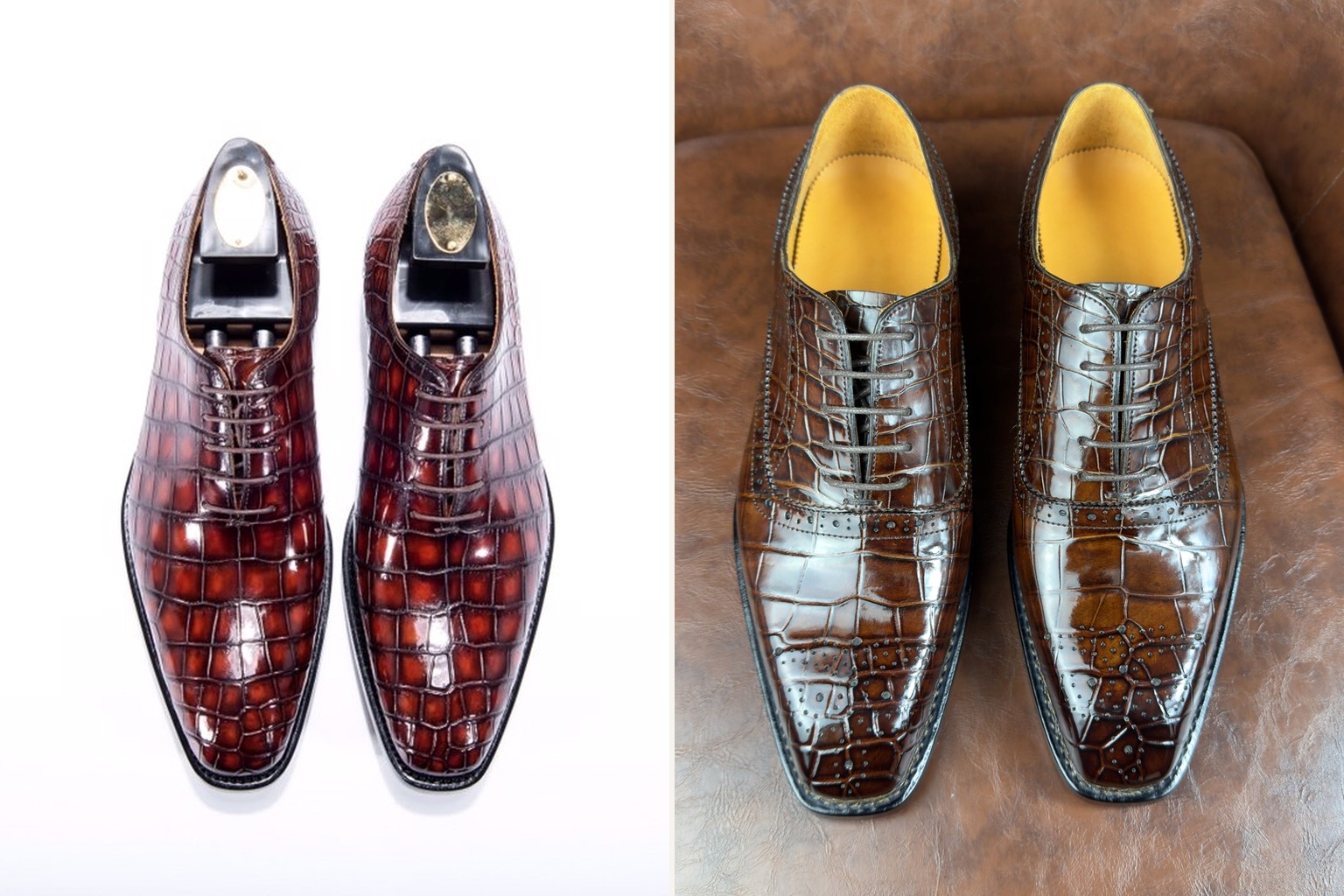
That answer may feel less satisfying than a neat winner. It is also much safer for your money. A personal pair uses small, curved panels; dye and glaze can change what the grain looks like; and the most recognizable part of a hide may never appear on the finished shoe. The sensible decision is not “Which animal sounds more premium?” It is “Which documented material and approved layout give me the pair I actually want?”
If you are still collecting visual references, compare the current alligator shoe styles with the crocodile shoe styles. Use those pages for silhouette, color and finish ideas—not as a substitute for the material declaration on your own order.
Alligator vs crocodile shoes: what can you really see?
There are real anatomical clues, but the internet often turns them into rules that are far too confident. The Louisiana Department of Wildlife and Fisheries describes an umbilical scar as a useful alligator feature. It also explains that crocodile skins have small integumentary sensory organ pores in their scales, while alligator and caiman skins do not. The IUCN Crocodile Specialist Group uses the same presence-or-absence distinction in its commercial hide identification material.
Now the awkward part: those clues may be absent from the specific panels used in a shoe. The umbilical area might not be cut into the vamp. Pores can be difficult to see after finishing. A toe, quarter or strap gives you only a small body region, and several panels may be paired for appearance rather than for biological identification. Even good close-up photographs can be inconclusive.
One official detail is especially useful because it punctures a common sales line. Louisiana’s guide says American alligator has a slightly less even tile pattern than crocodile. Yet many retail comparison pages say the opposite. This does not make every alligator shoe irregular or every crocodile shoe uniform. It shows why “symmetrical means alligator” is a poor buying rule.
Use visual clues to notice questions, not to close them. The site’s real-versus-embossed crocodile guide explains the separate problem of genuine crocodilian material versus an embossed surface. Species comparison and genuine-versus-embossed verification are related, but they are not the same decision.
Where does caiman fit into the comparison?
Caiman should not be treated as a casual synonym for alligator or crocodile. All three are crocodilians, but they are not one interchangeable material name. Louisiana’s official guide notes that alligator and crocodile belly skins are smooth and pliable, while caiman belly skin contains bony plates called osteoderms that can make it stiffer and prone to cracks between the scales.
That does not make every caiman product “bad.” It means the buyer should know what is actually being quoted and whether it suits the shoe design. A stiff or heavily structured product may tolerate one material differently from a soft loafer with a close flex point. If a quote says only “genuine crocodile pattern leather,” ask whether the material is crocodile, alligator, caiman, another leather embossed with a crocodilian pattern, or a non-leather material.
Why finish and panel placement can matter more than the species stereotype
Imagine two pairs. One uses a high-gloss finish, broad central scales on the vamp and tightly matched left-right panels. The other uses a quieter matte finish, smaller side sections and more visible natural variation. Most people will notice those choices before they identify a species.
A glaze can sharpen reflections and make each tile look more graphic. A matte finish can make the same surface feel calmer. Dark color can hide some variation; lighter or shaded finishes may reveal more. The toe shape stretches and curves the panel over the last. Brogue perforations, seams and toe caps divide the grain. None of these changes the species, but all of them change how the finished pair reads.
For a custom order, ask for a panel map rather than a promise of “perfect scales.” A panel map says which visual zone matters most—the vamp, toe, quarters, tongue, strap or back—and what level of left-right variation you will accept. Natural material will not repeat like printed vinyl. The goal is an approved visual range, not a claim that two skins can be made identical.
| Decision | What to compare | What not to assume | Record to request |
|---|---|---|---|
| Species | Proposed common and scientific name, where available, plus the exact product description | A grain adjective or one finished photo proves species | Written material declaration tied to the quote and order |
| Appearance | Selected skin or material reference, body region, panel size, pattern direction and pairing | All hides of one species have one uniform look | Marked panel proposal and accepted variation |
| Finish | Matte, satin or gloss direction; color reference; lighting used for approval photos | Gloss proves quality, or matte proves durability | Approved swatch or dated sample reference |
| Wear | How often you will wear the pair, climate, walking conditions and care tolerance | One species is universally waterproof or indestructible | Written use and care expectations |
| Custom fit | Last, size, width, foot measurements, known fit issues and fitting route | Premium leather can compensate for a poor last | Fit brief and agreed alteration/remake boundary |
| Delivery | Species, source, origin, exporter, importer, destination and current route requirements | A label or tag guarantees clearance or product quality | Order-specific document responsibility plan |
Which one is better for a personal custom pair?
Start with the shoe you want to wear, not the animal name. A formal Oxford with a clean toe may need a different material allocation from a soft loafer, a boot or a pair designed around dramatic texture. Send the intended style, finish and use, then ask what exact material is available for those panels.
- If visual balance is your priority: ask to see the proposed material and marked cutting areas before cutting. State which panels must feel related and where more natural variation is acceptable.
- If understated wear is your priority: discuss finish, color, toe shape and seam layout. “Alligator” alone does not define a quiet-looking shoe.
- If a bold pattern is your priority: identify the panel where that character should appear. Do not assume a catalogue pair can be reproduced from a different individual skin.
- If frequent wear is your priority: discuss construction, flex zones, sole choice, weather exposure and aftercare. Species is only one part of durability.
- If certainty is your priority: spend more time on the written material record, selected-panel evidence and approval gates than on comparison-page adjectives.
There is no shame in choosing by appearance. Exotic leather is partly an aesthetic purchase. The mistake is paying a premium for a name while leaving the visible result, fit and evidence undefined.
What changes the price of custom alligator or crocodile shoes?
A responsible quote cannot be reverse-engineered from species alone. The usable area and condition of the offered material matter. So do the size of the panels, how tightly the pair must be matched, the amount of cutting yield sacrificed to a preferred layout, the finish, lining, construction, sole, last work, fitting or sample stages, authorized branding, packaging, quality evidence and destination route.
One personal pair also has a different cost structure from a repeatable small run. Pattern and last review, material reservation, component access and approval work still happen even when there is only one final pair. That is why a low headline price, without an exact specification, is not yet a comparable quote.
Ask every seller to quote the same brief. If one quote includes selected-panel approval, fit review and pre-shipment evidence while another includes only “brown crocodile shoes,” the totals are not measuring the same job.
What proof should you request before any skin is cut?
“Send me a certificate” is not specific enough. A tag or export document may support a legal traceability process, but it does not tell you whether the vamp placement, finish or fit matches your order. The U.S. Fish and Wildlife Service, for example, explains the role of state CITES tagging programs for American alligator skins. That is a traceability control; it is not a shoe-quality grade.
Before cutting, ask for a small but connected evidence set:
- The exact material description proposed for the order, including common and scientific species name when genuine crocodilian leather is offered.
- The source/origin information and the exporter, importer and destination assumptions that need route-specific review.
- A photograph or reference for the actual material allocation when available, with the proposed panels marked if placement matters.
- The approved color and finish reference under a stated lighting setup.
- The written rules for substitutions. “Equivalent exotic leather” is not precise enough.
- The decision date and the person authorized to approve the material, fit sample and any later deviation.
If the pieces are too small or the finish hides diagnostic features, visual identification may remain uncertain. A published mass-spectrometry study found that laboratory marker peptides could discriminate several crocodilian species in leather. The practical lesson is not that every retail buyer needs a laboratory test. It is that a photograph is not the highest possible level of evidence. When the financial or legal risk justifies more certainty, ask the relevant authority or a qualified laboratory what method fits the processed material.
A custom-pair workflow that keeps the decision under your control
The process below is deliberately plain. It gives both sides fewer opportunities to remember the order differently.
- Define the use. Say whether this is an occasional formal pair, regular office wear, travel shoe, statement loafer or another use. Mention climate and likely water exposure.
- Choose the shoe before the skin. Set the silhouette, toe, closure, sole and construction direction. A beautiful hide cannot solve an undefined product.
- Name the material. Put the proposed species or the actual embossed base material in the quote. Do not accept “crocodile style” as a species declaration.
- Approve the visible plan. Review the material reference, panel map, color, finish and acceptable natural variation before cutting.
- Build the fit record. Provide separate left/right measurements, usual sizes, a known well-fitting shoe and fit preferences using the custom-shoe measurement guide. Remote measurements reduce guesswork but cannot guarantee fit.
- Approve the sample or reference. Give it a dated ID. Record what is approved and what must change. The custom crocodile shoe sample workflow gives the full hand-off checklist.
- Confirm the production input. Before the final pair is made, confirm that the allocated material and current specification still match the approved record.
- Review the finished pair and documents separately. Appearance and workmanship approval do not replace the route-specific document check, and document presence does not prove the shoe matches the sample.
Keep three approval gates separate
| Gate | What you decide | Evidence worth keeping |
|---|---|---|
| Sample or reference approval | Fit direction, silhouette, construction, material description, panel layout, color, finish and accepted variation | Dated sample ID, measured points, marked photos and open-correction list |
| Production release | The actual material allocation and components are consistent with the approved reference; substitutions are resolved | Material/panel reference, current specification revision and written release |
| Pre-shipment acceptance | The finished pair matches the approved record and all open findings have a disposition | Left/right views, close-ups, measurements where agreed, packing view, deviation log and separate document review |
A single “looks good” message should not cover all three gates. If the material changes after sample approval, the production release must reopen that question. If a document is still pending, the attractive finished-pair photos do not close it.
What to send us for a useful one-pair review
You do not need a technical package to begin. You do need enough context for an honest feasibility reply. Copy this and fill in what you know:
Subject: Personal custom exotic-leather shoes — feasibility review
Shoe: Oxford / derby / loafer / boot / other
Use: how often, where and in what weather
Material: alligator / crocodile / caiman / unsure; please state the exact proposed material
Look: color, matte/satin/gloss, quiet or bold pattern, and the most important panel
Fit: usual size, known well-fitting shoe, separate left/right measurements and any recurring fit issue
Construction: preferred sole or construction, or options requested
Reference files: images I own or am authorized to use, with the features I like marked
Destination: country and state/province where relevant
Approval: what can be reviewed before cutting, what becomes the approved reference, and what finished evidence will be supplied
Unknowns: please identify any missing input, conditional price/timing item, substitution rule or route-specific document question
Send that brief through the Buyer Portal. If you want one personal pair, say so in the first line. Availability, material allocation, price, timing and shipment path still need a project-specific confirmation; a website article cannot approve a transaction.
Care and delivery are part of the buying decision
Do not wait until the pair arrives to ask how it should be worn and stored. Frequent rain, strong heat, rough walking and long periods in a sealed or damp space can change the practical choice of finish, sole and use. Ask what aftercare is appropriate for the approved finish, and keep the answer with the order record. The crocodile-leather care guide covers water exposure, drying and storage without pretending that one home treatment fits every finish.
For international delivery, species, source, origin, exporter, importer, product form and destination can affect the route. The CITES planning checklist helps organize those questions, but current requirements must be confirmed with the responsible authorities and parties for the actual shipment. No article, tag or seller statement can guarantee border clearance.
Questions buyers ask before ordering
Are alligator shoes better than crocodile shoes?
Not as a universal rule. Compare the exact offered material, usable section, finish, panel layout, shoe construction, fit process, evidence and intended use. A well-specified pair in either material is a better purchase than an expensive name attached to an undefined order.
Can I identify alligator or crocodile shoes from the scale pattern?
Sometimes the pattern raises useful questions, but a finished shoe may omit the diagnostic body region and the finish can obscure details. Pores and an alligator umbilical scar are recognized clues, yet photographs of small processed panels may be inconclusive. Use the material declaration and traceable order records; escalate to a competent authority or qualified laboratory when the risk requires stronger identification.
Is caiman the same as crocodile leather?
No. Caiman, alligator and crocodile are different crocodilian groups and should not be used as interchangeable sales names. Ask for the exact proposed material. Caiman belly can contain bony plates that affect flexibility, so suitability depends on the panel and shoe design.
What should I approve before a custom exotic-leather shoe is made?
Approve the material description, selected skin or reference, panel map, color and finish, shoe specification, fit inputs, sample or dated reference, accepted natural variation, substitution rule and separate production-release and pre-shipment evidence. Review route-specific shipment documents as their own workstream.
Official sources behind this guide
- Louisiana Department of Wildlife and Fisheries: Crocodilian Leather Features — anatomy, skin pattern, pores, umbilical scar and caiman osteoderms.
- IUCN Crocodile Specialist Group: Identification of Crocodilian Hides and Products — commercial-hide identification by taxonomic group and body region.
- U.S. Fish and Wildlife Service: American Alligator CITES Export Programs — the traceability role of state tagging programs.
- Rapid authentication of five crocodilian leather species by MALDI-TOF mass spectrometry — evidence that laboratory methods can distinguish species when visual screening is insufficient.
Source boundary: these references support anatomical clues, identification limits, traceability context and the existence of laboratory authentication methods. They do not certify any catalogue photograph, current stock, customer order, price, delivery route or finished product on this website.