
How Crocodile Leather Is Cut for Shoes: Panel Placement, Pair Matching and Cost
Part of: Exotic Leather Guide
Crocodile leather is not cut by finding the biggest empty space and placing a shoe pattern on it. The cutter first reads the skin, marks defects and usable zones, decides which scales should appear on the most visible panels, then plans the left and right shoe together. Tighter matching and larger uninterrupted panels can improve the look, but they reduce usable yield and can raise the cost.
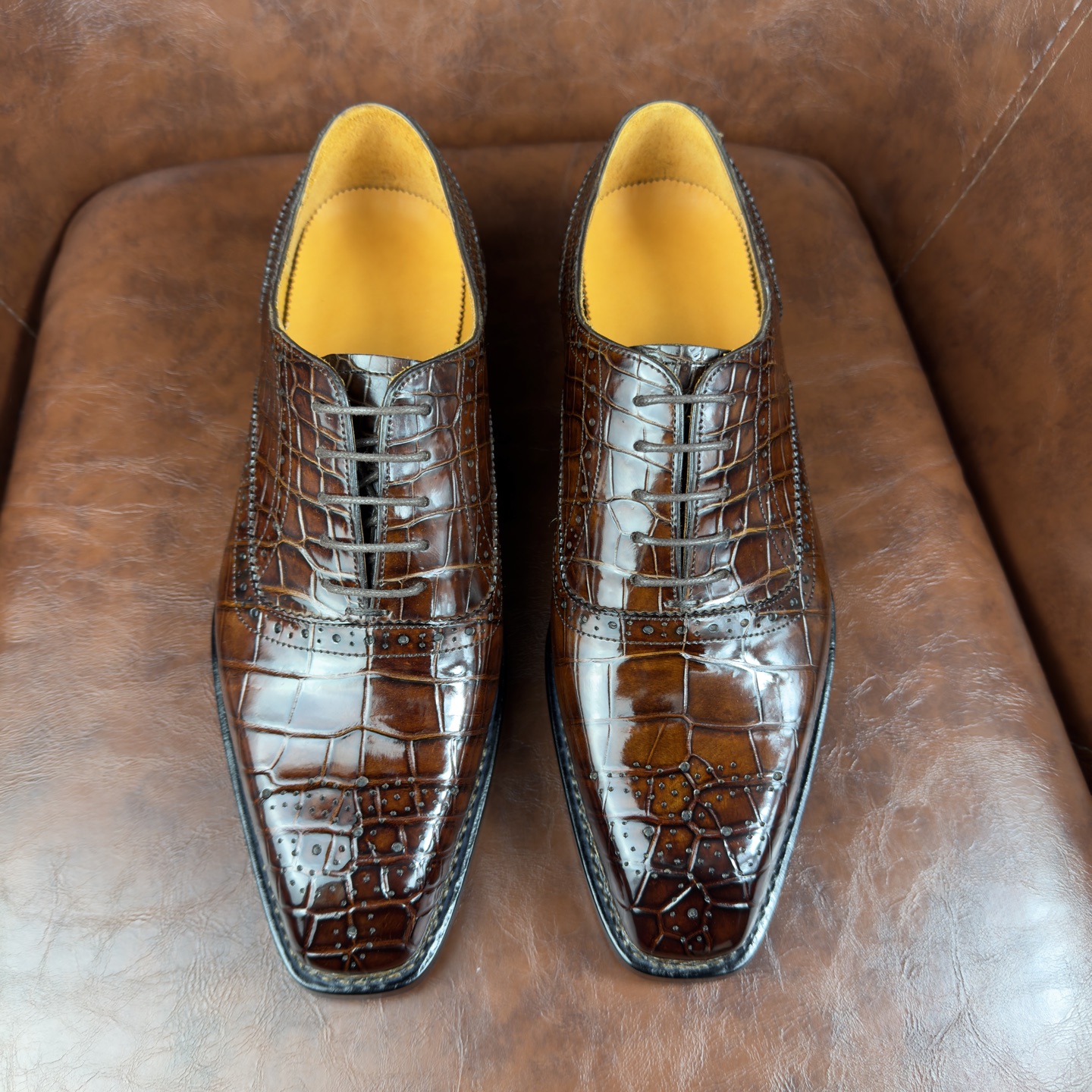
That is the short answer. The useful answer is a little more human. When a customer sends us a reference photo, the first comment is often, “I want the pattern to look exactly like this.” We understand why. The scale layout is what makes the shoe memorable. But every natural skin has its own map. A good cutter does not copy that map; the cutter interprets it for the new shoe.
This guide is for someone ordering one personal pair as well as a designer planning a small run. It explains what happens before cutting, where the best-looking areas normally go, what “matching” can honestly mean, and which choices affect the quote. If you are deciding between material names rather than cutting layouts, start with our alligator versus crocodile custom-shoe guide. Here, we stay with the cutting-room problem.
What happens before the first crocodile panel is cut?
The shoe pattern is already divided into pieces: vamp, toe cap if the design has one, quarters, tongue, facings, straps and smaller trims. The cutter does not treat those pieces as equal. Each has a different visibility, curvature, flex requirement and seam relationship. A broad wholecut vamp asks for a very different leather map from a brogued Oxford whose seams divide the surface.
Before placing any template, the skin is viewed as a complete working surface. The cutter checks scale size and direction, color consistency, finish, thickness, softness and any holes, scars or weak areas. The Northern Territory Government’s crocodile-industry report notes that grading considers blemishes, scarring and scale pattern, and that a skin’s grade can change after tanning. That matters because a clean-looking raw area is not the only question; the finished leather in front of the cutter is the real input.
Professional cutter training describes the same practical habits in plain terms: read the leather, detect natural defects, judge color harmony and position pieces before cutting. Footwear production then continues through closing, lasting, sole attachment and finishing, as the Skills England footwear standard outlines. Cutting is therefore an early decision with consequences for every later stage. Once the prized central area has been used for the wrong piece, no finishing department can put it back.
Which shoe panels usually receive the best-looking area?
There is no universal rule, because “best” depends on the design. Still, buyers usually notice the front of the shoe first. On an Oxford, derby or loafer, the vamp and toe area dominate the view from above. Those panels often receive the clearest, most balanced section available. Quarters and back pieces can accept more gradual changes, especially when seams break up the surface.
A tassel loafer creates another choice. Should the calmest scale field sit under the tassels, where part of it will be covered, or should the most characterful area be saved for the exposed toe? A monk strap may need a visually quiet strap so the buckle sits cleanly. Boots require larger and taller sections, which can make strict repetition harder. Women’s shoes with narrower toes, cut-outs or multiple small overlays may use the same skin very differently from a men’s wholecut.
This is why we ask customers to rank their priorities. If your answer is “the toe must have broad, centered scales,” that can guide the cutter. If everything must be the number-one panel, the plan may become wasteful or simply impossible. A marked panel map is more useful than the phrase “use the best leather everywhere.”
How is panel placement planned on a natural skin?
Think of panel placement as a conversation between the shoe pattern and the skin. The cutter moves physical or digital templates over the leather, watching where scale lines will begin and end after stitching and lasting. The pattern must include the required cutting allowance; the visible edge in a finished shoe is not the same as the edge of the raw component.
Direction matters. A panel can be clean in isolation but look awkward when its scales run against the neighboring piece. Centering matters too, especially on a plain vamp. Yet perfect geometric centering is not always the most attractive choice. Moving a template slightly may create a calmer transition, avoid a blemish or preserve a stronger area for the second shoe.
The cutter also has to imagine the three-dimensional result. Lasting pulls a flat upper over a curved last. A scale field that appears evenly spaced on the table may open, compress or tilt around the toe. Experienced placement leaves room for that change. The job is not simply to photograph a nice flat layout; it is to make a balanced pair after the uppers have been closed and lasted.
What does left-and-right pair matching really mean?
Pair matching means visual relationship, not photocopy identity. The left and right vamps should normally have a compatible scale size, direction, color and overall rhythm. Their key features can be placed at similar positions, but natural tiles do not repeat like a printed pattern. Asking for exact mirror images can create an expectation no honest cutter should promise.
There are several sensible matching levels. A relaxed match keeps color and general character consistent while accepting more scale variation. A balanced match aligns the dominant scale direction and visual weight on the main panels. A selective match reserves closely related zones for the vamps and accepts more variation on quarters, tongues or covered areas. Which one is right depends on how formal the shoe is, how bold the grain is and what you are willing to spend on usable yield.
Look again at the pair in the photograph. The shoes belong together immediately. The front panels share a similar visual weight, and the lace areas speak the same language. But individual tiles differ. That is a normal, appealing result. Matching should make the pair feel intentional without erasing the fact that the material is natural.
Why can a beautiful skin still be difficult to cut?
A skin can be attractive as a whole and still have limited shoe yield. The visual center may be narrow. A small scar may sit exactly where a vamp needs to go. Color may deepen toward one side. Scale size can change across the body. The finish can reveal a blemish that was less obvious earlier. None of these automatically makes the skin unusable; they affect which components it can supply.
Shoe size matters as well. A larger vamp needs a larger uninterrupted zone. A wide last, long toe or high boot shaft increases that demand. A design with more seams may use smaller zones efficiently, while a wholecut or very plain design exposes more leather and gives the cutter fewer places to hide a transition. Broguing can decorate the surface, but perforations do not repair a weak section.
This is where photographs can mislead. A close crop of one attractive area does not show whether enough compatible leather exists for both shoes. Before cutting, the useful evidence is a view of the proposed material allocation with the important panels marked, not only a beauty shot of one corner.
How do design choices change leather yield and cost?
Material cost is partly a yield problem: how much of the available skin can become approved shoe components. Every restriction narrows the usable map. Large seamless panels, strict scale centering, very close left-right matching, avoidance of all visible natural marks and a specific scale size can each remove otherwise serviceable areas from consideration.
| Choice | What it gives you | Effect on cutting | Question to settle |
|---|---|---|---|
| Large wholecut or plain vamp | An uninterrupted, dramatic surface | Needs a larger clean zone and fewer placement options | Is the seamless look more important than tight scale matching? |
| Toe cap and additional seams | More structure and smaller visible fields | Can improve use of smaller zones, but every seam must still look intentional | Where may scale direction change? |
| Very close pair matching | A formal, controlled left-right appearance | Rejects more usable placements and may require more material choice | Which panels need the closest relationship? |
| Bold central scales | A strong visual statement on the vamp or toe | Reserves a limited zone for one priority area | Should the toe, vamp or strap get that feature? |
| Accepting natural variation | A more organic pair with its own character | Lets the cutter use sound areas more efficiently | What variation is acceptable before cutting? |
A higher-yield design is not automatically inferior. Sometimes an extra seam makes the shoe more coherent and uses the leather responsibly. Conversely, paying for tighter selection does not guarantee a better fit or construction. It buys a narrower visual brief. Keep appearance, fit and workmanship as separate decisions.
What should a crocodile-shoe quote explain?
A useful quote should describe the shoe, not just name the animal. It should identify the style and size range, construction, lining, sole, finish, color direction, panel priority and expected matching level. It should also state whether the work is one personal pair, an approved sample or a repeatable small run.
The main cost drivers are the available material grade and usable area, panel size, matching tolerance, design complexity, last or pattern work, sample and approval stages, component choices, quality records, packaging and destination-specific handling. Quantity changes how setup and material reservation are spread, but it does not remove the need for an exact specification. We can review a request beginning with one pair as well as small wholesale quantities; material availability, price and production route are confirmed for the actual project.
Be cautious with two quotes that use the same phrase but include different work. “Brown crocodile Oxford” might mean a standard last and relaxed match in one quote, while another includes fit review, selected-panel approval and pre-shipment close-ups. The totals are not comparable until the included decisions are comparable.
What should you approve before cutting starts?
The safest moment to solve a visual disagreement is while every panel is still a template. Ask for the proposed material reference and, when placement is important, a marked layout showing the priority panels. Approve the color and finish reference, the accepted range of natural variation and what happens if the allocated material changes.
Keep three gates separate. A sample can approve proportions and a visual direction without approving every future skin. Production release confirms the actual inputs for the pair or run. Pre-shipment review checks the finished work against the approved record.
| Gate | What to check | Useful record |
|---|---|---|
| Sample or reference approval | Silhouette, fit direction, construction, finish, panel priorities and acceptable variation | Dated sample ID, marked photos and a correction list |
| Production release | Actual material allocation, marked main panels, components, current specification and any substitution | Approved layout or material reference tied to the order revision |
| Pre-shipment acceptance | Left-right relationship, workmanship, color under consistent light, agreed measurements, packing and open deviations | Full-pair views, close-ups, measurement record where agreed and disposition log |
For a repeat order, do not write “same as last time” and stop there. Refer to the approved sample ID, then define which natural differences may change. For a clearer hand-off, use our reference-to-approved-sample workflow. If fit is also being customized, send separate left and right information using the foot-measurement guide; beautiful panel placement cannot compensate for the wrong last.
What photos help—and what can they not prove?
Good photographs can answer practical questions: Is the proposed vamp centered? Do the left and right pieces have similar visual weight? Is a scar outside the visible line? Does the finish look consistent under the same light? Ask for a full view first, then close-ups. Close-ups without context make it difficult to understand where the piece sits.
Photos do not by themselves authenticate species, legal origin or chain of custody. The real-versus-embossed crocodile guide explains why surface clues are screening tools, not a complete proof system. The Leather Working Group describes traceability as a connected physical or documented chain. For regulated crocodilian trade, universal tagging records include identifiers such as origin, serial number and species code. Those records are handled with the order and shipment; they should not dominate the design conversation or be mistaken for a shoe-quality grade.
What should you send for an accurate cutting and cost review?
You do not need to speak like a pattern engineer. A clear customer brief is enough to start. Copy this into an email or the Buyer Portal:
Subject: Crocodile shoe panel and quote review
Order: one personal pair / sample / small run
Style: Oxford / derby / loafer / boot / women’s shoe / other
Size and fit: usual size, width, known good-fitting shoe and any recurring fit issue
Design: toe shape, seams, broguing, straps or other details
Material: genuine crocodile requested, or please explain the proposed material clearly
Look: color, matte/satin/gloss, preferred scale size and the panel that matters most
Matching: relaxed / balanced / selective close match; please explain what is feasible
References: images I own or am authorized to use, with the features I like marked
Destination: country and state/province where relevant
Approval: what I can review before cutting, at production release and before shipment
Quote: please identify material availability, included sample or approval work, substitutions and any conditional cost or timing item
If you are still choosing a silhouette, browse the current crocodile shoe collection and tell us which toe, closure and scale character you prefer. Catalogue photographs are references, not a promise that another natural skin will repeat the same pattern.
Frequently asked questions about cutting crocodile leather for shoes
Can the left and right crocodile shoes have exactly the same scales?
No honest maker should promise photocopy-identical natural scales. The realistic goal is a planned relationship in scale size, direction, color and visual weight. Tell the cutter which panels need the closest match and where more natural variation is acceptable.
Does tighter scale matching always make crocodile shoes more expensive?
It can increase cost because fewer placements meet the brief and usable yield may fall. The effect depends on the skin, shoe size, panel shapes and matching level. Ask for the matching standard to be written into the quote instead of assuming “premium” includes it.
Which part of the shoe should get the best crocodile panel?
Usually the vamp or toe receives priority because it is seen first, but the design decides. A strap, boot shaft or wholecut side may be more important to you. Rank the visible panels before cutting so the limited feature area is used where you will value it.
Can a scarred area still be used?
Sometimes it can be moved into a hidden or low-stress component; sometimes it should be excluded. Location, depth, finish and the panel’s function matter. A marked layout lets you approve the visible result without demanding that every harmless natural mark disappear.
Can I order one pair, or is this only for wholesale buyers?
You can request a review for one personal custom pair, a development sample or a small wholesale run. Feasibility, material allocation, quote and approval route are confirmed case by case. Send the style, size, destination and matching priorities first.
Sources and evidence boundary
- Northern Territory Government: Economic Contribution of the NT Crocodile Industry — skin grading factors, post-tanning variation and product use.
- École Hermès: Cutter training — reading leather, finding natural defects, judging color harmony and positioning pieces before cutting.
- Skills England: Footwear manufacturer occupational standard — the relationship between cutting, closing, lasting, sole attachment and finishing.
- Leather Working Group: Chain of Custody — the distinction between connected traceability records and visual product inspection.
- CITES Resolution Conf. 11.12 — universal crocodilian skin tagging fields used in regulated trade.
Evidence boundary: these sources support the process and traceability principles in this guide. They do not certify the catalogue photograph, current stock, a future skin allocation, a customer order, a quote or a delivery route. Those details must be confirmed for the actual project.