
Real vs Embossed Crocodile: How to Verify Before You Pay
Part of: Exotic Leather Guide
Imagine receiving two quotations for the same loafer. Both suppliers send polished close-ups of a glossy, scale-patterned upper. One quotation says “genuine crocodile.” The other says “crocodile-embossed cowhide.” You zoom in, compare the squares, and still cannot answer the question that matters: what material will actually be used in the product you pay for?
Appearance photos can raise useful questions, but are not conclusive proof of base material or species. Before approving a crocodile leather shoe, bag, belt, or wallet, put five points in writing:
- the actual base material;
- whether the surface is natural, printed, embossed, or otherwise processed;
- the common and scientific species name, if natural crocodilian leather is claimed;
- the exact components covered by that claim; and
- the SKU, batch, source, and shipment records that must match the finished goods.
Approve a dated sample and check production against it. That is more useful than a visual shortcut when money, labels, customs documents, and customer trust are involved.
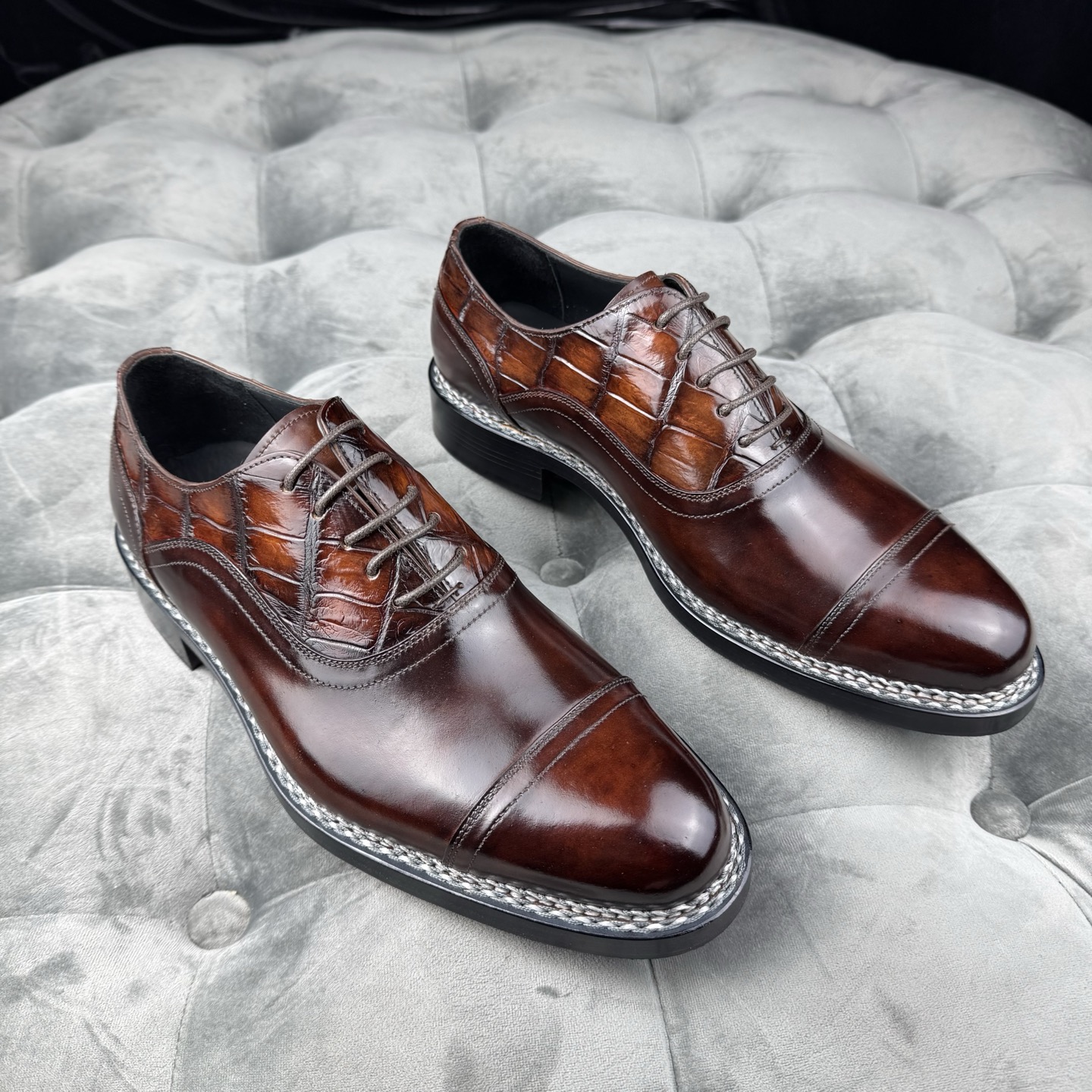
First, separate appearance from composition
“Crocodile look” describes an appearance. It does not tell you what is underneath the finish.
A crocodile-look material may be cowhide, calfskin, another leather, or a non-leather material. Its surface may be embossed, printed, or created through combined processes. When described accurately, it is a legitimate product with a different cost and repeatability profile.
A natural crocodilian material is a different claim. “Crocodile,” “alligator,” and “caiman” should not be used as interchangeable marketing words. If a supplier makes a species claim, the written specification should state the exact common and scientific name supported by its records.
Mixed construction creates a third possibility. A bag may use a scale-patterned flap but another material on its gussets, handles, lining, or base. A shoe may limit the claimed material to certain upper panels. “Crocodile leather shoe” is incomplete unless the quotation identifies which parts carry the claim.
For products sold in the United States, the FTC Leather Guides say that when leather is embossed or processed to simulate another leather type, the actual kind and type of leather should be disclosed. The same section says that a representation about a particular part should clearly identify that part. For footwear, footnote 2 says that the presence of non-leather materials may be disclosed for three parts—the upper, the lining and sock, and the outersole—according to material predominance. The more detailed panel map recommended below is a procurement control, not a universal US panel-by-panel labelling requirement. Even when another market uses different rules, naming the base material, treatment, and component scope separately is sound buying practice.
| Wording in a quotation | What it does—and does not—tell you | What to request next |
|---|---|---|
| “Crocodile pattern” | Describes an appearance only | Actual base material, surface treatment, and components covered |
| “Crocodile-embossed leather” | Says the surface is simulated, but may still omit the leather type | Cowhide, calfskin, or other actual base leather; finish; component scope |
| “Genuine crocodile leather” | Makes a natural-material claim, but remains incomplete | Common and scientific name, source/origin, component scope, SKU or batch record, and route-specific documents |
| “Crocodile leather upper” | Limits the claim to the upper, but may still omit species and mixed panels | Exact upper panels covered, other upper materials, species record, and approved sample |
| “Crocodile trim” | May mean only a small decorative component | Location, dimensions or panel map, base material elsewhere, and quantity basis |
What photographs are good for
Photographs still have value. They can help a buyer compare:
- the overall silhouette and visible finish;
- how the pattern has been placed on the vamp, quarters, flap, or side panels;
- whether left and right shoes—or the front and back of a bag—feel visually balanced;
- color variation under a stated lighting setup;
- obvious differences between the approved sample and later production.
Request the whole item, several panels, both sides, edges or seams, and multiple units when repeatability matters. For a loose swatch, include the visible reverse or backing: it can expose layers or raise base-material questions, but it is only a screening clue and cannot identify species. Keep lighting and editing consistent.
But keep the limit clear. A repeated motif, an irregular-looking scale field, a pore-like mark, or a change in tile size may justify another question. None of those observations proves the exact species by itself. Modern surface treatments can be convincing, while natural material can be selected, cut, and finished to look unusually regular.
Even microscopy has a narrower role than many buyers assume. ISO 17131:2020 describes a microscopy method for distinguishing leather from other materials, but the standard expressly says the method is not intended to identify a particular leather type. In other words, “a lab confirmed leather” is not the same statement as “the lab confirmed this crocodile species.” If the identity remains commercially or legally important, ask the relevant wildlife authority or a qualified specialist which method is suitable for that processed material.
Build a five-line material record before you approve a quote
A long sales description is less useful than five precise lines. Put the following block into the quotation, purchase specification, sample record, invoice, and product data. The wording should remain consistent from one document to the next.
1. Base material
State what the product is physically made from: for example, cowhide, calfskin, another named leather, a named non-leather material, or a claimed natural crocodilian material. Do not write “leather” alone when the type affects price, labelling, or approval.
2. Surface treatment
State whether the visible surface is natural, embossed, printed, coated, glazed, matte, or otherwise finished. Base material and surface treatment are two different fields. “Crocodile-embossed cowhide” is much clearer than “crocodile leather.”
3. Species claim
If natural crocodilian leather is proposed, record the common and scientific name supported by the supplier’s source documents. If the material is embossed cowhide, there is no crocodile species to declare; the crocodile wording describes the simulated appearance only.
4. Component scope
List the parts covered by the claim. For shoes, this may include specified upper panels, trim, lining, sock, or another component. For bags, identify the front, back, flap, gussets, handles, base, trim, and lining as applicable. A panel map is often clearer than one broad sentence.
5. Evidence reference
Name the SKU, material lot or batch, approved sample ID, supplier declaration, bill of materials, invoice wording, and any source or shipment document that must match. The goal is not to collect a folder of unrelated PDFs. It is to connect the exact product being approved to the exact claim being made.
If a line is unresolved, mark it “pending written confirmation” rather than guessing a species.
What CITES records can prove—and what they cannot
CITES is an international convention implemented by its Parties through national laws and permit or certificate systems for trade in listed specimens. It is not a quality grade, an animal-welfare certificate, or a general factory certification.
The legal position can depend on the exact species, population or source, country of origin, export or re-export country, destination, product form, and current national rules. Check the exact scientific name in the live legal view of Species+, which provides current CITES listings, quotas, suspensions, and EU decisions. Then confirm the applicable requirements with the CITES Management Authorities and customs or wildlife authorities responsible for the exporting and importing countries.
CITES Resolution Conf. 11.12 recommends non-reusable tags for raw, tanned and/or finished crocodilian skins entering international trade from countries of origin, individual tagging for skins, flanks and chalecos, and container marking for certain skin parts. Its tagging system does not cover manufactured finished products such as shoes, belts, and handbags. For procurement traceability, ask how the finished SKU is linked to the relevant upstream skin, tag, batch, and route-specific records; do not imply that the Resolution itself requires a retail product tag.
Before payment or material cutting, the buyer and supplier should agree who will check:
- the exact scientific name and source;
- current listing, quota, suspension, and stricter domestic controls;
- required export, re-export, and import documents;
- consignee, quantity, product form, and route details;
- document validity and consistency with the final shipment.
Recheck before dispatch. A permit-looking PDF sent after the goods have already moved is not a sound approval process. Also, do not assume that a single personal order sent by courier receives the same treatment as an item carried in passenger luggage. Route and destination matter. The site’s CITES document checklist can help organize the questions, but the competent authorities decide the transaction requirements.
Most importantly, documents and quality answer different questions. A document chain may support legal-trade and traceability review. It does not tell you whether the finish is even, the panels are well matched, the construction is sound, or the bulk order follows the approved sample.
Approve the sample as a record, not just a nice object
A buyer sends “looks good.” The supplier reads that as approval of the material, construction, and variation; the buyer meant only the color. Avoid that dispute by defining the sample’s approval scope.
Give the sample a dated ID and define the approval scope. At minimum, record:
- the five-line material claim;
- the product style, last or dimensions, and construction;
- the panel map and left-right or front-back matching priorities;
- color and finish reference;
- target thickness and tolerance where relevant;
- lining, outsole, reinforcement, hardware, logo, and packaging;
- accepted natural variation and unacceptable deviations;
- photographs, measurements, bill of materials, and written corrections.
If a physical swatch is important, keep it with the sample record. If photographs are used, identify the files and lighting conditions. “Same as the photo” is not an acceptance standard.
Sample approval has limits. It does not prove that the bulk material comes from the same allocation, that every size will fit, that route-specific documents have been issued, or that production will contain no defects. It creates a dated reference against which later decisions can be made.
For a custom shoe project, the separate guide on turning a reference image into an approved sample covers fit, last, construction, and panel placement in more detail.
Keep four inspection gates separate
Do not save every question for final inspection. By then the leather has been cut, the goods have been assembled, and a preventable misunderstanding has become an expensive dispute.
| Gate | What to check | The decision to record |
|---|---|---|
| Sample approval | Material wording, component scope, appearance, finish, panel priorities, construction, dimensions, and permitted variation | Is this the reference, and what remains conditional? |
| Pre-production | Allocated material or lot, supplier declaration, bill of materials, approved sample ID, panel plan, substitutions, and document responsibilities | Are the inputs consistent with the approved record before cutting? |
| In-line or bulk review | Several units, material drift, unapproved substitutions, panel placement, pair balance, finish, dimensions, and visible defects | Is production still within the agreed range while correction is possible? |
| Pre-shipment | Finished quantity, approved deviations, labels and invoices, packaging, final document match, consignee, route, and destination | Do the goods and records match, and are the responsible parties ready to authorize dispatch? |
For a small batch, agree how units will be selected for inspection. If ISO 2859-1:2026 is used, record the lot size, inspection severity, inspection level, sampling scheme and sample size, buyer-defined defect categories and their AQLs, acceptance/rejection numbers, and any applicable switching rules. “AQL 2.5” alone is not a promise that 2.5% defective goods are acceptable, and it is not a zero-defect guarantee.
Why prices and minimums vary
Why do two crocodile-looking products cost so differently? Material identity is one reason, but price is not authentication. A low quote does not prove embossing, and a high one does not prove natural crocodile. Supplier grade and cut names are not a universal quality ladder; require written criteria.
A useful quotation separates the drivers:
- actual base material and surface treatment;
- exact species and source, when claimed and verified;
- supplier-defined grade and cut plan, including usable panel area, placement, matching, and material yield;
- finish, color, thickness target, and acceptable variation;
- product size, construction, lining, outsole, hardware, and reinforcement;
- sample work, pattern or last development, and revision rounds;
- size range, quantity, packaging, testing, and inspection;
- documentation, destination, route, and shipping requirements.
MOQ is also project-specific. A sample quantity, a material supplier’s minimum, a component minimum, and the factory’s bulk minimum are not necessarily the same number. Ask the quotation to list them separately, together with every assumption that could change the price or schedule.
This makes comparisons fair. If one supplier quotes embossed cowhide and another quotes a documented natural crocodilian upper with stricter matching, comparing only the final unit price tells you very little. Put both suppliers against the same written specification first.
Red flags worth slowing down for
Pause the order when you see any of these:
- “crocodile leather” appears without a base material, species, or component scope;
- the seller treats one polished photograph as conclusive proof;
- crocodile, alligator, caiman, and “gator” are mixed in the same record;
- the quotation, sample label, invoice, and machine-readable product data use different material wording;
- “CITES certified” is offered instead of an explanation of the route-specific permit, certificate, exemption, and supporting records that actually apply;
- paperwork is promised only after payment, cutting, or dispatch;
- a sample is approved with “make it the same” and no dated criteria;
- the price is used as the only proof of authenticity;
- the supplier refuses to state the material claim in writing.
A red flag is a reason to ask for evidence, not a verdict about the product. The right response is usually a narrower claim, a clearer record, or a pause until the missing information is available.
Email-ready request for material verification
Copy this into an inquiry and remove anything that does not apply:
Subject: Material and sample verification — crocodile-look [shoe/bag] project
Product or SKU: [reference]
Intended project: [one personal item / sample / possible small batch]
Destination country: [country and state/province if relevant]
Please state the proposed material in five lines:
- Base material: [exact material]
- Surface treatment: [natural / printed / embossed / coated / finish]
- Species, if claimed: [common and scientific name]
- Components covered: [upper panels / trim / flap / gussets / handles / other]
- Evidence references: [SKU, batch or lot, declaration, BOM, invoice wording, source and shipment records]
Please also confirm:
- which facts can be verified before payment and before cutting;
- what photos, swatches, or physical sample will be supplied;
- the sample quantity, bulk MOQ, and material or component minimums separately;
- the sample approval, pre-production, in-line, and pre-shipment checks;
- any substitutions that require written approval;
- who is responsible for checking export, re-export, import, and destination requirements;
- which price or schedule assumptions remain conditional.
This message does not accuse a supplier of mislabelling. It simply makes both sides define the same product before money and material are committed.
What to send for a useful feasibility review
Send the product reference or SKU, intended use, destination, quantity range, size or dimensions, material request, component scope, color and finish, construction, hardware, branding and packaging needs, inspection expectations, and any deadline that is genuinely fixed. If you start with a catalog image, attach the exact crocodile shoe reference or crocodile bag reference and treat it as a design starting point, not material proof.
If you do not know the scientific species name, do not guess. Ask the supplier to state the proposed claim and show which record supports it. If you are open to both natural crocodilian material and an embossed alternative, request two clearly separated specifications. That often produces a more honest comparison than asking for a single “best price.”
For a personal item, focus on the exact piece, fit or dimensions, alteration or return terms, and the courier route. For a small batch, add the size run, material allocation, matching rules, permitted substitutions, sampling plan, repeat-order needs, and who signs each production gate.
Use the Buyer Portal to request a project-specific feasibility review; availability, minimums, price, timing, and shipment requirements remain subject to written confirmation.
The buying decision in one sentence
Do not ask only, “Does this look like real crocodile?” Ask, “Can the supplier connect this exact SKU or batch to a clear material declaration, an approved sample, consistent production records, and the documents required for the actual shipment route?”
That question is harder to answer with a marketing photograph—and much easier to use when you have to approve a quote, inspect a batch, label a product, or explain the purchase to your own customer.
Fact-checking sources
- ISO 17131:2020 — microscopy can distinguish leather from other materials but is not intended to identify a specific leather type.
- ISO 2859-1:2026 — AQL-indexed sampling schemes for lot-by-lot inspection; the complete plan determines sample size and acceptance or rejection.
- 16 CFR § 24.2, FTC Leather Guides — composition, simulated-leather, embossed-leather, component-scope, and advertising disclosures for the US market.
- Species+ — current CITES listings, quotas, suspensions, and EU wildlife-trade decisions by species.
- CITES Resolution Conf. 11.12 (Rev. CoP15) — the universal tagging and tracking system for crocodilian skins and parts.
- CITES Convention text — permit and certificate framework for international trade in listed specimens.
- UK government CITES import and export guidance — an example of how route, product form, permits, stricter controls, and personal-effects rules must be checked with the relevant authorities.
Buyer FAQ
Crocodile Authenticity FAQ
Can photographs prove that crocodile leather is genuine?
Appearance photos can raise useful questions, but they cannot prove the base material or exact species. Request a written record stating the base material, surface treatment, claimed common and scientific species name, components covered, and the SKU or batch evidence that must match the approved sample and shipment.
What does crocodile-embossed leather mean?
Crocodile-embossed material has a surface pattern made to simulate a crocodile appearance; the phrase does not identify the base material. The specification should name the actual cowhide, calfskin, other leather or non-leather material, the embossed or printed treatment, and the components covered. Price and pattern appearance are not authentication tests.
What can CITES records prove for crocodilian products?
CITES and related transaction records can support a review of the declared species, source and trade route for a particular shipment. They do not by themselves prove product quality, workmanship or the material used in every component. Match the records to the SKU or batch and confirm current requirements with the responsible authorities.