
What Makes a Crocodile Bag, Belt or Pair of Shoes Luxury-Grade?
Part of: Exotic Leather Guide
Two black crocodile bags can sit side by side on our cutting-room table and one of them is worth three times the other. Same species, same color, both genuine. A customer looking at them through a shop window would struggle to say why — and that gap is exactly where the word "luxury" gets abused. We make crocodile bags, shoes and belts in Guangzhou, and this is the checklist we'd hand a friend who wanted a high-end piece: where the grade actually lives, how to see it in five minutes, and which part of a boutique price tag the object itself can and can't explain.
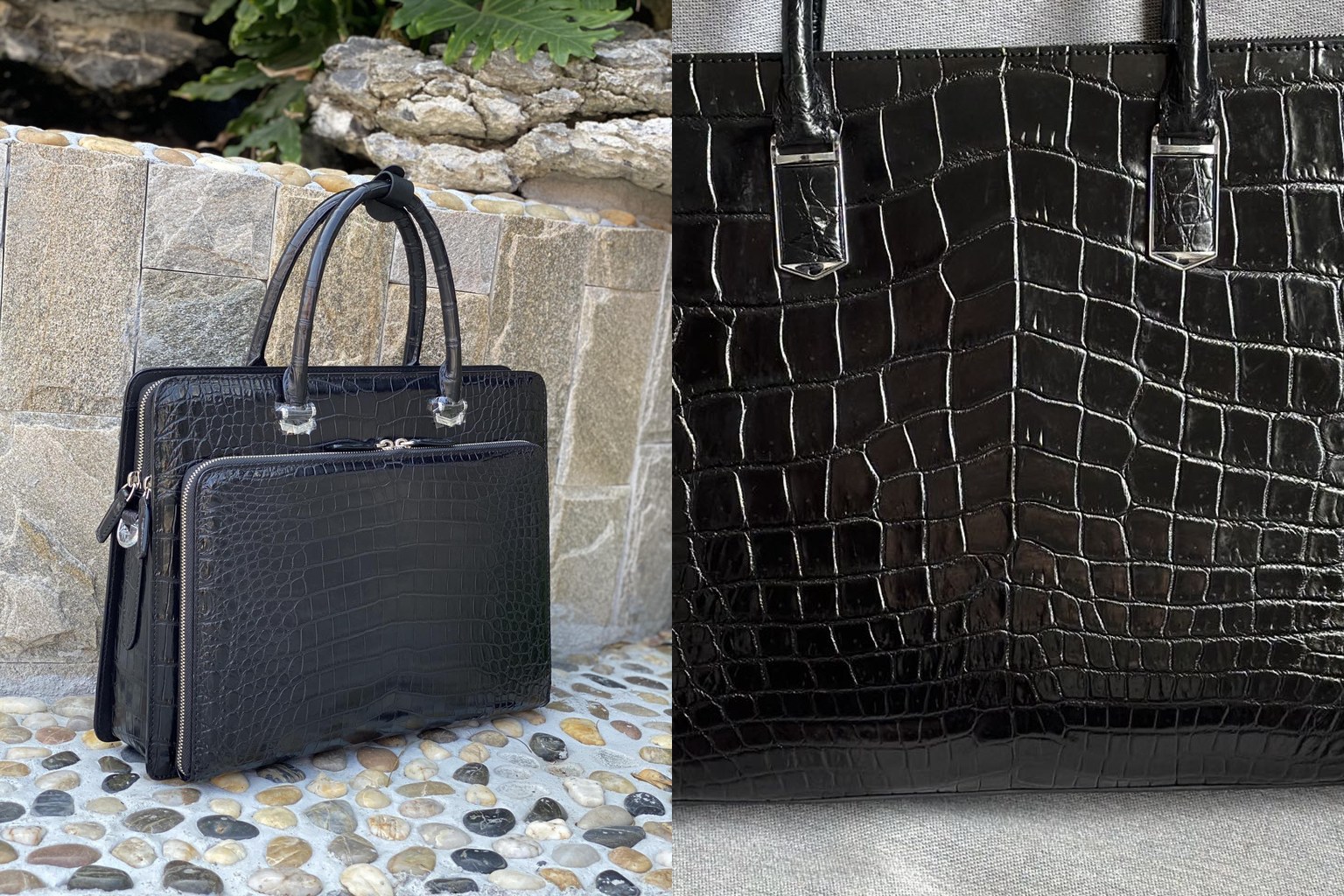
The honest answer to "is it worth it?"
People ask this on menswear forums all the time — are exotic leathers actually worth the money? — and the answers usually split between "absolutely" and "you're paying for vanity". Both camps are half right, because the question mixes up two different purchases.
The material itself earns its price when the piece is made properly. A crocodile hide takes years to raise, yields far less usable panel than a calf hide, and can't be rushed through cutting — every tile layout is unique, so the cutter is committing an unrepeatable section of skin with each pass. Done right, the result outlasts calf, ages with more character, and can't be mistaken for anything else. Done wrong — flank skin sold at belly prices, one-coat edge paint, cardboard-stiff structure — you've paid exotic money for ordinary work.
So the honest answer is: the leather is worth it; careless construction isn't; and the brand premium is a third thing entirely, which we'll get to at the end. First make sure the piece is genuine at all — our real-vs-embossed verification guide covers that in detail — because no finish or stitching argument matters on pressed calf.
Start with the hide: the cut decides the look
A crocodile skin isn't uniform, and where a panel comes from matters more than anything else about the piece.
Belly is the prime cut: large, flexible, evenly tiled squares that flow in gradual transitions. On a luxury-grade bag the front panel is belly, laid out symmetrically — look for a center line with tiles mirroring outward, like the close-up in the photo above. That symmetry isn't decoration; it means the maker committed the best part of the hide to the face of the bag and cut it deliberately.
Flank and leg tiles run smaller, rounder and less regular. Nothing wrong with them — they belong on gussets, sides and straps — but a "luxury" bag whose front panel is all small irregular scales was cut for economy, not for grade.
Hornback is its own aesthetic: the ridged spine down the middle, rugged rather than formal. A hornback piece isn't lower quality — it's a different statement, and it should be priced by the same construction standards.
Two more hide tells. Scars and healed marks are natural, but on a formal high-end piece the visible panels should be clean — a maker with hide selection discipline positions blemishes where they don't show. And on shoes, look at the pair together: matched vamps, with tile scale and flow deliberately paired between left and right, are one of the clearest signs someone cared. Mismatched vamps on a "luxury" pair mean the maker cut whatever was closest.
The finish is where corners get cut first
Crocodile leaves the tannery either glazed — polished under pressure to that hard, glassy shine — or matte, closer to the natural surface. Both can be luxury-grade. What separates grades is evenness. Run your eye across a glazed panel at an angle to the light: the luster should be continuous, not brighter on some tiles and cloudy on others. Patchy glaze means rushed finishing or mixed panels.
Then turn the piece over and look at the edges, because edge paint is the single fastest quality tell on any leather goods. A high-end edge is built in thin layers, sanded between coats, and ends up smooth, slightly rounded and crisp against the leather with no bleed onto the tiles. A cheap edge is one thick coat of paint that looks like plastic piping and will crack within a season. Ten seconds on the edges tells you more than a minute on the front.
Stitching, lining, hardware: the five-minute inspection
None of this needs expertise — it needs attention, up close, in good light.
- Stitching. Even length, even tension, straight lines that stay parallel to the edge, and clean corners where the stitch line turns. Loose threads, wandering lines or crowded corner stitches are disqualifying at luxury prices.
- Lining. Open the bag. Leather or suede lining, fitted without wrinkles, is what the price implies. A thin fabric liner glued in loosely tells you where the budget went — the outside only.
- Hardware. Weight is information: solid fittings feel dense, plated pot-metal feels hollow. Work the zipper the whole way — it should glide without catching. Check how handles anchor: through reinforced, stitched mounts, not just glued tabs.
- Structure. Set the bag down empty. A structured piece should stand and hold its line; slumping panels on a formal design mean the internal reinforcement was skipped.
- Smell, honestly. Leather and glue both have smells; a piece that reeks of solvent was rushed out of assembly.
Any single miss might be forgivable. Two or more and you're not looking at a luxury-grade piece, whatever the tag says.
Shoes: what "custom alligator shoes" should actually mean
Search interest in custom alligator and crocodile shoes keeps growing, and the phrase deserves a definition. Custom means the shoe is built for your order — your size run, your last shape preference, your color and finish, your sole construction — not pulled from a shelf. On crocodile shoes at this level you should expect matched vamps as standard, a stated construction (Goodyear welt or Blake stitch, named honestly, since they wear and repair differently), and a leather lining and insole. We build exotic shoes from a single pair, which is how most private customers order: one pair, to their spec, rather than a size run for a shop — though shops order the same way and scale up after sell-through.
Give the underside the same minute you gave the bag edges. A leather outsole should be finished at its edge — waxed and burnished, not left raw — and the heel stack should sit square with clean, even layers. Inside, a full leather sock and lining, not a printed cardboard footbed. And press gently where the vamp meets the sole: on welted or properly Blake-stitched work the join feels solid and deliberate; if the upper flexes away from the sole with a hollow gap, the "handmade" claim is doing a lot of unpaid work.
Color: the tell almost nobody checks
Crocodile takes color two broad ways, and you can read which one you're holding. Water-dyed hides drink the color in: look into the creases between tiles and the valleys carry the same depth as the surface, with the slight tonal movement from tile to tile that makes a good black look alive rather than flat. Pigment-heavy finishes sit on top: the surface reads perfectly uniform, almost sprayed, and the crease valleys show paler where the coating didn't reach. Neither is a scam — pigment finishes have their place on hard-wearing goods — but depth of dye is part of what a luxury price is supposed to be buying, and it takes five seconds to look. While you're that close, check any spot where two panels meet: on a high-grade piece the color match across seams is exact, because both panels were dyed in the same batch and selected to sit together.
Belts: the piece most often sold as "handmade" without earning it
Queries for handmade and bespoke crocodile belts show up in our search data constantly, and belts are where loose language does the most damage, because a belt looks simple. The grade checks: a one-piece front panel — not two short sections joined under a keeper where you won't look; edge finishing at the same standard as a bag, since a belt's edges take more abuse than any bag's; keeper and tip stitched, not just glued; and screw-fitted or interchangeable buckle hardware rather than a crimped fitting that dies with the buckle. Bespoke, properly used, means cut to your waist measurement with your choice of width, buckle and finish — our exotic belt sourcing guide walks through the full specification if you want to go that deep, and the exotic belt catalog shows what the finished work looks like.
The brand premium, separated honestly
Here's the part most guides dance around. When a fashion house sells a crocodile bag for the price of a car, the object on the counter — hide grade, cut, finish, construction — accounts for part of that number. The rest is the design language, the boutique experience, the waiting list, and a resale story. Those are real things. They're just not properties of the leather, and paying for them should be a choice you make knowingly rather than a spell the word "luxury" casts on you.
Everything on this page — the cut, the symmetry, the edges, the stitching, the lining, the hardware — can be verified on any bag from any source, with your own eyes, in minutes. For calibration on what the object itself costs when it's bought at the factory door: our genuine crocodile dress shoes run roughly US$300-780 across catalog tiers, and our crocodile price guide breaks down what moves a piece within that band — skin cut, finish, construction and hardware, the same levers this checklist inspects. If a "luxury" piece fails the five-minute inspection, the premium isn't buying craftsmanship; it's only buying the story.
Commissioning a piece when the minimum is one
The part most people don't know: you don't need to be a boutique or place a bulk order to have this done properly. Made-to-order is how exotic leather work has always run, and at our factory it starts from a single piece. The process is plain: pick a reference — one of our crocodile bags, or photos of what you want — state what changes (color, finish, hardware, size, strap, lining), and confirm the written specification. A sample takes 7-15 days depending on complexity; repeat or bulk production runs 15-21 days after confirmation. Ask to see the hide panels or cutting photos before assembly — a serious workshop shows its work, and the request costs you nothing. And once the piece is in your hands, the care guide covers keeping it in shape for the years it's built to last.
Quick questions, straight answers
Why are genuine crocodile bags so expensive?
Three reasons stack: the hide itself is scarce and takes years to produce; only part of each hide is prime belly cut, so a symmetric front panel consumes the best of a skin; and the construction that deserves the material — layered edges, leather lining, solid hardware, hand-finished details — is slow work. Brand pricing adds a fourth layer on top that has nothing to do with the object.
Is a crocodile bag worth the money?
When the piece passes inspection — prime cut where it shows, even finish, clean edges, tight stitching, real lining, solid hardware — it outlasts calf and ages better, so on a cost-per-year basis a genuine piece bought at a fair price holds up well. What isn't worth it is exotic-level money for economy construction, which is why the five-minute inspection matters more than the label.
Can I have crocodile shoes or a belt made to my own design?
Yes — that's standard made-to-order work, not a special favor. Exotic orders start from one pair or one piece: you specify the reference, material and cut, color and finish, hardware and sizing, approve a written spec, and a sample follows in 7-15 days. Shops commission the same way and reorder after sell-through.
The factory door is open
If what you want is the object — the prime cut, the even glaze, the edges that were sanded between coats — rather than the shopping bag it comes in, you're the customer this page was written for. Browse the crocodile catalog, pick the piece closest to what you have in mind, and tell us what should change. The specification comes back in writing, the sample follows, and every claim on it can be checked against the list above. That's what luxury-grade means when a factory says it.
Grade is only half the decision — how to choose a crocodile bag starts from the other half: what you actually carry and how the bag will live.
That definition is easier to judge against real pairs — our custom alligator shoes range lists the panel placement, sole and construction options behind each style.
Buyer FAQ
Crocodile Luxury FAQ
Why are genuine crocodile bags so expensive?
Three costs stack: the hide is scarce and takes years to produce; only part of each hide is prime belly cut, and a symmetric front panel consumes the best of a skin; and construction that matches the material — layered sanded edges, leather lining, solid hardware — is slow handwork. Brand pricing adds a further premium that belongs to the label, not the object.
Is a crocodile bag worth the money?
Value depends on the verified material claim, construction, function, repair options, care requirements and quoted price for the intended use. No material has a universal cost-per-year advantage. Review the written specification and approved sample rather than assuming that appearance or a material label guarantees a longer life.
Can I have crocodile shoes or a belt made to my own design?
Custom development may be feasible, but availability, sample quantity, production minimum, price and schedule must be confirmed for the exact specification. Send the reference, fit or dimensions, material request, component scope, construction, finish, hardware, branding and destination, then approve a dated written specification and sample before repeat production.
Crocodile Bag Selection FAQ
What size crocodile bag should I buy?
Choose size from the things you will actually carry, then check the finished dimensions, opening, interior layout, strap drop, handle clearance, and closure before confirming an order. For one piece, ask for those measurements with the reference; for a small run, add them to the approved specification so the intended capacity is consistent.
Is a leather lining better than a fabric lining in a bag?
Not automatically. Leather and suede linings suit an exotic bag and wear well, but they add weight and pale suede can pick up dye transfer. A dense woven fabric lining is lighter, easier to clean and makes the interior easier to see into. What separates good from bad is whether the lining is stitched in rather than glued, and cut to fit rather than bunching at the corners — pull it gently away from the bag wall and you will know at once.
Why do two crocodile bags that look the same cost different amounts?
A similar silhouette can require different work, including for a one-piece request. Compare quotations only when the written material declaration and panel placement, dimensions, structure, hardware, lining, branding, packaging, quantity, sample changes, inspection scope, destination, and included services are matched.