
How to Choose a Crocodile Bag You'll Actually Use
Part of: Exotic Leather Guide
The saddest message we get isn't about a fault. It's the one that starts "I love it, but I never use it." Usually the bag is beautiful and the buyer chose it the way you choose a photograph — by how it looked in the frame, not by what they carry on a Tuesday. We've been making crocodile bags in Guangzhou for years, and the difference between a bag someone reaches for daily and a bag that lives in its dust bag almost never comes down to the leather. It comes down to four decisions people make quickly and regret slowly: size, closure, hardware and lining.
Start with what's in your current bag
Before any question about skin or finish, empty the bag you carry now onto a table. That pile is your brief, and it beats any size chart.
Most people discover one of two things. Either they carry far less than they assumed — phone, cardholder, keys, sunglasses — in which case a small shoulder bag or a clutch is not a compromise, it's the right answer, and it happens to be the least expensive way into genuine crocodile because it uses less hide. Or they carry a laptop, a charger, a water bottle and a notebook, in which case a delicate top-handle bag will be a daily annoyance no matter how good it looks on the shelf.
Then ask a second question people skip: where does the bag spend its day? A bag that sits on a desk and a bag that goes on the floor of a train are different products. If yours will be set down on hard surfaces, insist on metal base feet — five small fittings that decide whether the bottom corners look presentable in two years. It's the cheapest longevity feature in the whole bag and the one most often left out.
Match the type to your week, not to the photo
Here's how the shapes we make actually behave once they leave us.
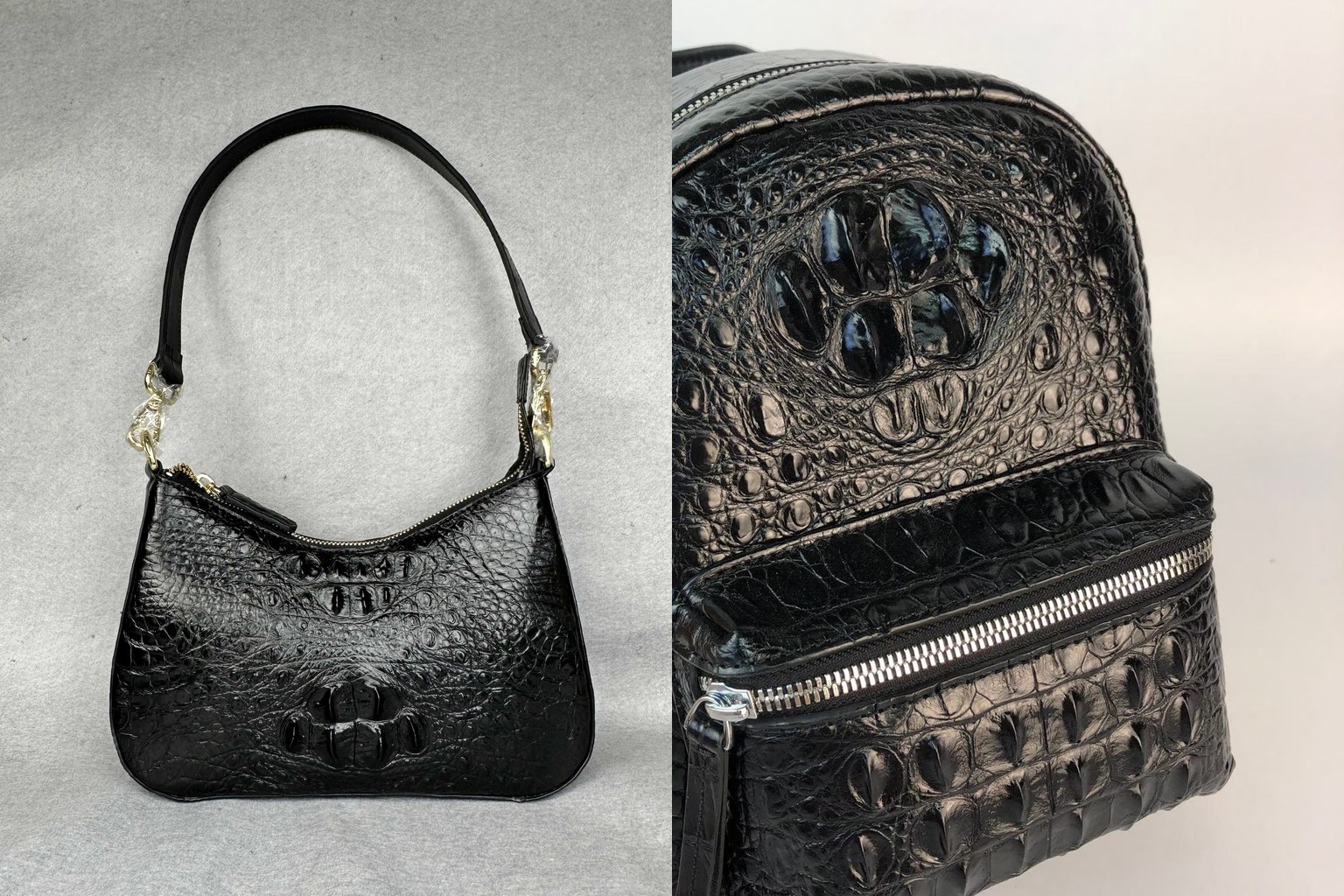
Small shoulder bags and clutches. The most forgiving entry into crocodile. Less hide means a lower price, the scale suits the pattern, and a small bag in glazed black works from an office to a dinner. What they don't do is carry a working day.
Structured top-handle bags. The dressiest silhouette and the one that photographs best, which is exactly why it gets over-bought. Wonderful if you genuinely have places to take it; frustrating as a daily driver, because you'll be reaching past a flap for your phone twenty times a day.
Totes and business bags. The workhorses. If you want one crocodile piece that earns its keep, this is usually it — a zip closure, a strap that clears a coat shoulder, and room for a laptop. Our crocodile bag catalog is deepest here for exactly that reason.
Backpacks. The honest choice for anyone who commutes or travels, and increasingly what younger buyers ask us for. A crocodile backpack reads as quiet luxury rather than announcement, and the weight sits on both shoulders instead of dragging one down.
Wallets and small leather goods. Worth mentioning because they're where a lot of people should start. A crocodile wallet costs a fraction of a bag, sees your hands every day, and tells you within a month whether you actually love the material or just liked the idea.
The closure decides how the bag feels to live with
Nobody asks about this before buying and everybody has an opinion after six months.
A zip is the practical choice: secure on public transport, keeps rain out, keeps the shape. A flap with a turn lock looks refined and is slower to open — fine for evenings, tiring on a commute. An open top is the fastest to use and the least secure; good for a desk bag, not for travel.
Whatever the closure, work it fifteen or twenty times before you commit. A zip on a well-made bag glides with one finger and doesn't need a second hand to steady the bag. If a brand-new zip snags at the corners, it will only get worse, and on a crocodile bag the zip is the part most likely to send it to a repairer.
Hardware: what you're actually judging
Ask in any handbag community which hardware is better and you'll get a hundred replies about gold versus silver and very few about how the fittings are made. The finish is taste. These four things are quality.
- Weight. Solid brass fittings feel dense in the hand; hollow plated pot-metal feels light and slightly rattly. Lift the clasp or the buckle on its own and you'll feel the difference immediately.
- Plating. Thin plating wears through at contact points — the edge of a turn lock, the tongue of a buckle, the top of a zip pull — usually within a year of daily use. You can't measure plating thickness in a shop, but you can ask the seller directly, and you can look at how the sample piece has worn if it's been handled.
- Attachment. This matters more than the fitting itself. Hardware should be riveted or stitched through reinforced leather, not glued to a single layer. Look underneath a D-ring or a handle anchor: reinforcement should be visible as an extra layer of leather or a stitched tab.
- Serviceability. Screw-fitted hardware can be replaced. Crimped or welded fittings mean a broken clasp is a bag problem rather than a part problem. Nobody thinks about this until it happens.
A small aside for anyone weighing gold against silver: gold-tone plating shows wear more visibly because the base metal underneath is a different color, while silver-tone wear is subtler. That's a genuine practical difference, not just aesthetics.
Lining: the argument people get wrong
"Leather lining or fabric?" comes up constantly, and the confident answer — leather, obviously — is only half right.
Leather and suede linings feel appropriate in a crocodile bag, wear beautifully, and are what most buyers expect at this price. Suede in particular hides scuffs and grips items so they don't slide around. The downsides are real though: leather lining adds weight, and a light-colored suede lining will pick up dye transfer from a new pair of denim-blue anything.
Fabric linings are not automatically the cheap option — a dense woven cotton or a heavy twill is light, easy to clean, and lets you see what's inside, which matters more than people admit in a dark bag. The cheap version is the thin, shiny polyester glued in rather than stitched, and you can spot it by pulling the lining gently away from the wall: stitched linings are attached at the seams, glued ones lift.
The honest ranking, then, isn't leather over fabric. It's stitched over glued, and fitted over baggy. A lining that puckers or bunches in the corners was cut to the wrong pattern, and that tells you about the workshop more reliably than the material does.
One more thing to look for while the bag is open: interior pockets that are actually sized for real objects. A phone slot that doesn't fit a current phone is a sign the pattern was copied rather than designed.
Why two similar crocodile bags can differ so much in price
This question comes up wherever exotic leather is discussed — people comparing two crocodile pieces that look alike and wondering what justifies a large gap. Five things, in roughly the order they move the price:
- Which part of the hide. Belly is the prime cut with large even tiles; flank and leg run smaller and less regular. A bag whose front panel is all belly costs more because it commits the best of a skin.
- How much hide the design eats. A large structured bag may consume several times the usable area of a small one, and any design where the pattern has to line up across panels wastes more.
- Finishing labor. Edges built in thin sanded layers, hand-set hardware, an evenly fitted lining — all slow work, all invisible in a photograph.
- Hardware quality. Solid, properly plated, serviceable fittings cost several times what generic ones do.
- Everything after the object. Brand, boutique, story. Real value to some buyers, but not a property of the bag.
If a price seems too good for genuine crocodile, the first thing to confirm is that it is genuine — our verification guide covers the checks, and honestly labeled embossed leather is a perfectly good product at its own price. If it's genuine and still cheap, look at the cut and the fittings; that's usually where the money was saved. The price guide lays out the bands we actually quote, and our guide to luxury-grade construction goes deeper into the inspection itself.
What actually wears out, in order
After enough repair requests you learn where bags die, and it's almost never the crocodile.
Corners and base go first, from being set down — which is the argument for base feet and for a bag with a flat, reinforced bottom rather than a soft one. Handles and straps are second, and they fail at the anchor points rather than in the middle, which is why stitched-through reinforcement matters more than strap thickness. Zips are third, usually because grit was never brushed out of the teeth. Lining is fourth, typically a pen or a leaking bottle rather than wear.
The crocodile panels themselves usually outlive all of it. That's the real case for the material — but only if the bag around it was built to the same standard, and only if you look after it. A soft dry cloth along the scales, stuffing to hold the shape in storage, and a breathable dust bag rather than plastic cover most of it; the full routine is in our care guide.
If you want one made properly
Made-to-order isn't reserved for boutiques. Our exotic orders start at one piece, and a good share of the crocodile bags we build each month are single commissions for individuals: choose a reference from the catalog or send photos, then specify the size, the closure, the hardware finish, the lining, the strap drop and any interior pockets you actually need. We confirm that in writing before anything is cut. A sample takes 7-15 days depending on complexity, and a repeat or larger order runs 15-21 days after confirmation. Shops work identically — one piece to test, then a run once it sells, which is covered in our retail stocking guide.
Tell us what you carry and where the bag goes during the day. That single sentence changes what we recommend more than any other information you can give us — and occasionally it means telling someone the bag they asked about is the wrong one.
Questions we get before people buy
What size crocodile bag should I buy?
Empty your current bag onto a table and buy for that pile, not for the photo. If it's phone, cardholder, keys and sunglasses, a small shoulder bag or clutch is the right answer and the least expensive route into genuine crocodile because it uses less hide. If a laptop and charger are in the pile, buy a tote, business bag or backpack with a zip closure — a structured top-handle bag will frustrate you daily no matter how good it looks.
Is a leather lining better than a fabric lining?
Not automatically. Leather and suede linings feel appropriate and wear well but add weight, and pale suede can pick up dye transfer. A dense woven fabric lining is lighter, easier to clean and makes the interior easier to see into. What actually separates good from bad is whether the lining is stitched in rather than glued, and whether it's cut to fit rather than bunching at the corners — pull it gently away from the wall of the bag and you'll know within seconds.
Why do two crocodile bags that look the same cost different amounts?
Mostly the cut of hide used on the visible panels (belly is the prime cut and costs the most), how much hide the design consumes, the finishing labor in edges and lining fit, and the quality of the hardware — solid, well-plated, serviceable fittings cost several times what generic ones do. Brand premium sits on top of all of that and isn't a property of the bag.
Before you decide
Look at the bag you use most and ask what it gets right. Nine times out of ten the answer is boring — the right size, a closure that suits your hands, a strap that sits where you want it. Buy the crocodile version of that, made properly, and you'll carry it for a decade. Buy the version that photographs best and you'll admire it in a cupboard.
For a deeper look at lining materials on custom orders — leather, suede, microfiber and fabric compared — see our bag lining materials guide.
And if a small bag is where you land, smaller-scaled skins deserve a look too — the fine scale pattern on lizard leather bags suits compact shapes particularly well.
Buyer FAQ
Crocodile Bag Selection FAQ
What size crocodile bag should I buy?
Choose size from the things you will actually carry, then check the finished dimensions, opening, interior layout, strap drop, handle clearance, and closure before confirming an order. For one piece, ask for those measurements with the reference; for a small run, add them to the approved specification so the intended capacity is consistent.
Is a leather lining better than a fabric lining in a bag?
Not automatically. Leather and suede linings suit an exotic bag and wear well, but they add weight and pale suede can pick up dye transfer. A dense woven fabric lining is lighter, easier to clean and makes the interior easier to see into. What separates good from bad is whether the lining is stitched in rather than glued, and cut to fit rather than bunching at the corners — pull it gently away from the bag wall and you will know at once.
Why do two crocodile bags that look the same cost different amounts?
A similar silhouette can require different work, including for a one-piece request. Compare quotations only when the written material declaration and panel placement, dimensions, structure, hardware, lining, branding, packaging, quantity, sample changes, inspection scope, destination, and included services are matched.