
Footwear Labeling Requirements for U.S. and EU Importers
Part of: China Footwear Sourcing Guide
A shoe label is ready for production only when it matches the destination market, the actual bill of materials, the sales channel, and the finished packaging. For U.S. imports, country-of-origin marking is a core requirement, while leather-like claims and children's products can add other duties. For footwear sold to EU consumers, the material label identifies the upper, lining and sock, and outer sole. EU product-safety rules can also require product identification and economic-operator details.
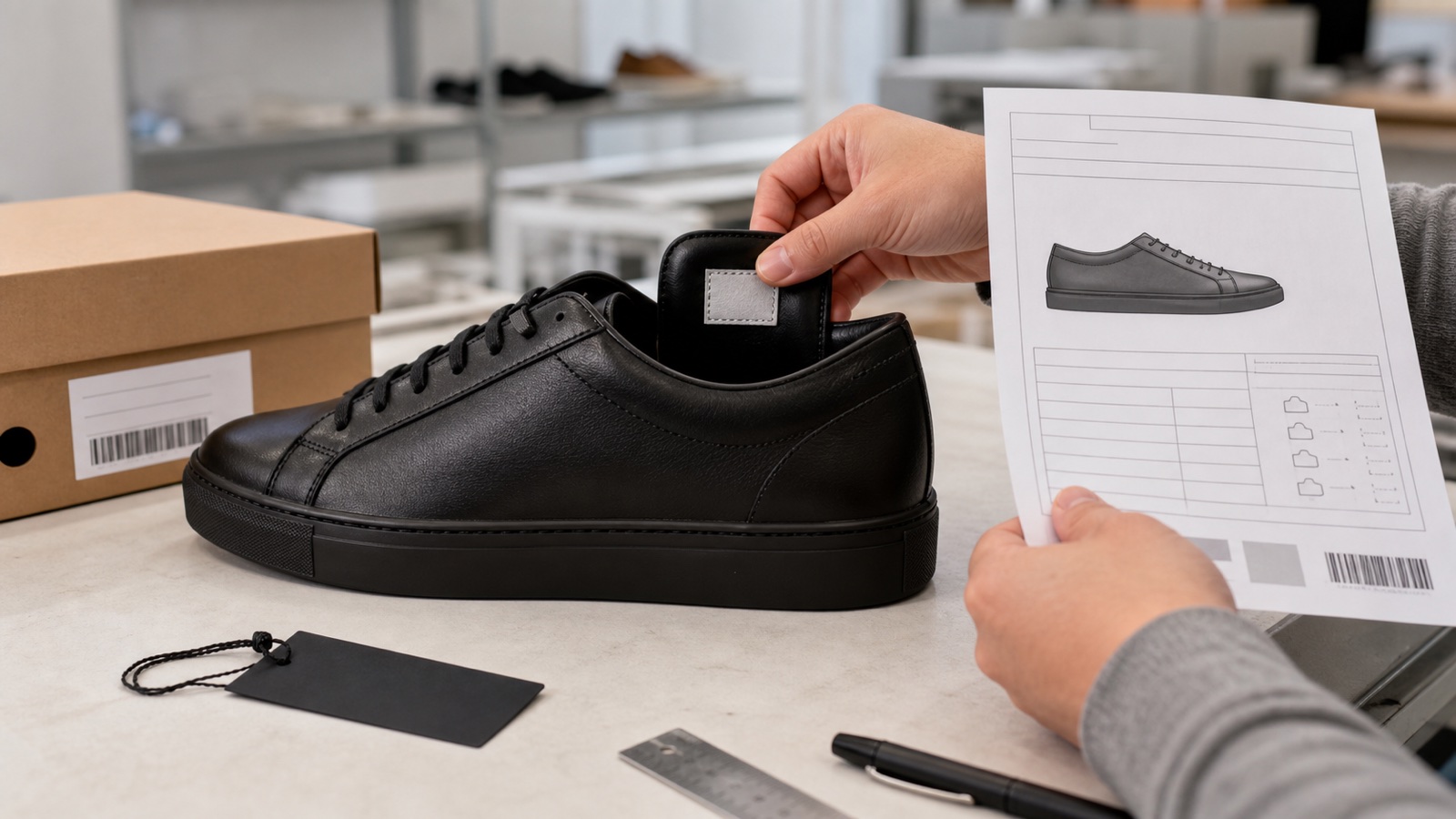
That short answer is more useful than asking a factory for its “standard label.” A label that works for an adult leather shoe sold by an independent U.S. retailer may not work for a children's sneaker listed in several EU countries. Retailers and marketplaces can add barcode, carton, language, and online-listing fields that are separate from the underlying legal requirements.
This guide was checked against official U.S. and EU sources on July 15, 2026. It is a production-planning guide, not legal advice. The importer or brand should confirm the final artwork with its customs broker, compliance adviser, laboratory, marketplace, or relevant authority before production.
U.S. vs EU footwear labeling: the practical difference
| Label area | United States | European Union |
|---|---|---|
| Origin | Imported articles generally need the English name of the country of origin under 19 CFR Part 134. | Origin claims must be truthful, but the footwear material label described below is a separate requirement. |
| Material composition | Check claims and product-specific rules; leather-look non-leather content should not be presented deceptively. | Identify materials for the upper, lining and sock, and outer sole under Directive 94/11/EC. |
| Traceability | Children's products have specific tracking-label duties; other requirements depend on the product and channel. | For products within scope, GPSR adds product identification and manufacturer/importer or responsible-person information. |
| Retail data | Size, SKU, color, barcode, price, carton mark, and marketplace fields are often commercially required, but they are not interchangeable with legal labels. | |
Start with a label map, not an artwork file
Before the designer places a logo or barcode, create a one-page map showing every information surface: tongue or lining label, insole print, outsole mark, hangtag, shoebox end label, consumer polybag, master carton, instruction insert, and online product page. Assign each field to the surface where it must appear and identify who approves it.
The label map should state the destination country, intended consumer age, product type, upper material, lining and sock material, outer sole material, origin, style code, color, size system, batch logic, importer or responsible-person details, warnings, barcode owner, and retailer template. This is also the right time to decide which fields change by size, color, order, or production run.
If the construction is still changing, do not freeze the material statement. A revised lining, coated upper, textile panel, or rubber insert can change the accurate declaration. Link label approval to the final shoe sample approval record, not to the first quotation.
U.S. shoe labels: three checks for importers
1. Make the country-of-origin marking durable and easy to find
19 CFR Part 134 states that, unless an exception applies, a foreign-origin article or its container must indicate the English name of the country of origin to the ultimate purchaser. The rule describes the marking as conspicuous, legible, indelible, and as permanent as the nature of the article or container permits.
For a shoe program, the buyer should approve the exact wording, position, method, size, contrast, and durability. A faint ink mark hidden by a removable insert is a different risk from a well-placed sewn or printed mark. Do not assume that printing origin only on the master carton satisfies a retail pair. Ask the customs broker to confirm any proposed exception or container-only approach for the actual import.
2. Make material and leather claims match the shoe
The U.S. FTC Leather Guides address misleading claims about the composition and characteristics of leather and imitation-leather goods. They also state that non-leather content should be disclosed when a material looks like leather but is not leather.
This matters beyond the small sewn label. Product names, hangtags, box copy, online listings, invoices, and sales presentations should describe the same construction. If only part of the upper is leather, a broad “leather shoe” claim deserves a component review. The factory can provide a bill of materials and supplier declarations, but the brand decides which consumer claim it will make.
3. Add tracking information for children's footwear
The U.S. Consumer Product Safety Commission says products designed and primarily intended for children age 12 or younger require permanent distinguishing marks on the product and packaging to the extent practicable. The information must make the manufacturer or private labeler, production location and date, batch or run, and specific source ascertainable.
A generic style number alone may not identify a production run. Build the code system before the label order, and keep a record connecting the code to the purchase order, factory, production date, materials, and test file. Other CPSC rules may apply according to age, components, and product features, so children's footwear needs a dedicated compliance review.
EU footwear labels: map three components and their materials
Directive 94/11/EC applies to material labeling for footwear offered for sale to consumers, subject to its scope and exclusions. It separates the shoe into three parts:
- Upper: the outer face of the structural element attached to the outer sole, excluding specified accessories and reinforcements when materials are classified.
- Lining and sock: the lining of the upper together with the insole area forming the inside of the footwear.
- Outer sole: the bottom part attached to the upper and exposed to abrasive wear.
For the upper and lining and sock, the label identifies a material that makes up at least 80 percent of the surface area. For the outer sole, the threshold is at least 80 percent of its volume. If no single material reaches 80 percent, the two main materials are shown.
The Directive provides pictograms and written indications for leather, coated leather, textiles, and other materials. The label may use the prescribed pictograms or permitted written wording. It must be visible, securely attached, accessible, and placed on at least one shoe in the pair. Printing, embossing, an adhesive label, or an attached tag can be used as provided by the rule and national implementation.
For imported footwear, the person who first places the product on the EU market is responsible for supplying the label and its accuracy. A factory should not guess the icons from a product photo. Give it an approved component-to-material table based on the final bill of materials.
Do not stop at the EU material pictograms
The EU General Product Safety Regulation, Regulation (EU) 2023/988, has applied since December 13, 2024. For consumer products within its scope, it requires a type, batch, serial number, or another element that identifies the product. It also sets manufacturer and importer contact-information duties and requires an EU-based responsible economic operator where applicable.
Depending on what can reasonably fit on the product, the Regulation allows specified information on packaging or an accompanying document in the circumstances described by its provisions. Online offers have their own visible information requirements, including product identification, manufacturer details, the EU responsible person's details when the manufacturer is outside the Union, and applicable warnings or safety information.
In practice, the shoe, box, accompanying documents, and product listing should use the same model and batch logic. An attractive box label does not repair missing online information, and a complete web listing does not replace the physical material label.
A seven-step label approval workflow
- Define the market and channel. Name every country, age group, retailer, marketplace, and warehouse program.
- Freeze the construction data. Confirm the final bill of materials for the upper, lining, sock, outsole, trims, and any leather-look panels.
- Build the information matrix. Separate legal marks, safety and traceability data, retail identifiers, and brand copy.
- Assign responsibility. Record who supplies the origin decision, material classification, EU operator details, barcode, translations, and retailer template.
- Approve digital artwork. Check wording, icons, dimensions, contrast, variable fields, and version number.
- Approve a physical sample. Review attachment, readability, abrasion or adhesion as relevant, scan performance, box position, and whether the label interferes with fit.
- Inspect bulk packing. Match style, color, size, pair, box, barcode, origin, batch, carton quantity, and carton mark before shipment.
Keep the approved artwork, physical reference, and revision history with the tech pack. The pre-shipment shoe inspection checklist can then turn label verification into a repeatable carton and pair check.
Common label mistakes that cause rework
- Using one global label without listing the countries and sales channels it is meant to cover.
- Copying the material icons from a reference shoe instead of classifying the final bill of materials.
- Changing the lining, sock, coating, or outsole after label artwork has been approved.
- Confusing “genuine leather,” coated leather, leather-look synthetics, and textile panels in consumer copy.
- Putting a barcode on the box without checking the encoded number, printed number, size, color, or scan quality.
- Using a style code where a production batch or run needs to be identifiable.
- Assuming the factory owns the importer, responsible-person, language, or marketplace decision.
- Checking only the artwork PDF and never the label attached to the finished shoe.
What to send a shoe manufacturer
Send a controlled label pack with the style and color code, size range and size system, final materials, intended age group, destination countries, origin wording, traceability code format, importer or economic-operator details, approved translations, barcode data, shoebox dieline, carton mark, retailer manual, and one responsible approver.
If the shoe itself is still being developed, start with the custom leather shoe buyer guide. Buyers planning the wider shipment can also use the shoe import checklist to connect labels with documents, inspection, packing, freight, and customs preparation.
To review a real project with Marcusius, send the footwear type, market, quantity, materials, artwork status, packaging format, and deadline through the contact form. For label files, retailer manuals, and an active sampling thread, use the Buyer Portal so the approved version stays with the product discussion.
Before sample or order decisions are recorded, review this next reference: supplier verification checklist.
Browse the product catalog for styles that will carry your compliant labels.