
How to Specify Hardware for Custom Leather Bags: A Buyer Checklist
Part of: Exotic Leather Guide
Do not approve custom bag hardware from a finish name and one supplier photo. Freeze each part's function, dimensions, declared base material, finish system, physical color master, assembly method and pass/fail checks. Then approve the hardware on the complete bag, not only as loose components.
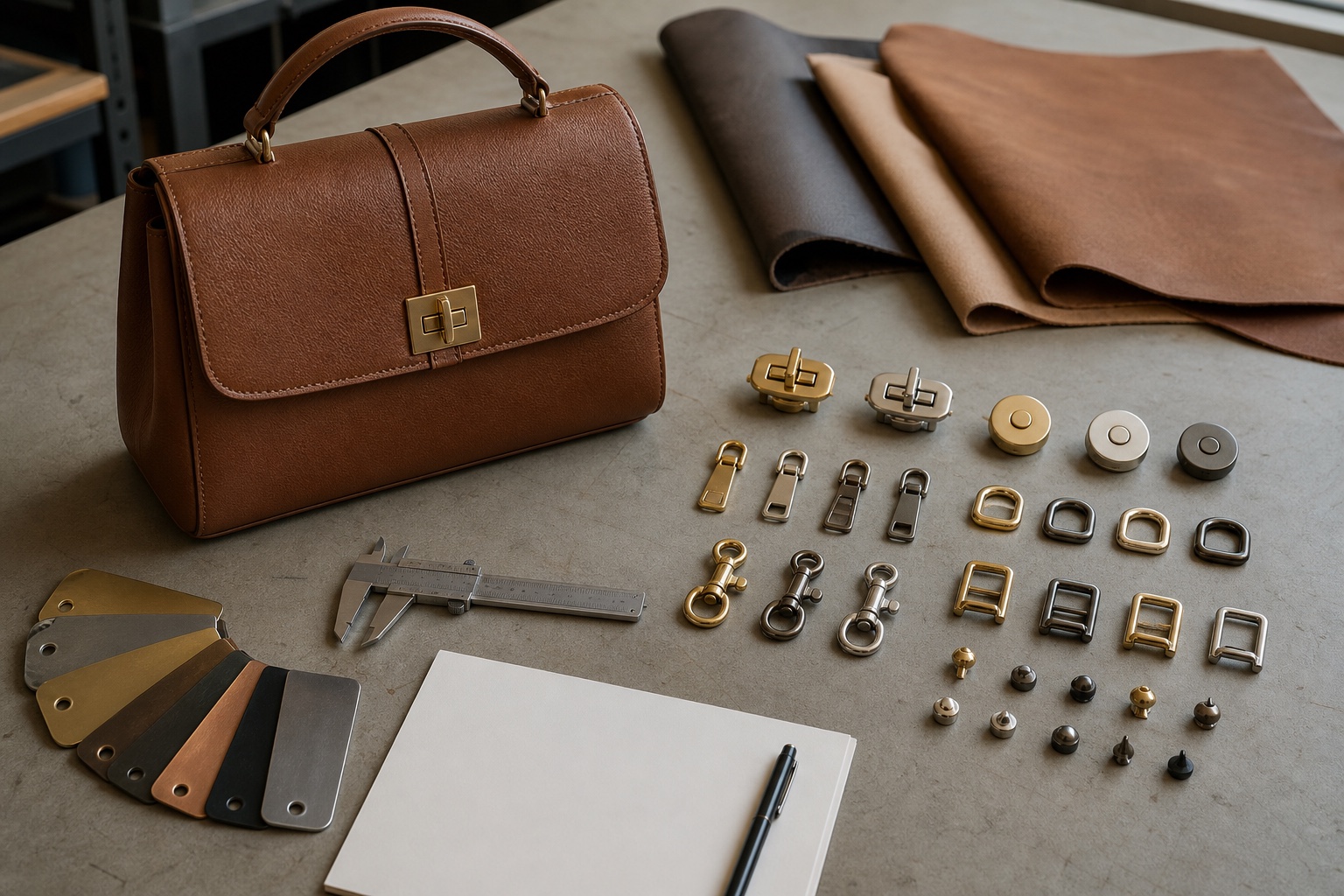
A lock can have the right color and still feel loose. A swivel hook can look substantial but interfere with the strap. Two parts both called “light gold” can appear different on one bag.
This quotation and quality-control workflow was checked against current ISO and ECHA information on July 18, 2026. Choose test methods and legal requirements for the actual component, use and destination market.
Start with the job each component must do
Hardware is part of the bag's structure as well as its appearance. Start with the opening action, strap load, bag weight, leather thickness, expected use and repair plan. A decorative turn lock, a magnetic snap and a zip closure solve different problems. Changing one can alter the flap, reinforcement, lining and stitching pattern.
| Component | Buyer decision | What can go wrong |
|---|---|---|
| Turn lock or clasp | Opening action, tongue length, plate size, orientation and backing | Misalignment, sharp action, loose rotation or leather distortion |
| Zipper slider and pull | Chain type, slider match, pull size, pull orientation and finish | Rough travel, pull detachment, finish wear or mixed color |
| D-ring or O-ring | Inside dimensions, wire section, gap, weld and strap fit | Strap crowding, rotation, opening at the join or edge abrasion |
| Swivel hook | Gate clearance, swivel movement, ring size and attachment point | Gate interference, sticking, unwanted release or bag imbalance |
| Buckle or adjuster | Strap width, pin or bar position, hole spacing and adjustability | Slipping, leather marking, poor range or crooked strap alignment |
| Rivet, stud or bag foot | Post length, cap size, backing and leather stack thickness | Loose setting, visible dents, exposed backs or lining damage |
Put every visible and hidden part on one hardware schedule. Number the callouts on the drawing and use the same numbers on the sample comment sheet. Buyers developing exotic-leather styles can compare the component plan with the current alligator bag category, while the crocodile leather bag buyer checklist connects hardware choices with material selection, documentation and final inspection.
What belongs in a bag hardware specification?
A useful specification is short enough to quote but precise enough to repeat. Record the following for each component:
- Part identity: component name, drawing callout, supplier code, version and left/right orientation where relevant.
- Function: decorative, closure, adjustment, strap connection, reinforcement or protection.
- Dimensions: the measurements that affect fit, plus the agreed measurement method and tolerance.
- Declared base material: for example zinc alloy, brass, steel or aluminium, where that declaration matters to weight, strength, corrosion control or price.
- Surface system: polished, brushed, plated, coated, lacquered or otherwise treated, with the supplier's exact process description when available.
- Approved appearance: finish code, gloss level, brushing direction, texture and physical master sample.
- Assembly: screw, rivet, prong, post, weld, stitch tab or another method, including backing and reinforcement.
- Logo: artwork version, placement, size, relief direction and whether it is cast, engraved, stamped or laser marked.
- Testing: the agreed component, method, conditioning, sample count and acceptance result.
- Packing: protective film, tissue, individual separation or spare parts needed to prevent metal-to-metal and metal-to-leather damage.
Do not turn a supplier declaration into a laboratory claim. If a base metal, coating thickness or substance limit matters to the project, state how it will be verified and who is responsible for the test.
Base metal and finish are two separate decisions
Zinc alloy can suit complex cast shapes. Brass offers a different machining, weight and finishing profile. Steel is relevant to springs, pins and parts needing stiffness, while aluminium can reduce weight in a suitable design. None is automatically “premium.” Geometry, casting quality, assembly and the surface system matter too.
Keep the supplier's base-material declaration with the approved sample. Compare weight only within the same design; unnecessary weight can pull a flap down and make a shoulder bag tiring.
Ask whether the visible finish is a stock color, custom plating batch, vacuum-applied coating, painted or electrophoretic coating, or top-coated antique effect. That choice affects color matching, batch setup and repeat-order consistency.
Approve color with a physical master
Gold, champagne, antique brass, nickel and gunmetal are directions, not complete standards. Screens, cameras and lighting shift color. Approve a physical master or complete hardware set under agreed lighting, then label it for the production record.
Review every part together and define acceptable variation in gloss, brushing and antique shading. If variation is intentional, approve a range instead of one ideal piece.
Choose tests that answer the actual failure risk
Connect each test to how the bag will be used, and ask a qualified laboratory or technician to confirm the method and acceptance criteria.
Function and attachment
Operate locks, snaps, hooks and zippers on the assembled sample. Agree a project-specific cycle, then record looseness, sticking, release, deformation and leather damage. Test strap hardware with the intended strap, reinforcement, stitching and bag body.
Finish adhesion and wear
ISO 2819:2017 reviews qualitative methods for checking adhesion of electrodeposited and chemically deposited coatings. It also makes clear that the methods are qualitative and that some can damage the coating or part. Select a method that suits the actual base and coating instead of writing “adhesion test passed” without a procedure.
Wear often begins at zipper pulls, hooks, rings, lock tongues, buckle bars and bag feet. Mark those locations during sample use and decide which visible change is acceptable. A loose-part rub may not reproduce wear on the assembled bag.
Corrosion
ISO 9227:2022 describes neutral, acetic acid and copper-accelerated acetic acid salt-spray procedures for metallic materials and coatings. The standard does not choose the product's exposure period or interpret the result, and it is not intended to predict long-term corrosion in service. Your specification therefore needs to name the method, duration, evaluated area and pass/fail condition instead of requesting “salt spray” alone.
Destination-market chemical checks
Restricted-substance and nickel-release requirements depend on the market, product and intended contact. The European Chemicals Agency's nickel guidance explains the context for direct and prolonged skin contact under REACH Annex XVII Entry 27. Do not assume every bag part has the same contact pattern. Give the complete product and intended use to the laboratory or compliance adviser and confirm the current destination rules before bulk approval.
Control hardware at three different stages
1. Sample approval
Approve the loose parts and the finished bag. Check dimensions, finish, edges, casting or machining defects, opening action, alignment, strap movement, attachment backing and leather distortion. Keep a sealed hardware set, the signed complete sample and the hardware schedule under the same revision. The site's sample approval workflow is written for footwear but its golden-sample, comment and revision controls also work well for leather goods.
2. Bulk incoming and production control
At incoming inspection, identify the supplier batch and compare it with the approved master before the parts are issued to sewing and assembly. Separate obvious color or gloss drift, sharp edges, blocked threads, weak springs and dimension problems. During production, check setting pressure, screw security, backing position, left-right orientation and damage caused by tools. Record substitutions before use; do not discover them in the final cartons.
3. Pre-shipment inspection
Inspect hardware on finished, packed bags. Operate the closures, compare finish across the same bag and across sampled cartons, check visible scratches, confirm that protective film does not leave residue and look for contact marks caused by straps or packing. The pre-shipment inspection checklist shows how to turn approved references and written tolerances into a clear release decision.
What changes cost and MOQ?
Cost and MOQ change with new moulds or dies, custom shapes, logo tooling, part weight, base material, unique component count, custom finish setup, color matching, assembly, testing and protective packing. A stock component in an existing finish may suit a first order better than a custom lock.
Ask for hardware MOQ separately from bag MOQ because components may come from several suppliers. For surplus parts, agree ownership, storage and next-order identification. Request quantities and lead times against the final component list.
Common specification mistakes
- Writing only “gold hardware” without a physical master, gloss direction or supplier code.
- Approving loose components but not checking them on the intended leather thickness and reinforcement.
- Choosing a heavy lock without reviewing flap balance and the total bag weight.
- Using one finish across several suppliers without a coordinated approval set.
- Adding a logo after the mould, wall thickness or plating quotation has been approved.
- Requesting a salt-spray result without naming the method, exposure, evaluated surface or acceptance rule.
- Testing a hook or ring alone while ignoring the strap, rivet, backing and stitched attachment.
- Changing the base material or finish process without updating the controlled sample and schedule.
- Packing metal parts so that they rub against leather, lining or each other in transit.
Email-ready hardware quotation checklist
Subject: Custom bag hardware quotation and sample request
- Bag type and reference images or drawing
- Target market and intended use
- Expected order quantity and colorways
- Numbered component list with required function
- Critical dimensions, strap widths and leather stack thicknesses
- Preferred base materials or requested supplier declarations
- Finish direction plus physical sample or color reference
- Logo artwork, size, placement and preferred method
- Required functional, corrosion, coating or chemical checks
- Packing, spare-part and destination requirements
Ask the supplier to return a line-by-line quote showing stock versus custom parts, hardware MOQ, tooling, finish setup, sample status, test responsibility and any point that still needs a physical reference.
What to send us
Send the bag reference, target dimensions, intended material, strap width, hardware callout list, finish direction, logo file, target market, expected quantity, testing needs and current sample stage. Mark which parts may use stock hardware and which must be custom.
Use the contact form for the initial brief. If the project includes drawings, artwork, finish photos, supplier declarations, test reports or several sample revisions, open a thread in the Buyer Portal so the approved files remain attached to the same sourcing discussion.
To see hardware in context on finished pieces, browse the crocodile bag styles.
Buckles and keepers follow the same specification logic as bag hardware, which is worth checking against the exotic leather belts range.