
Custom Shoe Packaging for Small Orders: MOQ, Proofs and QC
Part of: Private Label Shoe Manufacturing
For a small footwear order, do not start by customizing every layer of the package. Keep the structural box as simple and repeatable as the product allows, then spend customization on the elements buyers will actually notice: a sleeve, label, tissue, insert or controlled one-color print. Approve the complete packed sample before bulk packaging is released.
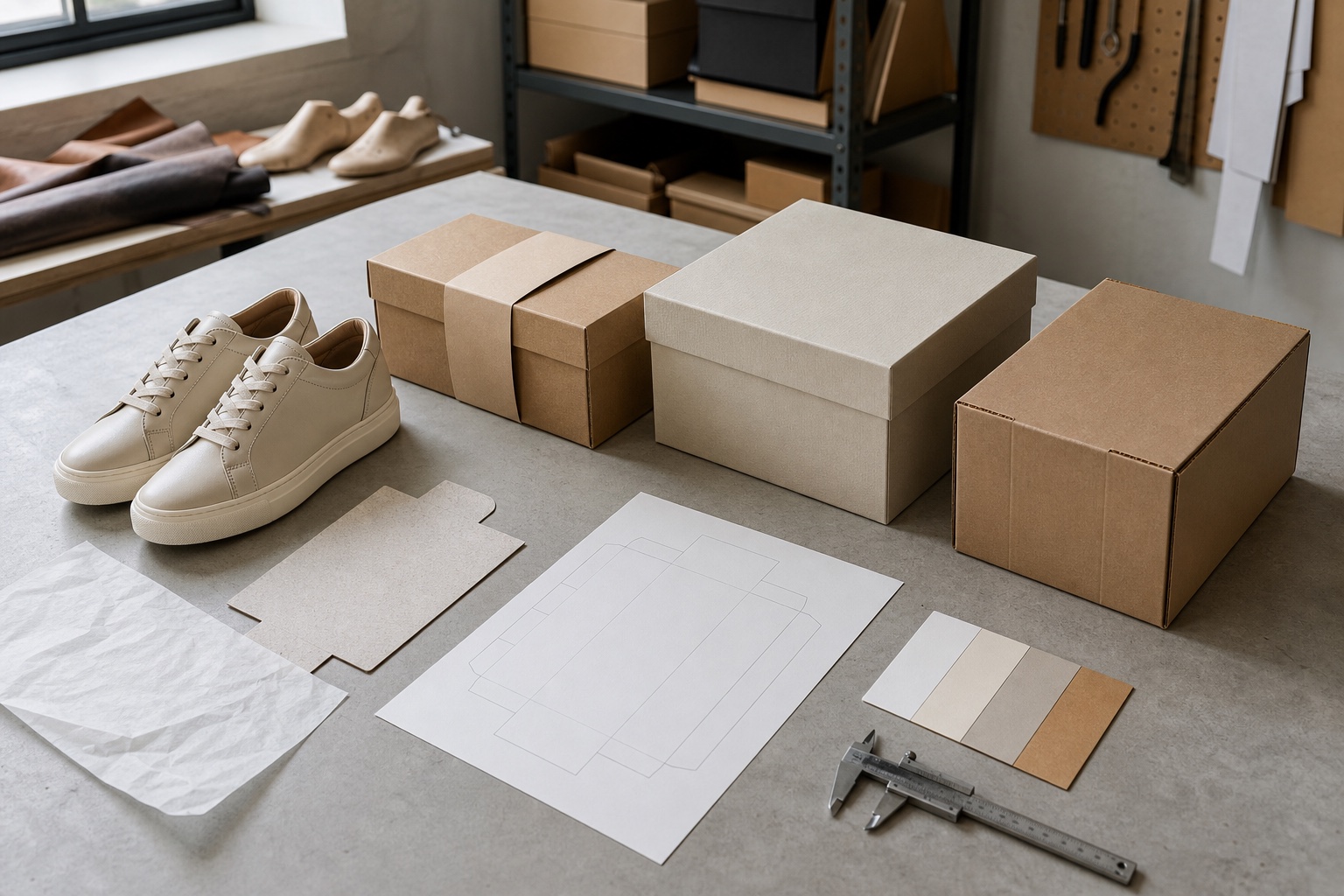
The common failure is to approve attractive artwork before confirming box size, shoe fit, label data and the route from factory to customer. A low-volume packaging plan works when the structure, variable information and brand layer can be controlled separately.
This guide was checked against current FEFCO, ISTA, GS1, ISO and FSC information on July 19, 2026. Testing, retailer rules, environmental claims and destination requirements still need project-specific confirmation.
Choose the packaging path before asking for a price
“Custom shoe box” can describe very different work. Tell the supplier which layer must be unique and which layer can remain standard.
| Packaging path | What changes | Where it helps | Main trade-off |
|---|---|---|---|
| Stock-size plain box plus label, sleeve or insert | Brand layer and variable product data | Early orders with several sizes or colorways | Less control over exact box dimensions and construction |
| Stock-size box with direct print | Printed surface while the existing structure stays fixed | A consistent brand presentation without a new box shape | Print setup and supplier stock sizes still set the production path |
| Custom-size folding shoe box | Dieline, dimensions, board, print and finish | Products needing a closer fit or a distinct opening experience | More tooling, proofing and material decisions |
| Rigid two-piece or specialty box | Wrapped board, structure, fit, inserts and surface finish | Projects where presentation and protection justify the complexity | Higher material use, packing volume and manual assembly can affect cost and MOQ |
Start with the simplest path that protects the shoes and communicates the brand. The site's first-order shoe MOQ guide explains why splitting a small order across many sizes, colors and components can create separate minimums even when the total pair count looks reasonable.
What can be customized without rebuilding the whole box?
A small order does not have to look unfinished. The practical question is which elements can be changed independently:
- Product label: style, color, size, barcode, country data and other variable fields.
- Sticker or seal: a controlled brand mark on a plain box, provided it stays attached through handling.
- Paper sleeve or belly band: a larger brand surface that can slide over an existing box.
- Tissue and insert card: color, fold, placement and printed message, subject to ink, rub and transfer checks.
- Dust bag or protective wrap: material, dimensions, closure and marking where the product needs it.
- Shipping carton and carton label: case structure, quantity, marks and protection for the selected delivery route.
Do not count an element as “standard” until its dimensions and specification are written down. A stock shoe box that is too shallow can crease the upper; an oversized box can allow movement and use more shipping volume. Confirm fit with the actual pair, stuffing, tissue, accessories and labels.
Why setup, plates and dies change MOQ and cost
Packaging cost is a system, not a single box price. Ask the supplier to separate recurring unit work from one-time or batch-level setup.
- Structure tooling: a new dieline may require a cutting die or other converting setup.
- Printing setup: plates, screens, cylinders, color matching and press preparation depend on the selected process.
- Board and paper: grade, thickness, surface, color and certified claims affect sourcing and conversion.
- Finishes: lamination, foil, embossing, spot coatings and wrapped surfaces add operations and approval points.
- Inserts: a molded, die-cut or folded insert can create its own tooling and material minimum.
- SKU spread: sizes, colors, languages, barcodes and retailer labels create more versions to print, sort and pack.
- Assembly and shipping volume: rigid boxes, pre-assembled boxes and complex inserts can change labor, storage and freight.
Request the MOQ for each packaging component, not only the footwear order. Also ask about allowed production variance, spare packaging, ownership of paid tooling, storage of unused material and what must be remade for a repeat order. Do not assume leftover labels remain usable after a barcode, address or product detail changes.
Write a packaging specification the supplier can quote
Record the complete packing sequence from the shoe to the export carton. For the presentation box, specify internal dimensions in a consistent length × width × height order, structure or dieline version, board description, surface paper, print process, color references, finish, logo artwork version, closure and insert.
For corrugated shipping cartons, a recognized structure code can reduce ambiguity. The FEFCO Code assigns design numbers to common corrugated package types; the code is a structural reference, not a complete board-strength or performance specification. Add internal dimensions, board grade, joint, closure, quantity per carton, gross-weight limit, marks and the actual packing arrangement.
Keep labeling requirements connected to the product specification. The footwear labeling requirements guide separates product material and origin information from retailer, barcode and logistics fields that may appear on the box or carton.
Approve three different proofs
1. Digital artwork and dieline proof
Check the dieline revision, panel orientation, folds, glue areas, bleed, safe area, artwork size, spelling, product data, barcode number and version. A screen proof can approve content and position. It cannot prove board feel, print color on the selected substrate, box fit or transport performance.
2. Unprinted structural sample
Pack the actual shoe and every insert. Check internal clearance, lid fit, opening action, finger access, corner strength, shoe movement, tissue folds and whether labels sit on a flat readable surface. Confirm that the product is not deformed after realistic storage in the box.
3. Printed physical proof or production-equivalent sample
Review color under agreed lighting, print registration, fine lines, small type, finish, scuffing, rub transfer, foil or emboss position and the interaction between labels and the printed design. Scan every barcode from the final printed method and surface. GS1 guidance highlights quiet zones, suitable light backgrounds and dark bars; decorative artwork must not invade the functional barcode area.
Attach each approval to a dated file and physical reference. The shoe sample approval checklist shows how to record approved details and open corrections without turning an early mockup into accidental bulk authorization.
Control packaging at three production stages
Sample approval
Approve the product inside the complete packaging system. Freeze the shoe-box fit, tissue and insert order, label data, barcode, artwork, shipper layout and sealing method. List any substitute material used only for the mockup so it is not mistaken for the bulk standard.
Bulk packaging control
Before packing starts, compare delivered boxes, labels, tissue, inserts and cartons with the approved references. Check revision, dimensions, board and paper appearance, print position, color direction, finish, odor, dust, rub, folding and glue. Verify that variable labels are correctly mapped to the shoe style, color and size, then perform a first packed-carton review.
Pre-shipment inspection
Sample finished cartons across the packed order. Confirm pair-to-box matching, quantity, tissue and accessories, box condition, label and barcode readability, shipping marks, carton closure and protection against box crushing or surface abrasion. The pre-shipment shoe inspection checklist provides a wider release workflow for product, packaging and shipping records.
Test the packaged product for its real route
A drop test written without the packaged-product weight, orientation, route and acceptance criteria is not a useful specification. The International Safe Transit Association separates test procedures by distribution environment, including parcel, less-than-truckload and unitized-load situations. Ask a qualified packaging laboratory or specialist to select the relevant procedure and define what counts as product or package failure.
Test the final shoe, presentation packaging, protective materials and shipping carton together. A presentation box may look perfect on a table but fail when empty space, carton stacking, vibration or repeated handling is introduced.
Be precise with environmental and certification claims
“Eco-friendly” is too broad to approve as packaging copy. Name the material, verified recycled content, certification scope or design change that supports the claim. ISO 18602:2013 treats optimization as reducing packaging material weight or volume while maintaining the functions of the packaging system; using less material is not useful if damage and replacement increase.
If the artwork includes an FSC trademark, confirm the certified supply chain, correct claim and trademark approval. FSC states that its trademarks are used by certified or licensed organizations. Do not download a logo and place it on a shoe box merely because the supplier describes the paper as certified.
Email-ready packaging quotation checklist
Subject: Small-order custom shoe packaging quotation
- Shoe type, sample status and reference photos
- Expected order quantity by style, color and size
- Destination market and sales channel
- Packed shoe dimensions and preferred box internal dimensions
- Preferred path: stock box, direct print, custom folding box or rigid box
- Board, paper, color and finish direction
- Logo artwork and dieline status
- Tissue, insert, dust bag, sticker or sleeve requirements
- Product-label, barcode, language and retailer-template requirements
- Pairs per export carton, carton marks and closure method
- Distribution route and requested package-testing review
- Quote breakdown for unit packaging, tooling, print setup, proofs, tests and spare packaging
Ask the supplier to mark assumptions and return separate MOQ information for every custom component. A clear “not yet confirmed” note is safer than a low quote built on the wrong box, print method or label set.
What to send us
Send the shoe reference, packed dimensions, quantity by SKU, destination, sales channel, packaging style, artwork files, color and finish direction, barcode and label data, insert needs, shipping route and inspection requirements. Mark which elements must be custom and which may use an existing structure.
Use the Contact page for the initial packaging brief. If the project includes dielines, artwork revisions, barcode files, physical-proof photos and several approvals, keep them together in the Buyer Portal.
For the next sourcing step, review product catalog alongside the material and construction points above.
Packaging is the outside of the program — for the product itself, our durable leather sneaker specification guide covers upper, lining, sole and repairability choices.