
What Does EVA Mean in Shoes? EVA Midsole Guide
Part of: Private Label Shoe Manufacturing
EVA stands for ethylene-vinyl acetate. In shoes it's a foam — light, springy, and used for the midsole, the footbed and most cushioning parts you can press with a thumb. That's the acronym answered in one line. The more useful question, and the reason you probably searched, is what having EVA in your shoes actually means for you: whether it's good, how long it stays springy, why it eventually feels flat, and how it compares with the rubber and PU you see on spec sheets. That's the rest of this page.
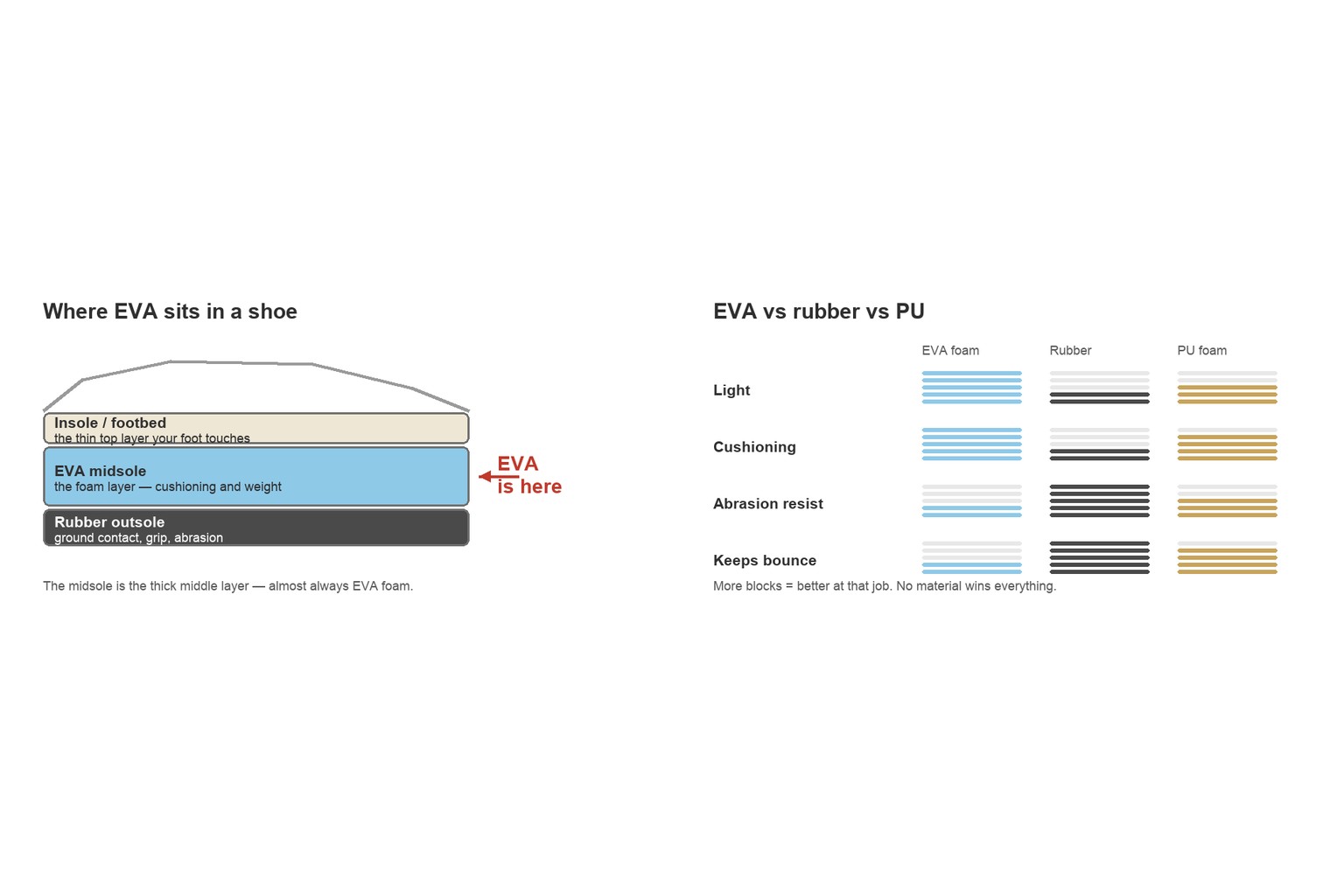
Where EVA is in your shoe
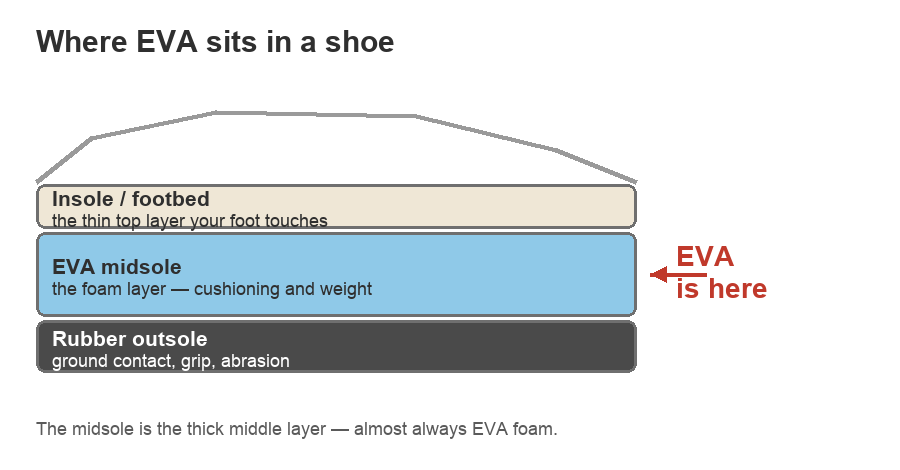
Pick up almost any sneaker and the sole is three layers. On top, the insole or footbed — the thin removable layer your foot rests on, often EVA too. In the middle, the midsole, the thick pale layer that gives the shoe its height and most of its cushioning; this is where EVA almost always lives. Underneath, the outsole, the tougher rubber layer that meets the ground.
So when a listing says "EVA midsole," it means the cushioning layer is foam rather than something denser. When it says "EVA footbed," it means the insole you could pull out is foam. Both are ordinary and neither is a red flag — EVA is in the vast majority of athletic and casual shoes made today, at every price point.
Why shoemakers use it
Three reasons, and they're the same three whether the shoe costs twenty dollars or two hundred.
It's light. Foam is mostly gas — closed cells of it — so EVA delivers thickness without weight. Every gram in a midsole is a gram your leg lifts thousands of times a day, which is why chunky-looking sneakers can feel weightless.
It cushions. The cells compress under impact and push back, absorbing shock that would otherwise reach your joints. That's the springy feel underfoot when a shoe is new.
It can be shaped. EVA can be molded into contours, wedges and sculpted geometry, or cut from sheet. That's how a midsole gets an arch shape or a rocker profile at all.
What it isn't good at is abrasion. Drag foam along concrete and it wears fast, which is exactly why almost every EVA midsole has a rubber outsole glued beneath it. The two materials are a team, not rivals.
EVA vs rubber vs PU
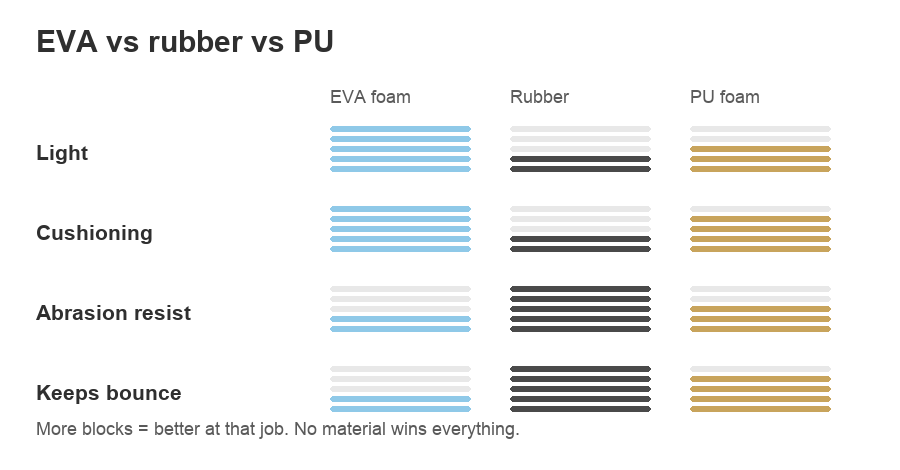
EVA is the lightest and the most cushioned when new, and the quickest to lose its bounce over time.
Rubber is the opposite: heavy and firm, but it resists abrasion far better and holds its properties for years. That's why it's under your foam, not instead of it.
PU (polyurethane) foam sits between the two. It's denser and heavier than EVA but holds its cushioning longer, which is why it turns up in work boots and shoes built for standing all day. The trade-off is weight, and in humid heat some PU formulations break down over long periods of storage — one reason EVA dominates fast-moving footwear.
If you want the outsole side of this comparison in more depth — rubber compounds, TPR, TPU — our outsole materials guide covers the ground-contact layer specifically.
Is EVA good? The honest answer
EVA is good at what it's for, and it is not a marker of quality in either direction. A cheap shoe and an expensive shoe can both have EVA midsoles; what separates them is the specification — how dense the foam is, how thick, how it's molded, and what's underneath.
Density is the one that matters most and the one nobody advertises. Low-density EVA feels wonderfully soft in the shop and packs down fastest. Higher-density EVA feels firmer at first and holds up much longer. Neither is "better" in the abstract — a walking shoe and a court shoe want different answers — but if a shoe feels unusually plush for its price, softness is the cheapest feeling to manufacture, and it's usually the first thing to go.
You can't measure density in a shop, but you can press. Push a thumb hard into the midsole: quality foam gives, then pushes back and returns to shape promptly. Foam that stays dented for a moment is low density, and it will flatten sooner underfoot.
Why EVA goes flat — and how to tell
This is the honest limitation, and no brand will lead with it. EVA is a closed-cell foam: your weight compresses those cells thousands of times per walk, and gradually some stop springing back. The material takes a permanent set. Nothing is broken; the foam has simply used up its bounce.
How to check yours: set the shoes on a table and look from behind at eye level. Compressed midsoles show as visible wrinkling or creasing along the foam's sidewall, and often as a lean — the midsole collapses first where your weight lands, which for most people is the outer heel. If the shoe tilts and the tread still looks fine, that's foam fatigue, not sole wear.
Two things genuinely slow it down. Rotation — foam recovers a meaningful amount of thickness given a day off, so alternating two pairs makes both last considerably longer than wearing one into the ground. And heat avoidance — leaving shoes in a hot car or near a radiator accelerates the breakdown, so store them somewhere ordinary.
What doesn't work: nothing re-inflates a compressed midsole. No spray, no freezing trick, no drying method. Once foam has taken a set it stays set, which is why "the tread looks fine" is a bad reason to keep running in a flat shoe.
Quick answers
What does EVA stand for in shoes?
EVA stands for ethylene-vinyl acetate, a closed-cell foam used in footwear for midsoles, footbeds, insoles and other cushioning parts. It's chosen because it's light, absorbs impact and can be molded into shaped soles. It resists abrasion poorly, which is why an EVA midsole almost always sits above a rubber outsole that meets the ground.
Is an EVA midsole good?
It's the standard for good reasons — light, cushioned, mouldable — but the material name alone says nothing about quality, since shoes at every price use it. What differs is the specification: density, thickness and how it's molded. Higher-density EVA feels firmer at first and keeps its cushioning much longer, while very soft low-density foam feels plush in the shop and flattens fastest.
How long does an EVA midsole last?
There's no fixed figure — it depends on the foam's density, your weight, the surfaces you walk on and how often the shoes get a rest day. What's predictable is the failure mode: the foam gradually takes a permanent set and stops springing back, showing as creasing along the midsole sidewall and often a lean toward the outer heel. Rotating between two pairs meaningfully extends the life of both, and once foam is compressed it can't be restored.
What's the difference between an EVA midsole and an EVA footbed?
Position. The midsole is the thick structural foam layer between the insole and the outsole, and it provides most of the shoe's cushioning and stack height. The footbed — also called the insole or sock liner — is the thin layer your foot rests directly on, usually removable. Both are commonly EVA, but the midsole does the real cushioning work.
If you're specifying EVA rather than buying it
For brands and buyers ordering production, the material name is the beginning of the conversation rather than the end. Two components both described as "EVA" can feel completely different, so a workable specification names the density or hardness direction, thickness at heel and forefoot, the molding route (compression-molded, injected, or die-cut from sheet), the outsole it bonds to, and the bond preparation. Approve a physical sample against those points rather than a material name on a quotation, and check the same points again at bulk — foam is one of the components where sample-to-bulk drift shows up most. Our sample approval guide covers the approval mechanics, and the footwear defects guide covers what to inspect once bulk is running. We build sneakers and casual footwear to order in Guangzhou and quote EVA components against exactly these fields — the custom sneaker range is the place to start if you're planning a first order.
The one-line version
EVA is the foam in your midsole. It's light and cushioned by design, it wears out from the inside by going flat rather than by looking worn, rotating two pairs is the single best thing you can do about that, and the material name on a listing tells you far less than how the foam was specified. That's genuinely all most people need to know.
Buyer FAQ
Buyer Guide
What does EVA mean in shoes?
EVA means ethylene-vinyl acetate. In shoes it is usually foamed and used for midsoles, footbeds, insoles, or cushioning parts.
Is EVA good for shoe midsoles?
EVA is good when the buyer wants a lightweight and soft feel. The factory still needs to confirm density, hardness, compression, and outsole pairing during sampling.
Is EVA better than rubber?
EVA is usually lighter and softer, while rubber is usually better for grip and abrasion on outsole contact areas. Many shoes combine EVA cushioning with a rubber outsole.
Shoe Materials FAQ
What does EVA stand for in shoes?
EVA stands for ethylene-vinyl acetate, a closed-cell foam used in footwear for midsoles, footbeds, insoles and other cushioning parts. It is chosen because it is light, absorbs impact and can be molded into shaped soles. It resists abrasion poorly, which is why an EVA midsole almost always sits above a rubber outsole that meets the ground.
Is an EVA midsole good?
It is the industry standard for good reasons — light, cushioned and mouldable — but the material name alone says nothing about quality, since shoes at every price point use it. What differs is the specification: density, thickness and molding route. Higher-density EVA feels firmer at first and keeps its cushioning far longer, while very soft low-density foam feels plush in the shop and flattens fastest.
How long does an EVA midsole last?
There is no fixed figure — it depends on foam density, the wearer's weight, walking surfaces and how often the shoes get a rest day. The failure mode is predictable: the foam gradually takes a permanent set and stops springing back, showing as creasing along the midsole sidewall and often a lean toward the outer heel while the tread still looks fine. Rotating between two pairs meaningfully extends the life of both, and compressed foam cannot be restored.
What is the difference between an EVA midsole and an EVA footbed?
Position within the sole. The midsole is the thick structural foam layer between the insole and the outsole, providing most of the shoe's cushioning and stack height. The footbed — also called the insole or sock liner — is the thin layer the foot rests directly on and is usually removable. Both are commonly made of EVA, but the midsole does the real cushioning work.
Is rubber a durable material for shoes?
For the outsole, rubber is the most durable material in common use — abrasion resistance is the specific failure the ground causes, and nothing standard beats rubber there. It is a poor cushioning material because a rubber layer thick enough to cushion would be far too heavy, which is why shoes pair a thin rubber outsole with a foam midsole. Harder rubber compounds last longer but grip less, while softer compounds grip better and wear faster.
What is the most durable shoe material overall?
There is no single winner, because durability is position-specific. Rubber wins the outsole, full-grain leather wins the upper over the long term because it can be restored rather than only resisting damage, PU outlasts EVA in the midsole, and leather lining outlasts synthetic textile at the heel. The most durable shoe is one using the right material in each position and built so worn parts can be replaced.
Which shoe material lasts longest for work shoes?
For all-day work wear, the lasting combination is a full-grain leather upper, a rubber outsole, a PU midsole rather than EVA, and a leather lining at the heel. PU is the key difference from athletic footwear: it is heavier than EVA but keeps its cushioning far longer, which matters more than initial softness when shoes are worn eight hours a day over a year or more.