
Ostrich Leather Bags: What Buyers Should Know Before Ordering
Part of: Exotic Leather Guide
Those little raised bumps are the whole reason ostrich leather costs what it does — and most buyers ask for them the wrong way. The request we get, almost word for word, is "full quill please." It sounds precise. It isn't, and the gap between what that phrase means to a buyer and what it means at a cutting table is where ostrich bag orders usually go sideways. So let's start with the hide itself.
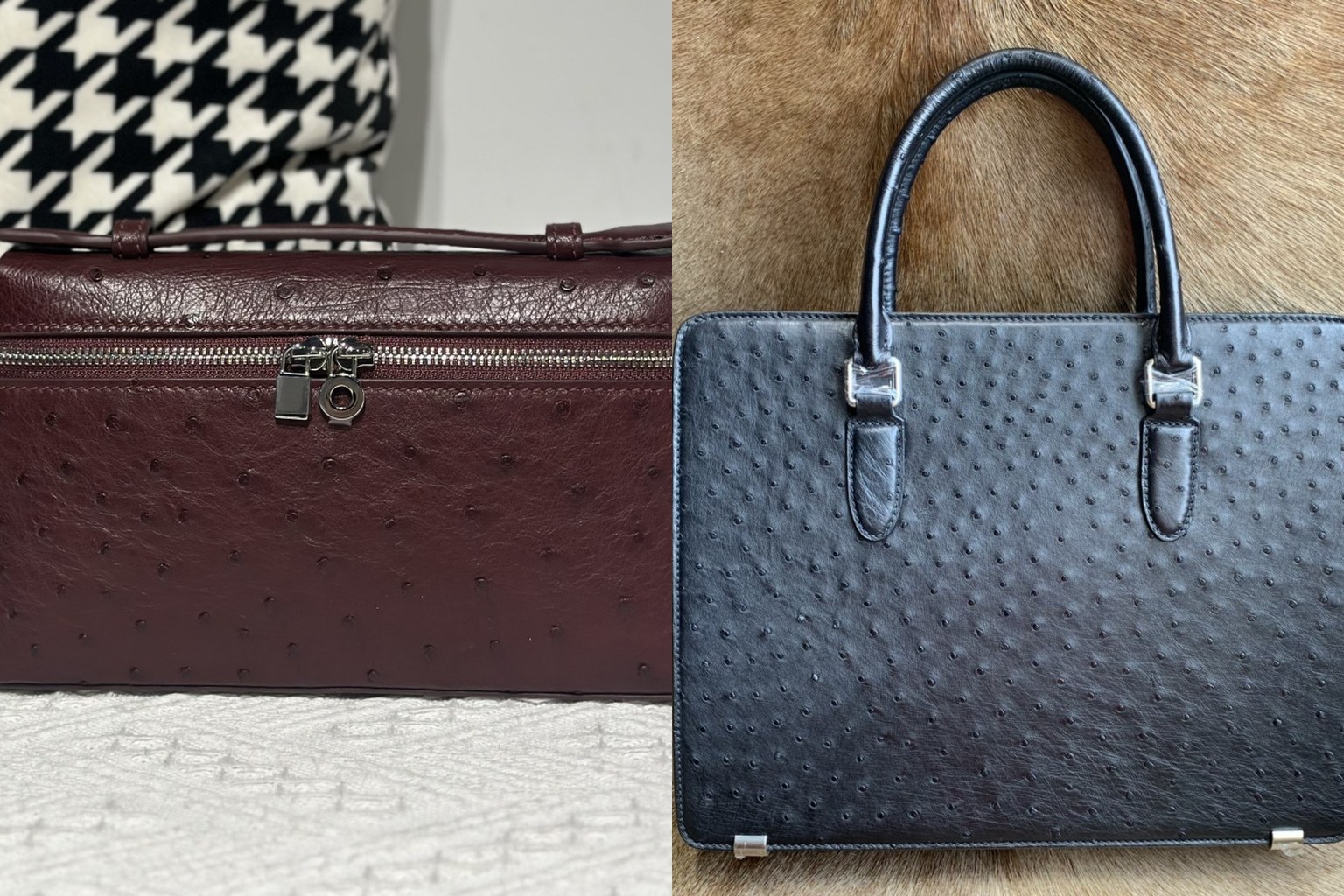
What the quill pattern actually is
Ostrich leather's signature dots are follicles: the points where feathers were rooted in the skin. They leave a raised, slightly domed bump that no embossing plate reproduces convincingly, which is why the pattern is the material's identity.
The part most people miss is that these follicles do not cover the animal. They occur on the crown — the back area where the plumage was densest. Everything outside the crown is smooth ostrich: same hide, same durability, no dots. The crown is also not uniform; quills sit tighter and more pronounced near its center and thin out toward the edges.
So one hide yields a limited amount of dense-quill area, a larger amount of transitional area, and a good deal of smooth leather. That single fact explains nearly every ostrich pricing question that follows.
Why "full quill" is a wish, not a specification
When a buyer says full quill, they usually picture even, prominent dots across the entire front of the bag. That is achievable — on a small bag. On a large tote it means cutting the front panel from the best part of the crown, which is precisely the scarcest real estate on the hide, and it may take more than one hide to build a matched set of panels.
A better specification names the panels. Tell us the quill character matters most on the front and flap, that the gusset may run transitional quill, and that the base and interior trim may be smooth ostrich or a stated lining leather. That version is quotable, cuttable, and produces a sample that looks like what you imagined. "Full quill" produces a price that protects the factory against your unstated expectations — which is a worse deal for you.
Three ostrich materials, one animal
| Material | What it looks like | Where it fits |
|---|---|---|
| Crown quill | The classic raised-dot surface, densest at the center of the crown. | Front panels, flaps, handles — anywhere the material needs to announce itself. |
| Smooth ostrich | Same hide, outside the crown. Fine, soft grain, no dots. | Gussets, bases, linings, trim — and full smooth bags for a quieter look at a lower cost. |
| Ostrich leg | A scaly, reptile-like surface from the leg. Visually closer to lizard than to crown quill. | Trim, small goods, or full panels when you want texture without the dots. Name it explicitly — it is not interchangeable with body leather. |
All three are honestly "ostrich leather." That is exactly why the quotation, the specification sheet and the product label should say which one. A customer who paid for crown quill and received smooth ostrich will not accept "but it is still ostrich" as an answer, and they shouldn't have to.
How ostrich behaves compared with crocodile
Buyers cross-shopping our exotic ranges usually want to know how the two feel in the hand. Ostrich is the softer, more pliable of the pair. Our exotic skin guide describes it as light, breathable and wear resistant, and notes that the natural oils in the hide help it resist cracking and ageing — which is also why an ostrich bag tends to soften rather than stiffen with use.
Crocodile, by contrast, reads as structured and formal; its tile pattern makes a stronger visual statement, and a crocodile bag holds its shape more assertively. Neither is better. They sell to slightly different customers, which is why stores that carry both usually see them move at different rates — compare the crocodile bags and ostrich bags ranges side by side before deciding which anchors your display.
What to specify for an ostrich bag
- Bag type and finished dimensions: handbag, top handle, tote, briefcase, crossbody, clutch or backpack, with width, height, depth and handle drop. Our reference sizes commonly run between 19cm and 25cm on top handle styles.
- Where quill matters: panel by panel. Front, flap, handles, gusset, base — say which need crown quill and which may be smooth.
- Quill density direction: dense and pronounced, or a calmer, more even field. Send a reference photo; words are slippery here.
- Color and finish: matte, semi-gloss or polished. Ostrich takes color well, and the same dye reads differently across quill and smooth areas.
- Structure: soft and slouchy or structured with a base board and shape support. This changes the pattern, not just the padding.
- Lining: leather, microfiber or textile, plus pocket layout. Our ostrich bags are typically built with a soft leather lining unless you specify otherwise.
- Hardware: plating tone and grade. Roughly two thirds of our current ostrich bag styles run silver hardware and one third gold, so either is a normal request.
- Branding and packaging: logo method and placement, dust bag, box, labels.
Checking the sample
Ostrich hides an easy trap: because the quill field is naturally irregular, real defects and normal variation look similar to an untrained eye. Three things to separate them on the sample table:
- Placement versus pattern. Quill density varying gradually across a panel is the material. A hard line where dense quill meets smooth leather mid-panel is a cutting decision — fine if you approved it, a problem if you didn't.
- Follicle condition. Run a thumb across the field. Bumps should feel firm and rounded. Flattened or scuffed areas in a brand-new sample suggest handling damage rather than character.
- Panel matching. On multi-panel bags, check that adjacent panels were cut with a compatible quill direction and scale. A well-matched pair reads as one surface; a mismatched pair reads as a repair.
Photograph what you approve, in daylight, and keep it. That photo is what the reorder gets compared against — the method is in the reorder playbook, and it applies to ostrich exactly as it does to crocodile.
Ordering, documents and lead time
Ostrich bags in our catalog are quote-based rather than fixed-price, because the panel plan changes the cutting bill so much. The starting quantity is one piece, samples typically take 7-15 days and custom bulk typically 15-21 days, plus transit. If you are pricing several exotic materials at once, the wholesale price guide explains the cost drivers that apply across skins.
On paperwork: ostrich is a CITES-listed species, so documentation requirements depend on species, source and your destination, exactly as they do for crocodilian leather. Confirm what your import needs with your customs broker or destination authority before paying for bulk — our document checklist covers the questions to ask, and the same logic applies here.
What to send us
Send the bag style and finished dimensions, a note on which panels need crown quill, your color and finish direction, lining and hardware preferences, quantity, and destination country. Reference photos help more than adjectives — if you have seen the exact quill look you want, send the picture. You will get material wording, a panel plan and a written quotation back, and the whole thread stays in one place so the second order is quicker than the first.
Ostrich isn't only a bag leather — the same quill-marked hides build our ostrich leather shoes, and buyers often pair the two in one program.
Assortments that mix exotics can apply the same sourcing checks to python leather bags, where the scale pattern runs finer and the panel logic differs.
Buyer FAQ
Ostrich Leather Bag FAQ
What is the quill pattern on ostrich leather?
The quill pattern is the set of raised bumps left where feathers were rooted in the hide. These follicles occur only on the crown, the back area where plumage was densest, so a single hide yields a limited amount of dense-quill leather plus a larger area of smooth ostrich with no dots.
Why is asking for a full quill ostrich bag not enough?
Because the dense crown area of each hide is limited, a large full-quill panel is the scarcest cut available and may require more than one hide. A more useful specification names the panels: which need crown quill, which may run transitional quill, and which may be smooth ostrich or a stated lining leather.
How does an ostrich bag differ from a crocodile bag?
Ostrich is the softer and more pliable of the two and tends to soften with use, helped by the natural oils in the hide. Crocodile reads as more structured and formal, and its tile pattern makes a stronger visual statement. Stores carrying both usually find they appeal to slightly different customers.