
Oxfords or Brogues
Part of: Private Label Shoe Manufacturing
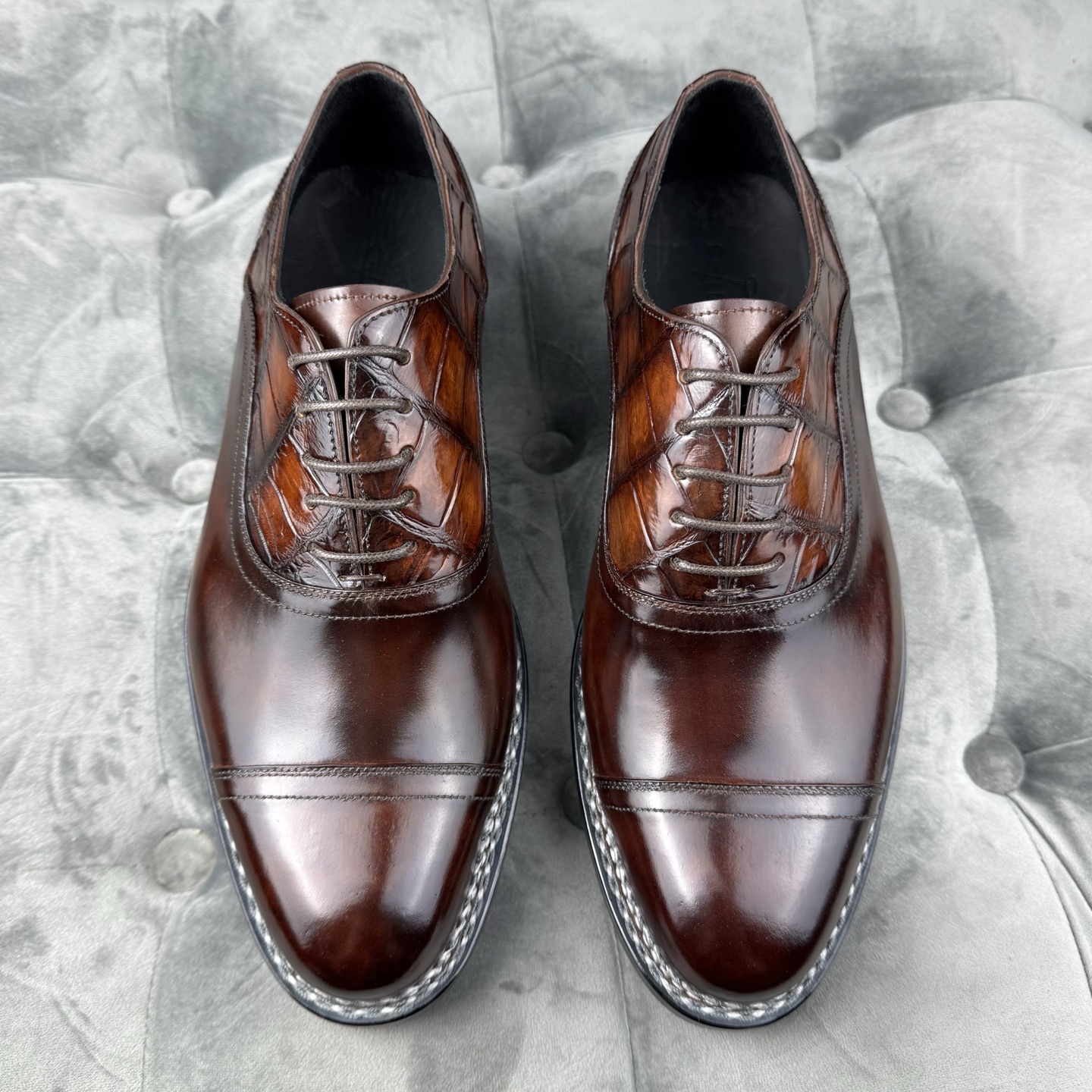
An Oxford is identified by its closed-lacing construction: the eyelet facings sit under the vamp and create a cleaner, closer line across the instep. Brogue describes perforated decoration and the shaped panels that carry it. A shoe can therefore be a plain Oxford, a cap-toe Oxford, or an Oxford with quarter, semi, or full brogue detailing.
Oxford and brogue do not describe the same feature
A Derby usually has open lacing, and it can also carry brogue decoration.
This distinction matters in production. Writing only “Oxford brogue” leaves the pattern maker to guess the toe pattern, wing length, perforation size, medallion, edge punching, and amount of contrast. A marked reference image is more reliable than a style name alone.
A practical specification for dress shoe buyers
- Confirm closed Oxford lacing or open Derby lacing and show the eyelet facing clearly.
- Choose plain toe, cap toe, quarter brogue, semi brogue, longwing, or full wingtip pattern.
- Mark the perforation diameter, spacing, edge shape, toe medallion, and whether holes should be decorative or open.
- Specify upper leather, lining, reinforcement, welt or cemented construction, outsole, heel, and edge finish.
- Provide last shape, toe profile, size range, width requirement, logo, packaging, and target quantity.
What changes when brogue decoration is added
Perforation creates more pattern edges, stitching lines, and opportunities for left-right variation. The factory should check that the wing tips meet at the same position, the medallion is centered, the punching is clean, and the decorative panels do not distort during lasting. On light leather, cutting and edge color need extra attention because small marks are easier to see.
Construction choices change the final character
A leather outsole and a restrained edge can keep an Oxford formal. A rubber insert can add practical grip without changing the whole profile, while a thicker rubber sole moves the shoe toward everyday use. Cemented, Blake-stitched, and welted options differ in edge thickness, flexibility, weight, production time, and cost. Ask the factory which construction has already been tested with the chosen last and outsole.
Leather selection also affects how clearly the brogue pattern appears. Smooth calf leather gives a clean punching edge, while corrected, embossed, suede, or heavily finished materials require their own sample review. Approve the actual material and color, not only a digital swatch.
Sample checks before approving a bulk order
Place both shoes together and compare toe shape, lacing gap, quarter height, cap or wing position, perforation alignment, heel height, and outsole edge. Lace and fit the sample rather than judging only from photographs. Closed lacing can feel tighter over a high instep, so confirm the last and fitting standard for the target customer before grading every size.
For the size set, compare the position of the cap or wing across small and large sizes. Decorative proportions should be graded deliberately rather than stretched mechanically. During final inspection, check pair matching, loose perforation waste, stitch ends, lining wrinkles, eyelet strength, lace length, sole balance, size labels, and packing against the signed sample.
Keep the correction record simple: one numbered photograph for each issue, a short written instruction, the responsible sample version, and an approval date. This prevents an old toe shape, perforation layout, or edge finish from returning when production moves between pattern, stitching, lasting, and finishing teams.
For a custom project, review the leather shoe collection and the Goodyear welt buyer checklist. Send the chosen construction, reference images, quantity, and size range through Contact Us for a clearer sample discussion.
Oxfords or Brogues
Everyone has heard of “oxfords,” also named “quarter brogue oxford shoes”, but many people would just call lace-up leather shoes “oxfords,” right?So, Oxfords or Brogues? The oxfords and the oxfords are so confused that some people say “Oxford is better than the oxfords”, but oxford not brogues shoes. In fact, both of them are the same in the beginning. The traditional oxfords are just a “fancy version” of the oxfords.
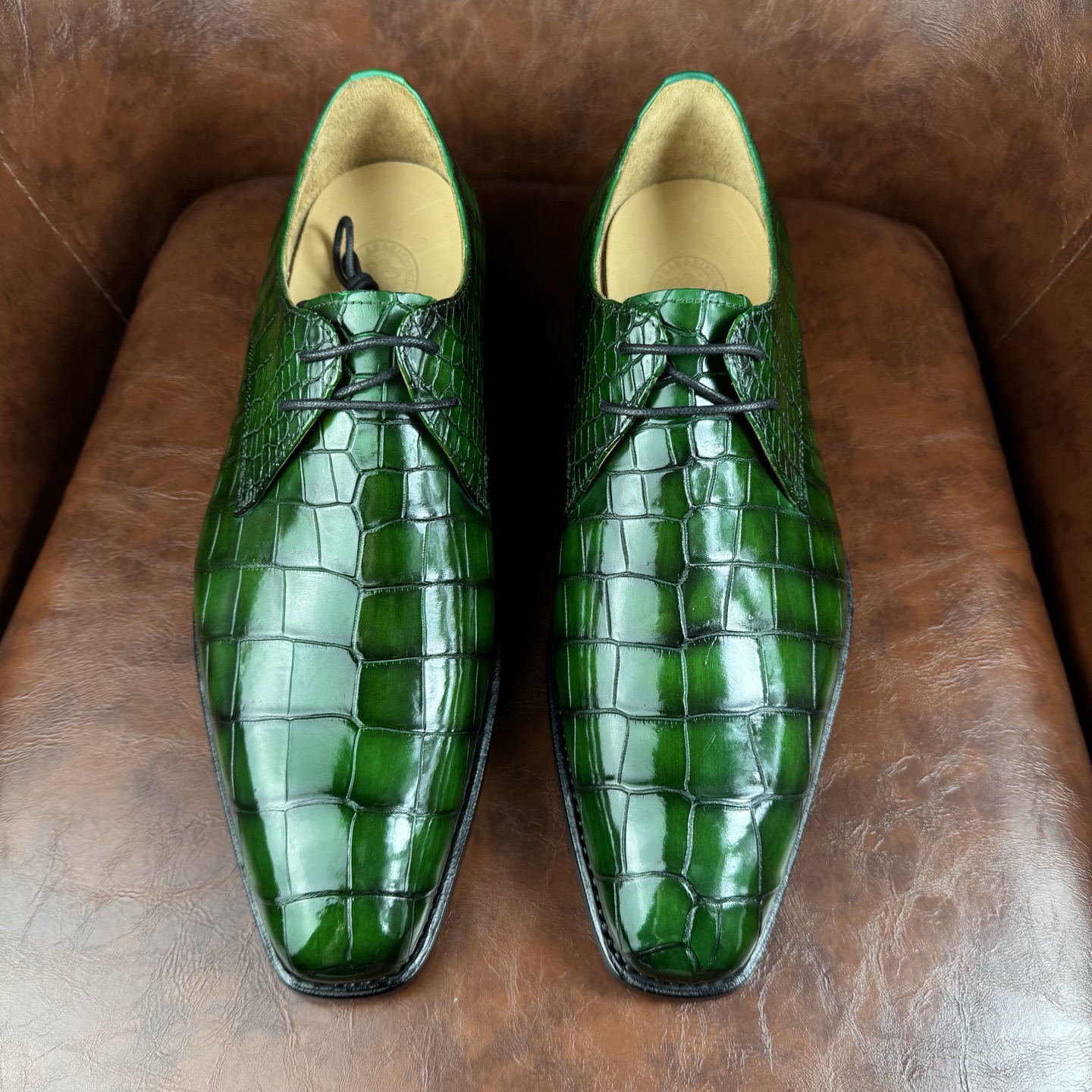
Oxford shoes are pure in blood. They saw by every formal occasion and become an indispensable part of western society. But the brogue also has a huge following and is a famous shoe in western tradition. So what is the difference between oxfords and brogues?
We know that during the most glorious period of the 17th to 19th centuries, the sun never set on Britain’s empire, which blossomed all over the earth. And its national strength brought its citizens a rich life. The oxfords and brogues were gradually developed under such a background, and the majority of British people could afford to wear these two kinds of shoes originally provide to the aristocratic society, which gradually became the tradition of British society. We can often see them on formal occasions.
Difference between brogues and oxford
Oxford shoes originated in Scotland and Ireland, and Oxford University students loved them. They gradually brought Oxford shoes into the upper class. Gentlemen and nobles like their unique aesthetics, thus establishing their status in the British society. Oxford shoes adopt open-fit flaps design, which can adapt to most foot types, and have numerous beautiful but low-key hollow out design on the shoe body. The design of shoe trees is refreshing, and most of them are handmade, which surprises people.
Brogues also originated in Ireland and Scotland, from the humble fur-laced shoes worn by farmers in the Scottish highlands. With the development of technology and the improvement of people’s wealth, fur lacing shoes joined the traditional carving process design in Scotland. Both sides of the shoes are rich in beauty and gorgeous carving design, and in the toe also has a vent effect of nail hole hollow. So that make it look gorgeous.
By now, you probably know the difference between the two shoes. The distinction of shoe of brock and Oxford depends on the difference of style, shoe of brock has luxuriant adornment. More and more young people love them, reveal youthful vigor, often use in although formal but atmosphere is active circumstance. And Oxford shoe low-key do not break colorful again however, reveal characteristic in collect inside, often get the love of middle aged gentleman, perhaps come in and out at atmosphere grave and formal occasion.
Key takeaways for buyers
- Choose plain toe, cap toe, quarter brogue, semi brogue, longwing, or full wingtip pattern.
- Specify upper leather, lining, reinforcement, welt or cemented construction, outsole, heel, and edge finish.
- Confirm closed Oxford lacing or open Derby lacing and show the eyelet facing clearly.
When the product direction is ready, review Goodyear welt shoes before requesting a quotation.
Buyer FAQ
Shoe Styles FAQ
What is the difference between an Oxford and a Derby?
The lacing construction. On an Oxford the eyelet facings are stitched underneath the vamp so the shoe closes to a V, giving a sleeker and dressier line. On a Derby the facings sit on top of the vamp and stay open at the front, which is slightly less formal but far more accommodating for a high instep or a wide foot. Toe shape, brogueing and colour can be identical on both.
What are the main types of men's leather shoes?
The laced styles are Oxfords with closed lacing and Derbies with open lacing, each available with plain, cap or wingtip toes and any level of brogue perforation. The non-laced styles are monk straps, fastening with one or two buckles, and loafers, which slip on. Chelsea and Chukka boots complete the range. Brogueing is decoration rather than a shoe type, so a full brogue can be either an Oxford or a Derby.
Which men's dress shoe is the most formal?
A plain or cap-toe black Oxford on a thin leather sole. Formality decreases as perforation increases, as lacing opens from Oxford to Derby, as colour lightens from black through brown to tan, and as the sole thickens or changes to rubber. A tan full-brogue wingtip on a chunky rubber sole sits at the opposite end of the same scale.