
White and Colored Crocodile Leather: What to Know Before You Buy
Part of: Exotic Leather Guide
"I love them. Can I actually live with them?" That's the real question inside every search for white crocodile loafers, and it deserves a straight answer instead of a product grid. We dye and finish crocodile leather in our Guangzhou workshop — blacks and browns by the hundred, but also whites, burgundies, ambers, blues, and hand-finished two-tones that shift color as the tiles catch light. So here's everything we'd tell a friend before they bought a colored crocodile piece: how the color gets there, why white is the most honest leather we make, what living with it is really like, and which colors belong on which products.
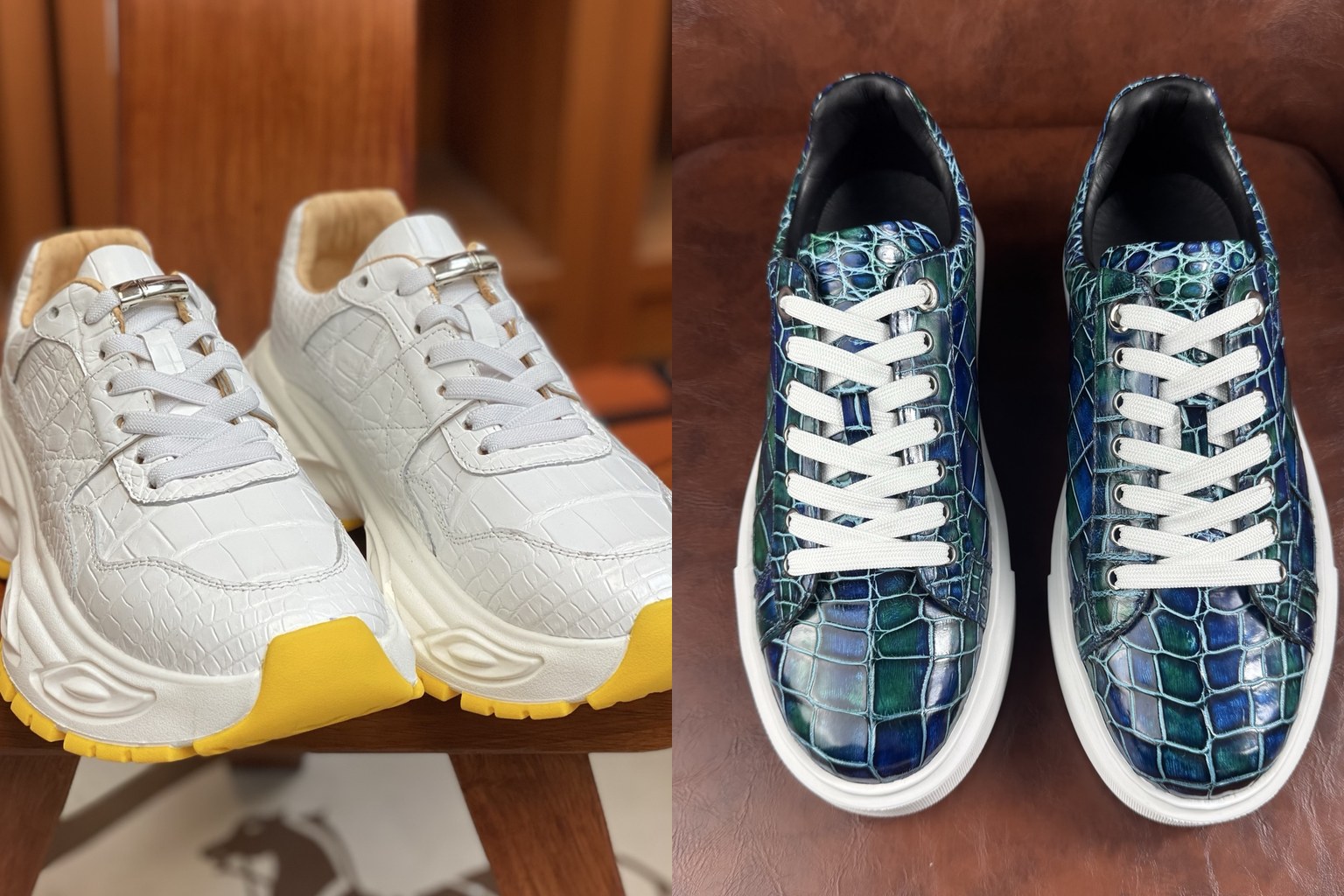
How crocodile leather gets its color
Crocodile hides don't arrive at the workshop in colors. They arrive tanned to what the trade calls crust — a pale, undyed state — and everything you see in a finished catalog happens after that. Broadly, color goes on in one of three ways, and you can read the difference on the finished piece.
Drum-dyed color soaks through the leather. Look into the creases between tiles on a drum-dyed piece and the valleys carry the same depth as the surface. This is the method behind most solid catalog colors, and it's why a good black or burgundy crocodile looks alive rather than painted — the color sits in the hide, and every tile takes it a fraction differently.
Surface finishing adds color and sheen on top — from the glaze that gives formal crocodile its glassy shine to pigmented finishes that even out tone. More coverage means more uniformity and less of the tile-to-tile life underneath; it's a legitimate trade, but you should know which you're buying.
Hand finishing is where the dramatic pieces come from — two-tone patinas, burnished gradients, and iridescent treatments where blues shade into greens across the panel, like the sneakers in the photo above. Because the work is done tile by tile by hand, no two panels repeat. On a print they would.
Why white is the most honest crocodile we make
Here's something most buyers never think about: dark colors forgive, white confesses. A deep burgundy dye will quietly absorb a healed scar, a feeding mark, a slight variation in tile surface. White has nowhere to hide any of it. Every mark the animal picked up in life, every unevenness in the hide, sits in plain view under a pale finish.
The practical consequence: a clean white crocodile piece has to start from a cleaner hide than the same piece in black. Panel selection gets pickier, more of the hide gets rejected for the visible faces, and that's the real reason white crocodile sits at a premium even when the price list says otherwise — you're paying for the hides that qualified. It's also a quiet authenticity signal. An embossed plate can stamp a flawless "crocodile" pattern into white calf all day; a genuine white crocodile panel almost always carries some small, honest irregularity if you look closely. Perfect is suspicious; nearly perfect is nature. The full set of genuine-versus-embossed checks is in our verification guide, and they work the same on white as on black.
Living with white: the honest version
White crocodile's enemy isn't dirt. Dirt wipes off a glazed tile surface more easily than off almost any other white shoe material — the finish is smooth and the scales don't hold grime the way fabric or suede does. The actual enemies, in order:
Dye transfer. New dark denim is the number-one killer of white leather goods of every kind, and crocodile is no exception. The indigo rubs off at every contact point — trouser hems against shoe collars, jeans against a white bag held at hip height. The fix is habits, not products: wash new denim before wearing it against white, and wipe contact zones with a soft dry cloth the same day rather than next month, before transfer sets.
Heat and sunlight. A white finish pushed toward yellow is almost always a story about a sunny shelf, a radiator, or a hot car — the same enemies every crocodile piece has, but visible sooner on white. Store white pieces in their dust bag, out of daylight, and the finish stays the color you bought.
Well-meant cleaning. No bleach, no whitening creams, no alcohol wipes, no kitchen sprays. Every one of those attacks the finish faster than it lifts any mark. A barely damp cloth, tested somewhere hidden first, then air-drying — the routine in our care guide — handles what a dry cloth can't. A mark that survives that is a job for a professional, and on white it's worth using one rather than experimenting.
And a reframe worth adopting: showroom-white is a launch state, not a life sentence. A white piece that's been worn softens toward ivory at the contact points, and on a well-made piece that reads as character, the same way glazed black's fine scratches do. Buyers who need factory-white forever are usually happier in a bone or cream tone that starts where white ends up.
Styling white crocodile without the costume effect
The styling questions people actually ask — there are whole forum threads devoted to styling loafers — get simpler with white croc, not harder, because white does one job extremely well: it grounds an outfit and pulls attention down.
White croc sneakers are the easy entry. They follow ordinary white-sneaker logic — jeans, chinos, shorts, anything casual — while the tile pattern quietly upgrades them from commodity to conversation. This is the pair for someone who wants their first exotic to feel effortless.
White croc loafers are a summer statement, and the search interest agrees. They want lighter trousers — stone, tan, pale grey, washed denim — and they'd rather be the only bold thing you're wearing. Dark suit with white croc loafers is a look you have to mean; linen trousers with them is a look that means itself.
White belts and bags follow the same one-statement rule from our wearing guide: let the white piece be the event. The classic mistake is white shoes plus white belt plus white bag — matched sets read as uniform, one white piece reads as chosen.
Beyond white: which colors actually work on crocodile
Color behaves differently on tiles than on smooth leather. Each scale catches light at its own angle, so a single dye reads with depth and movement that flat calf can't produce — which is why some colors that look loud on smooth leather look rich on crocodile.
Burgundy and oxblood are the gateway colors: formal enough for dress shoes and briefcases, warmer than black, and they deepen beautifully with age. If someone owns black croc and wants a second piece, this is the usual right answer.
Amber, cognac and honey glow on glazed tiles — the light gets into the finish and the piece looks lit from inside. They suit bags especially, where the larger panel gives the color room.
Blues and greens run from navy dress shoes to the iridescent hand-finished pieces that shift between the two. The saturated end belongs on casual silhouettes — sneakers, small bags — where the playfulness fits the shape.
True bolds — reds, oranges, pinks — work best small. A bright red 18cm bag is a delight; a bright red briefcase is a commitment very few wardrobes can keep. Small pieces are where color takes the least risk and gives the most pleasure, which is why our colored range runs deepest in compact bags. The full logic of matching color to product size is in the bag selection guide.
Is colored crocodile still "real" crocodile?
A question we get more often than you'd think, usually about the vivid pieces: surely the bright blue one is fake? No — dye says nothing about authenticity, in either direction. Genuine crocodile takes color the way genuine leather always has, and fakes come in sober black more often than in teal. Judge the tiles, not the palette: natural variation across the panel, irregularity between left and right pieces, depth of color in the crease valleys on a drum-dyed piece. What color does change is price logic — hand-finished multi-tone work adds real labor, and pale colors demand cleaner hides, so the same bag can price differently by color for honest reasons. The price guide covers what moves the number; the luxury-grade guide covers judging the workmanship the color sits on.
A word for black, the color everyone skips past
It would be dishonest to write a color guide without saying this: most people who ask us about white or blue end up happiest with black or burgundy for their first piece, and with the bold color for their second. Black crocodile is the default for reasons that hold up — it goes with everything you own, it hides the small accidents of daily life, glazed black shows the tile pattern at maximum contrast, and a black crocodile belt or pair of shoes works in rooms where a statement piece has to be defended. The color pieces are where the joy is; black is where the mileage is. A wardrobe that has both, bought in that order, tends to wear both. Buy the workhorse first, then reward yourself.
Ordering a color the catalog doesn't show
Because everything we make is built to order from one piece, color is a specification, not a fixed menu. The process: choose a reference style from the crocodile shoes or crocodile bags range, state the color direction — a photo of the tone you want works better than a color name — and we confirm the specification in writing before anything is cut. A sample follows in 7-15 days, repeat production 15-21 days after confirmation.
One honest caveat we give every custom-color buyer: natural hides take dye slightly differently from panel to panel and batch to batch. A sample tells you the true color of your piece; a phone photo of someone else's piece tells you the neighborhood. Approve the sample in daylight, not just under shop lighting, and you'll never be surprised.
Quick answers on color
How do you keep white crocodile leather clean?
Wipe contact points with a soft dry cloth the same day you wear it — dye transfer from dark denim, not dirt, is white leather's real enemy, and fresh transfer wipes away while old transfer sets. For marks, use a barely damp cloth tested on a hidden spot, then air-dry away from heat. Never use bleach, whitening products or alcohol wipes; they damage the finish faster than they clean it. Store the piece in its dust bag away from sunlight.
Does white crocodile leather turn yellow?
Kept sensibly, no — yellowing is almost always caused by sunlight, heat or harsh cleaning products attacking the finish, not by time itself. Store white pieces out of daylight, away from radiators and hot cars, and clean them with nothing stronger than a barely damp cloth. Expect honest wear at contact points to soften toward ivory over years of use; that's patina, and it's different from the all-over yellowing that neglect causes.
Is brightly colored crocodile leather real crocodile?
Color says nothing about authenticity. Genuine crocodile is drum-dyed and hand-finished into everything from white to iridescent blue-green, while imitation crocodile is most often sold in sober black and brown. Judge the tiles instead: genuine panels vary naturally across the piece and between left and right, embossed patterns repeat with plate regularity, and on drum-dyed genuine pieces the color reaches into the crease valleys between tiles.
The color question, settled the easy way
If you're circling a white or colored piece and hesitating, here's the test we offer customers: name the three outfits you'd wear it with this month. If they come easily, the color is right and you should have it made. If you're inventing outfits to justify the purchase, buy the burgundy — and let the color find you next time. Either way, the piece gets built one at a time, to your spec, and the sample will tell you the truth before you commit.
Buyer FAQ
Crocodile Color FAQ
How do you keep white crocodile leather clean?
Wipe contact points with a soft dry cloth the same day you wear the piece — dye transfer from dark denim, not dirt, is white leather's real enemy, and fresh transfer wipes away while old transfer sets permanently. For marks, use a barely damp cloth tested on a hidden spot first, then air-dry away from heat. Never use bleach, whitening creams or alcohol wipes, and store the piece in its dust bag away from sunlight.
Does white crocodile leather turn yellow?
Not from age alone. Yellowing is almost always caused by sunlight, heat from radiators or hot cars, or harsh cleaning products attacking the finish. Stored in a dust bag away from daylight and cleaned with nothing stronger than a barely damp cloth, a white piece keeps its color; honest wear softens contact points toward ivory over years, which is patina rather than the all-over yellowing neglect causes.
Is brightly colored crocodile leather real crocodile?
Color alone cannot prove or disprove a natural crocodilian material claim. Different leathers and non-leather materials can be dyed, printed, embossed or coated in many colors. Use photographs to approve color and panel appearance, but verify the base material, surface treatment, species claim and component scope through the written SKU or batch record.